The most revealing thing about Civic Champs is that its vocabulary is cheerful while its job is stubbornly clerical. Volunteers become “champions.” A shift becomes an opportunity. Yet behind those names sit the objects that make nonprofit offices groan: sign-in sheets, waiver folders, text chains, schedules, half-complete profiles, and the spreadsheet someone has to clean before a grant report is due.
Civic Champs packages that mess into a web dashboard and mobile app. A nonprofit can recruit and onboard volunteers, collect digital waivers and questionnaires, publish events and roles, take registrations, send messages, record attendance, track hours, ask for reflections, and export the results. The volunteer can browse shifts, check in, log other hours, and keep a record of service. The coordinator gets something rarer than another database: fewer moments when the database needs to be rescued.
Today the company says it works with hundreds of nonprofits across more than 40 states and Canada. Its customers include Habitat for Humanity affiliates, animal shelters, food pantries, homeless shelters, schools, conservation groups, United Way organizations, and mentoring programs. These are often small teams running operations that are not small at all. One customer, an animal rescue with nearly 300 active volunteers, uses the platform for hours, scheduling, contributions, and communication. Another said Civic Champs helped it maintain thousands of volunteer contacts across 12 clubhouses.
01 / The original trick
Catch the data while the volunteer is still in the parking lot
When Geng Wang, Michael Jeffery, and Ryan Underdahl started Civic Champs in February 2019, their wedge was a location-aware mobile check-in. A geofence around a volunteer site could notice an arriving phone and prompt its owner to check in with a tap, then do the same at departure. That tiny interaction solved a chain of larger problems. The hour did not have to be remembered on Friday, written on paper on Saturday, typed into Excel on Monday, and defended to a funder three months later.
The idea came from targeted conversations with nonprofits and from Wang's own questions about volunteering and corporate social responsibility. Civic Champs' early pitch estimated that an organization could spend roughly 750 hours a year on clerical volunteer management. Whether any one nonprofit hits that number is less important than the underlying observation: an unreliable input creates expensive work everywhere downstream.
That is what makes Civic Champs different from a generic constituent CRM. It owns the operational edge where service happens, then connects the record back to donor and reporting systems. Integrations with Little Green Light and, through Omatic, Salesforce, Altru, Blackbaud CRM, and Raiser's Edge reduce the odds that volunteer history becomes a sealed-off island. Competitors such as VolunteerHub, Better Impact, Bloomerang Volunteer, Volgistics, Cervis, Track It Forward, VolunteerLocal, and Rosterfy attack parts of the same market. The everyday incumbent, however, is still the spreadsheet plus habit.
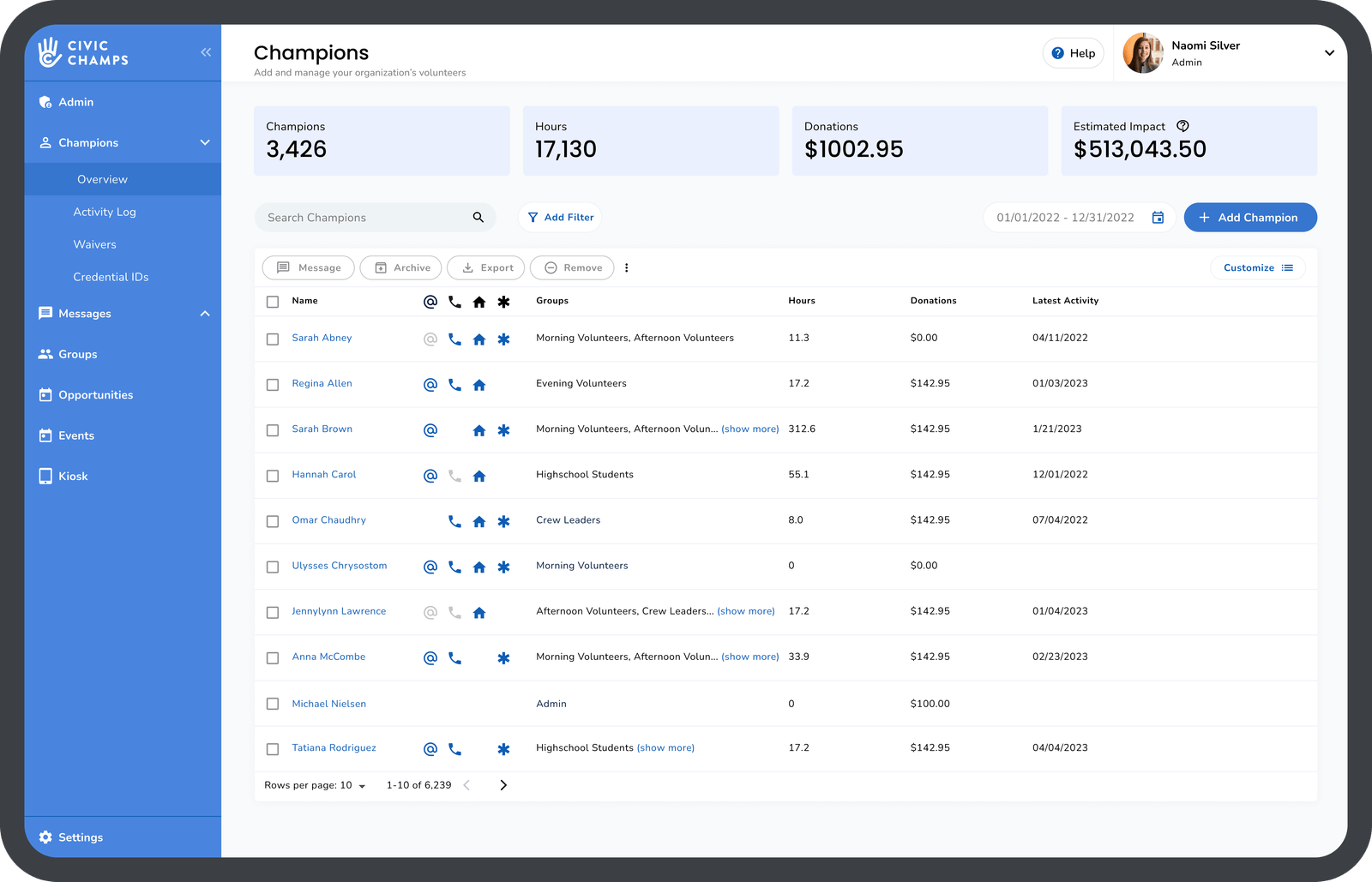
The Champions screen: 3,426 people, 17,130 hours, and no mystery clipboard under the passenger seat.
02 / The first thing that failed
A location product meets a stay-at-home order
Then COVID arrived. Civic Champs had built around people going places to serve; suddenly, people were not supposed to go anywhere. The original premise did not merely encounter a weak quarter. Its central physical action disappeared. Wang later described the need to reestablish the company's footing. The team repurposed its technology for Helping Hands, a program connecting volunteers with higher-risk neighbors who needed help with daily chores, and piloted it with United Way of Southwestern Pennsylvania with foundation support.
The useful pivot was not from nonprofit software to pandemic software. It was from loving the geofence to loving the job: remove friction from service.YesPress analysis
That distinction changed the roadmap. Check-in remained useful, but the product spread across the volunteer lifecycle: applications, groups, roles, waivers, events, messaging, feedback, reporting, and integrations. It also grew beyond a single check-in behavior. Volunteers can use the app; an organization can set up a shared kiosk; an administrator can check people in; or attendance can follow registration rules. This looks less elegant on a pitch slide than one magical tap. It works under more real-world conditions - including the condition that a volunteer does not want another app.
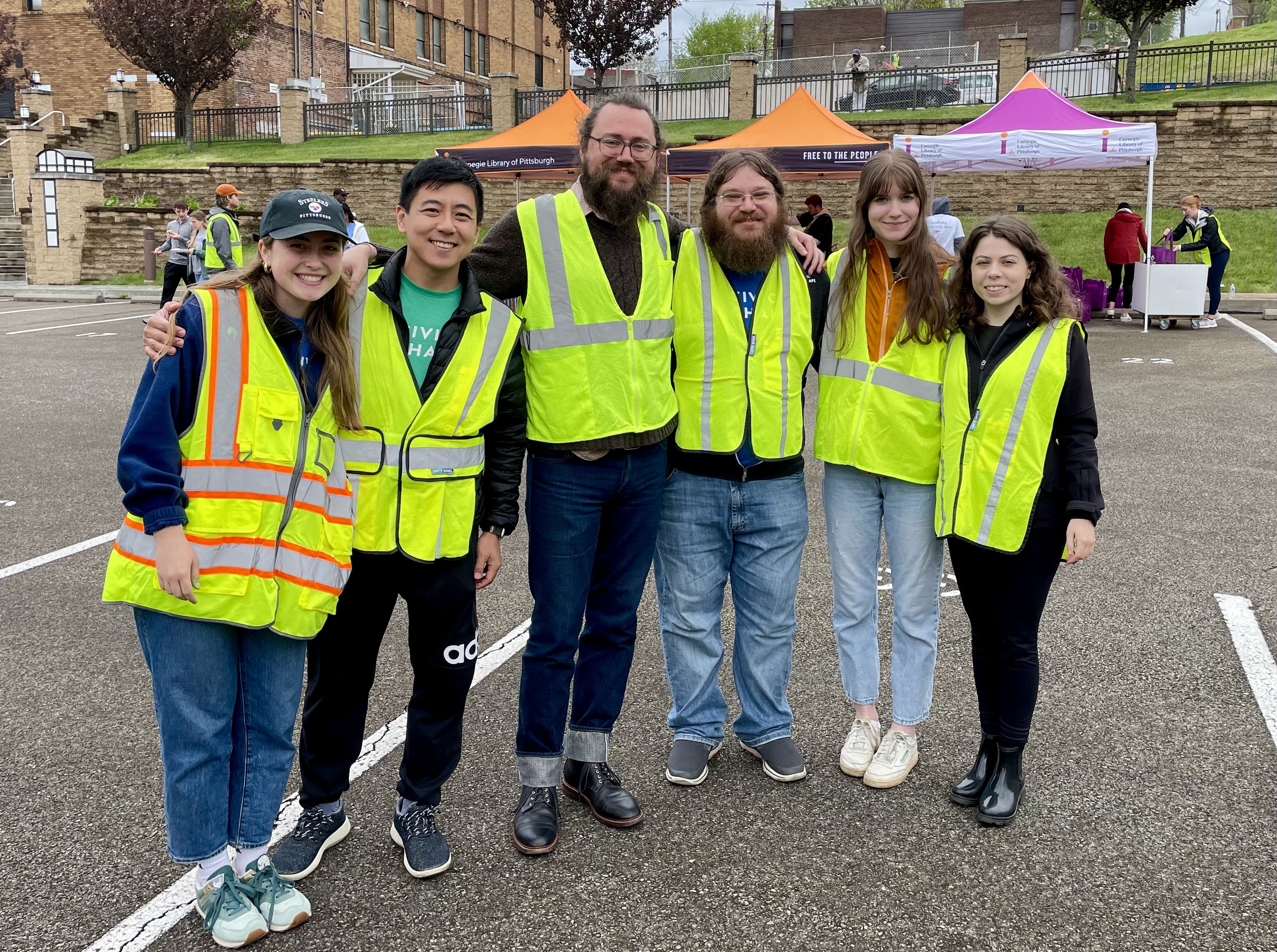
The team tests its nonprofit thesis in safety vests, where “high visibility” has nothing to do with a dashboard.
The company also tried to connect volunteer engagement to money. Its microdonations concept was one of 10 winners selected from more than 400 entries in a 2021 OpenIDEO and Gates Foundation charitable-giving challenge. The theory is delicate but sensible: people who give time may also become donors if the request respects the relationship. Mentoring Works, developed after pilots with mentoring organizations and support from the Richard King Mellon Foundation, extended the software into matching, meeting schedules, accountability, reflections, and relationship tracking.
03 / What it costs
Price the active volunteers, not the museum of old records
Civic Champs sells B2B software subscriptions to nonprofits and prices around active-volunteer volume. In a company-published 2024 comparison, the example for an organization with 1,000 volunteers was $174 a month. That base package included unlimited administrators, volunteer invitations, mobile and kiosk check-ins, hour tracking, messaging, digital waivers, reflections and questionnaires, event management, scheduling, CSV reports, groups, roles, and a Little Green Light integration. Data imports, text credits, and Blackbaud integration were listed as add-ons. Its help center priced SMS at $20 per 1,000 credits. Those are published benchmarks, not a promise that today's quote is identical.
for 1,000 volunteers
The relevant comparison is not “software versus free.” It is software versus coordinator time, missed attendance, duplicate entry, waiver risk, and a report assembled under deadline.
The business has been financed by a mix of equity, program-related investment, accelerators, and prize money. Public announcements show $312,000 raised by September 2019, a $130,000 IU Angel Network investment in 2020, and a $615,000 pre-seed round announced in 2022 with Elevate Ventures, Flywheel Fund, Innovation Works, IU Angels, the Richard King Mellon Foundation, and individual angels including Bloomerang founder Jay Love. RK Mellon later reported a $500,000 program-related investment to expand mentoring capacity. Civic Champs also passed through MassChallenge and Techstars and proved unusually good at pitch competitions - useful cash for a mission company serving customers who watch every dollar.
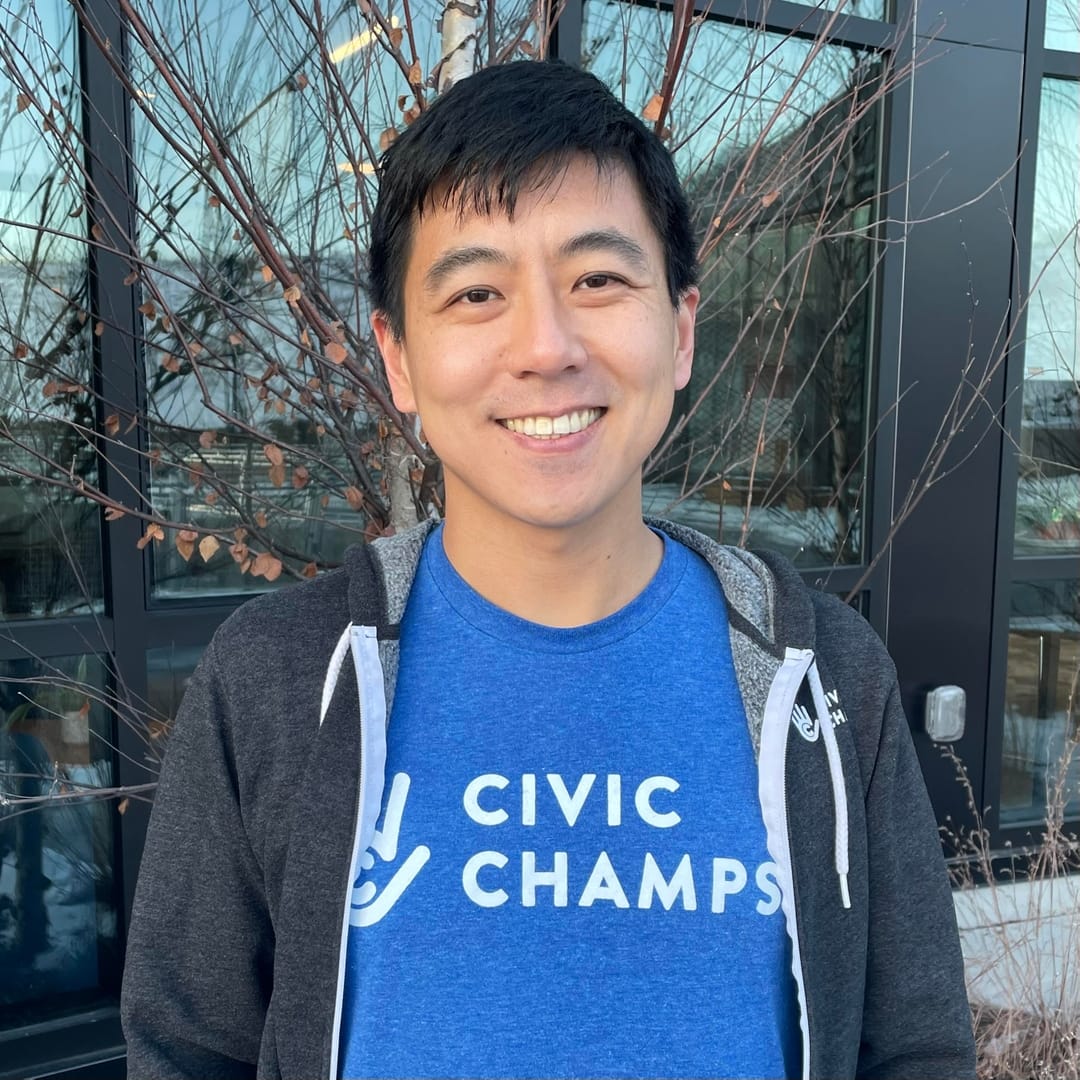
Geng Wang, photographed without the natural habitat of a SaaS founder: seventeen browser tabs and a quarterly pipeline review.
04 / The unglamorous moat
A feature list is easy. Adoption at a food pantry is not.
The company's expertise sits at the intersection of mobile product design and nonprofit operations. Volunteer programs are unusually hostile to software assumptions. Users may participate once a year. Ages and technical comfort vary. Sites can be noisy, outdoors, or short on devices. Staff turnover can make a beautiful configuration useless six months later. Civic Champs' advantage is the accumulated handling of those edge cases: limited groups, expiring waivers, multi-role shifts, bulk registration, manual records, automated reminders, kiosk mode, exports, and support.
Its July 2025 release notes offer a useful glimpse of the cost. The company called version 2025.7.1 its biggest release ever and acknowledged “many, many unexpected delays.” Critical bugs found in testing took time to clean up because the team was small. Some event and location functions stayed in closed beta before gradual rollout. The first thing to fail in that episode was scope: too many changes landed in one release. The response was not a heroic all-nighter story. It was slower testing, pilot organizations, and a stated return to smaller, more responsive updates.
Mobile adoption remains a live constraint. In September 2024, Android users reported crashes when opening opportunities; the company answered that a new version had fixed the bug. That is not a footnote in volunteer software. If check-in fails at the door, the coordinator reaches for paper, and the old system wins immediately. The product needs a fallback path and a support team willing to answer quickly. Customer testimonials repeatedly praise that support, sometimes more vividly than the features.
Where it fits
Small and midsized nonprofits with recurring volunteers, compliance forms, shift complexity, grant reporting, and a coordinator who needs one operational source of truth.
Where it bends
A tiny group with ten familiar helpers may be fine on a shared sheet. A global enterprise with deep workforce, security, and localization demands may need a heavier platform.
05 / What to copy
Steal the sequence, not the geofence
The copyable lesson begins with an ugly repeated action. Find the moment when information first becomes true - a person arrives, a waiver is signed, a session ends - and capture it there. Next, return an immediate benefit to the person doing the work. A one-tap check-in beats a promise of better analytics next quarter. Then follow the record downstream. Attendance becomes hours; hours become program capacity; capacity becomes grant evidence; reliable history improves recognition, retention, and fundraising.
The second lesson is to design around refusal. Some volunteers will not download an app. Some sites will not have clean reception. Some administrators will insist on helping at the door. Civic Champs offers multiple routes to the same clean record. A founder can copy that principle in any vertical: preserve the outcome while allowing human behavior to vary.
The playbook fails when the captured data has no valuable downstream use, when switching costs exceed the admin pain, or when the organization lacks a person responsible for implementation. It also fails when “all in one” becomes “too much to learn.” Civic Champs is strongest when volunteer operations are frequent enough to hurt, structured enough to automate, and important enough to measure. Below that threshold, a spreadsheet is not primitive. It is appropriate.
A mobile-first geofence attacks volunteer-hour paperwork.
The pandemic breaks in-person service and the team adapts.
Pre-seed funding backs self-service, integrations, and mentoring.
Bulk registration and rebuilt event flows arrive after critical bug fixes.
A May newsletter publishes a farewell to co-founder and CEO Geng Wang.
Civic Champs occupies a narrow but durable part of the nonprofit stack. It is not the place to run a general ledger, design a gala, or manage every donor relationship. It is the place where a volunteer becomes a reliable operational record without feeling like a row in a database. The company began by trying to make check-in disappear. Its more interesting achievement is making the clipboard's hidden consequences visible.