A founder’s farewell usually invites a little arithmetic. Count the money raised, list the milestones, thank the people. Yann Chong Tan did those things when he congratulated Nuevocor’s incoming chief executive, Al Gianchetti. Then he turned to what he wanted to do next: build, back and scale science. The company he had helped start was moving into another phase. His own account of the handover treated that change as a moment to begin again.
There is a useful question tucked inside that announcement. What does a founder want to keep doing once the title changes? Tan’s career offers a clear answer. At Stanford, he helped develop a technology that became the foundation of Atreca. In Singapore, he worked inside a public research institute on commercialization. At Nuevocor, he took on the job of assembling a company around academic work. The recurring activity is getting research into a form other people can build upon.
A dissertation with a second address
Tan studied biology at Duke University and earned his doctorate in immunology at Stanford. He received A*STAR National Science Scholarship fellowships for both undergraduate and doctoral study. Those institutions would remain connected in his working life: an education in the United States, support from Singapore, and a career moving between research and enterprise.
At Stanford, his mentor was William Robinson. Tan led development of the technology underlying Atreca’s Immune Repertoire Capture platform while doing his dissertation research in Robinson’s laboratory. The chronology matters. The work that helped give him an academic qualification also supplied material for a business. A dissertation can be quite enough paperwork for one person. His acquired a corporate sequel.
By 2012, he had co-founded Atreca, where he became chief technologist. That title kept him close to the technology itself. The early part of his career was about developing a scientific capability and helping establish the organization around it. His later leadership roles would involve a wider range of decisions, but this first venture began with work he had helped do at the bench.
One patent record supplies a particularly concrete piece of that history. An application titled “Identification of polynucleotides associated with a sample” names Tan alongside Robinson and Jeremy Sokolove as inventors. Its prior-art date is April 2011, and the US application was filed in April 2012. The record places his work within a collaboration, with named colleagues and institutions, before the later executive biographies compressed it into a few lines.
Tan’s dissertation work helped underpin Atreca’s technology. He subsequently became the company’s chief technologist.
The room around the researcher
Stanford’s account of Atreca’s beginnings includes a telling observation from Robinson. The founders benefited from being around participants in SPARK, the university’s translational research program, even though Atreca did not receive direct support from that program. Tan appears in that account as a graduate student who went on to become chief technologist.
It is a modest detail with considerable explanatory power. A laboratory has its own standards, habits and vocabulary. A company introduces investors, licenses, hiring and operating decisions. Being close to others making that transition offers a view of the work between the formal milestones. Robinson’s recollection gives the surrounding community a place in Atreca’s origin story.
Tan later appeared on the other side of that exchange. In June 2016, a Biotechin.Asia startup workshop in Singapore advertised an Atreca case study from him. The event, at NUS Enterprise@Blk71, addressed pitching to investors. Eddy Lee of Coffee Ventures conducted the workshop. Its agenda ranged from the contents of a slide deck to what an entrepreneur should say to an investor familiar with the industry.
Here was a researcher returning with experience that a paper alone could not convey. The advertised case study connected his scientific career to the practical business of explaining a company. There was also a networking session and a light dinner. Even ambitious ventures sometimes begin with the fairly ordinary advantage of people staying in the room long enough to talk.
The workshop’s questions were deliberately concrete. What belongs on the slides? What should a speaker say to an investor who already understands the field? Tan’s contribution was an example from a company he had helped create. The program gave that experience a place alongside instruction and discussion, rather than leaving it inside an executive biography.
When an internal primer opened its doors
In Singapore, Tan served as chief innovation officer at A*STAR’s Genome Institute of Singapore. His remit included initiating and leading strategic programs that resulted in spin-offs. Nuevocor was among them. The role put him at an institutional junction: research on one side, potential companies on the other, and a great deal of organizing in between.
A smaller initiative at Nuevocor makes that organizing visible. Tan and his colleagues were considering an intellectual-property primer for new staff. They expanded the idea into a four-part series open to Singapore’s wider community. Andrew T. Serafini and Yifan Mao of Kilpatrick Townsend & Stockton contributed their time. Tan reported almost 200 participants from more than 30 organizations.
The audience included academic institutions, government bodies, investment firms and other biotechnology companies. Intellectual property can sound like the chapter everyone plans to read later. Opening the series acknowledged how many people needed a working understanding of it. The internal training exercise had found an audience well beyond the new employees for whom it was originally imagined.
That episode offers a more precise view of Tan’s community involvement than a grand description of leadership would. A specific need became a shared event. He named the people who helped, described who attended and looked ahead to the next session. The scale was measurable; the act itself was straightforward. Someone had to decide to open the invitation.
Singapore, with the doors open
Nuevocor emerged as an A*STAR spin-off in 2020. Its founding scientific network included Brian Burke, Colin Stewart and Stanford’s Mark Kay. Tan’s role sat alongside those researchers’ contributions. The company’s story brought together academic work, institutional support and the people prepared to turn both into an operating business.
By June 2021, Nuevocor had raised a US$24 million Series A, co-led by EVX Ventures and Boehringer Ingelheim Venture Fund. That financing gave the young company a public business milestone. It also placed Tan within a broader Singapore effort to create ventures from research conducted in the country’s institutions.
A*STAR’s later institutional account placed Nuevocor’s origins within a longer process of scientific work and translational support. It named Colin Stewart and Brian Burke in the technology’s development. For Tan’s story, that context matters: joining the research to an enterprise required several kinds of expertise, with the founder working among people whose contributions began before the financing announcements.
His entrepreneurial connections extended to Cargene. In a June 2022 announcement welcoming Kathy He as CEO, Cargene chairman XQ Lin identified Tan as his co-founder. The announcement described a business based in Singapore, Boston and Shanghai. It provides another example of the international company structures surrounding Tan’s work, with different executives and collaborators carrying different responsibilities.
“Capabilities do not respect borders”
Yann Chong Tan, in a 2022 interview
Tan used that phrase while discussing collaboration. He described Singapore as a bridge between Asia and the West, and spoke about ties across North America, Europe and Asia. The language was practical: expertise is distributed, so working relationships need to extend beyond a headquarters address. His own education and company affiliations had already given that proposition a geographic shape.
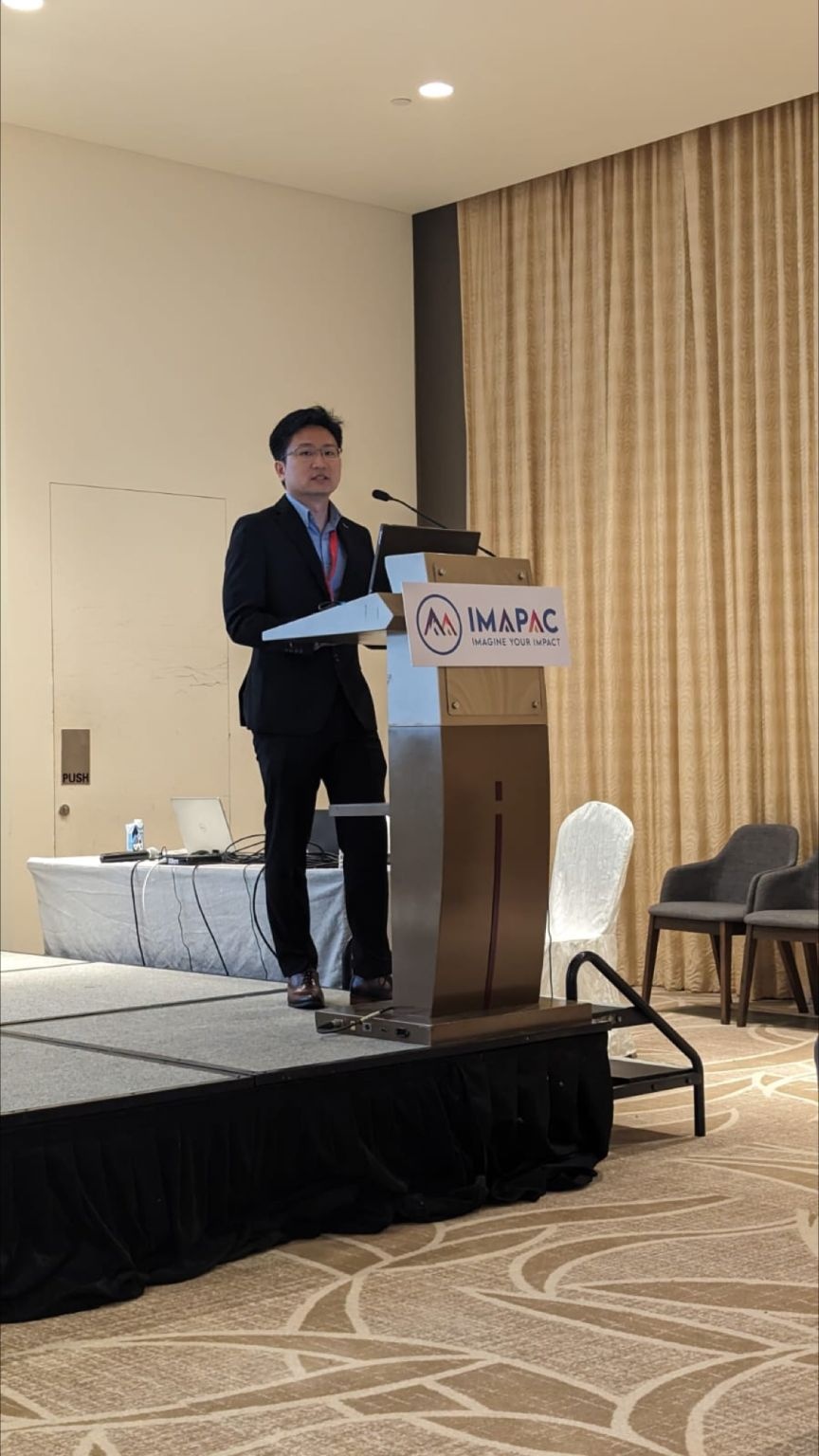
Conference appearances added further points to the map. Nuevocor announced his participation in a New York event in October 2024 and a presentation in Rome later that month. These were occasions to put the company’s work before specialist audiences. They also show the public-facing part of a founder’s job: the person responsible for a young company has to explain it repeatedly, in rooms far from where it began.
The capital, and the handover
In May 2025, Nuevocor announced a US$45 million Series B co-led by Kurma Partners and Angelini Ventures. Existing investors participated alongside new backers. The announcement also set out plans for a Paris office. By this point, Tan’s early company-building assignment involved an expanding international investor group and an organization reaching further into Europe.
January 2026 brought Gianchetti’s appointment as CEO and a board member. The announcement identified executive chairman Andreas Wallnoefer as the previous acting CEO. That detail gives the succession its proper shape: there had been an interim leadership arrangement before the new appointment. Nuevocor now lists Tan as co-founder and advisor.
His response to Gianchetti’s appointment emphasized colleagues, company culture and what the team had built in Singapore. He also made room for his own next projects. He described the recurring interest as “building, backing, and scaling science with global ambition.” It was a statement of direction that fit the different jobs already on his résumé, from technologist to innovation officer to founding executive.
The career can be read through those changing titles. A student developed technology. A technologist helped establish its use inside a company. An innovation officer worked on creating further ventures. A founder led an organization and later took an advisory role. At each stage, the work required a different relationship with the research and with the people around it.
For Tan, the next chapter follows a handover he publicly welcomed. Nuevocor continues with another chief executive; he remains among its founders and advisors. The satisfying detail is the verb he put first when describing what comes next: building. After the dissertation, the patents, the workshops and the financing announcements, he still has an appetite for the beginning.