Yancey Strickler wore a Gil Scott-Heron T-shirt under his blazer to the signing. In June 2026, the Kickstarter cofounder was in Denver for a ceremony marking Colorado’s new artist-company law. The governor had pens to distribute. Strickler had come dressed for an encounter between two institutions that have rarely agreed on the appropriate outfit: independent culture and the state.
The clothing makes a useful introduction. Strickler began as a music critic, became a technology executive, and now spends some of his time trying to change the legal arrangements under which artists work. He has kept returning to a question that sounds philosophical until the rent comes due. How can creative people have more control over the conditions of their lives?
Kickstarter supplied one answer: let people who want something to exist help pay for its creation. His newer projects address what follows. A book gets funded. A group forms. There is money to divide, work to own, and another book to make. Friendship has got everyone this far. At some point somebody asks whose name goes on the paperwork.
For a person raised on independent music’s suspicion of business, this is an entertaining destination. The small print has become part of the creative work. He has followed the argument far enough to need lawyers.
How do you turn creative enthusiasm into lasting independence?
Before the crowd, a fan club
Strickler grew up on a farm in Clover Hollow, Virginia. His childhood reading and listening offered routes beyond the Appalachian farmhouse. He started a Beach Boys fan club, recruiting his cousins. He filled black-and-white composition books with a fantasy series. The audience was modest; the urge to make a world and invite people into it was already there.
At William & Mary, he studied English and literary and cultural studies, graduating in 2000. Then came New York and the practical education of a freelance music writer. His bylines appeared in Pitchfork, Spin, and The Village Voice. A concert preview could pay $75. Seeing his name in print was part of the compensation.
The work also taught him to pay attention to people before a large audience arrived. At eMusic, he helped create eMusic Selects, which began in 2008. The program gave unsigned and overlooked acts prominent editorial attention and a period of exclusive digital distribution. Its early selections included High Places and Breathe Owl Breathe. Here was a critic trying to build a route from enthusiasm to income.
It is tempting to treat the writing as a prelude to the entrepreneurial career. That misses the continuity. A review, a record release, a funding platform: each can be a way of saying that something deserves to exist, then assembling the people who agree. Strickler’s tools changed more than his interests did.
A concert that didn’t happen
Kickstarter began with Perry Chen’s problem. He wanted to put on a concert in New Orleans but lacked the money to take the risk himself. What if an audience could commit first, and the event would happen only if enough people agreed? Strickler became his friend and collaborator; Charles Adler joined them. The idea took years of work before becoming a functioning website.
Strickler kept his day job through four years of developing the project. That detail gives the familiar startup origin a different rhythm. There was a long stretch of evenings and conversations before there was a company people recognized. Remembering the early work, he called it “a fun conspiracy with some friends.” The conspiracy eventually acquired a customer-support queue.
Kickstarter launched in April 2009. Strickler served as its first community-support representative and later took on communications and leadership responsibilities. He became CEO in January 2014 and held the job until 2017. By his departure announcement, he could point to more than 100,000 creators who had brought projects into existence and expansion to creators in 16 countries during his tenure.
The achievement came with a continuing question about the company itself. Helping creative projects required a viable business. Did a viable business have to organize every decision around making more money? In September 2015, the founders made Kickstarter a public benefit corporation, formally placing a broader social purpose inside its corporate obligations.
They also committed five percent of annual post-tax profits to arts education and organizations fighting inequality. It was a specific undertaking, with an amount attached. Strickler’s doubts about money had moved from the realm of taste into the machinery of the company.
Four seats at the lunch table
“Am I a class traitor for being good in this eight person meeting?”
Yancey Strickler, on discovering a talent for management
There was something comic about discovering an aptitude for management after identifying so thoroughly as a writer and music person. The joke contains a real conflict: what happens when the skills that help you protect creative work resemble the skills you once associated with selling out?
His 2019 book, This Could Be Our Future: A Manifesto for a More Generous World, widened the inquiry. Strickler challenged the habit of treating financial maximization as the natural objective of individual and organizational life. Money mattered. He wanted other kinds of value to become easier to recognize and defend when decisions were being made.
The book introduced Bentoism, a decision-making framework with four perspectives: Now Me, Future Me, Now Us, and Future Us. A decision belongs to the person making it today, but it also affects that person later, the people around them, and the people who will inherit its consequences. The diagram gives each of those interests somewhere to sit.
Its name grew from “Beyond Near Term Orientation” and the divided Japanese lunchbox. The analogy is pleasantly domestic for a proposal about rethinking capitalism. You can picture the compartments before you have accepted the argument. Strickler developed the idea through reading and drawing, then tested it in conversation. The Bento Society gave people a place to explore it together.
He had already helped establish another kind of gathering place. The Creative Independent launched in September 2016, led by Brandon Stosuy, with an opening piece by poet Eileen Myles. Its interviews and essays let practicing artists discuss the work of making things. Funding was one problem. Learning how other people kept going deserved an institution too.
The internet gets smaller on purpose
In May 2019, Strickler sent an essay to a newsletter list of 500 people. The Dark Forest Theory of the Internet borrowed an image from Liu Cixin’s science fiction to explain a familiar online behavior: people were taking their more candid conversations into smaller, quieter spaces, away from the pressures of public platforms.
Group chats, newsletters, and private communities offered a different setting for expression. He also saw a cost. Leaving the public conversation could mean surrendering influence over it. His essay held both possibilities together: the pleasure of a room where you know who is listening, and the question of what happens outside while you are there.
In 2024, The Dark Forest Anthology of the Internet brought the discussion into a book with other writers. His collaborators included Joshua Citarella, Maggie Appleton, and Venkatesh Rao. Citarella also became his cohost on the New Creative Era podcast. An observation sent to a small mailing list had become an occasion to make things with peers.
That desire also shaped Metalabel, which he cofounded in 2021. The model drew on independent record labels: people could release work under a shared identity without becoming interchangeable or having to create every piece together. There is room for individual authorship inside a collective undertaking. For a writer accustomed to a byline, that distinction matters.
In a 2026 interview, Strickler described looking for a more cooperative relationship with peers after returning to writing. The familiar online arrangement had made it easy to experience other people’s work as competition. Metalabel sought practical ways to help them release and sell work together. By October 2026, his current projects also included DFOS, the Dark Forest Operating System, built around private spaces for groups to gather, publish, and share money.
Who keeps the keys?
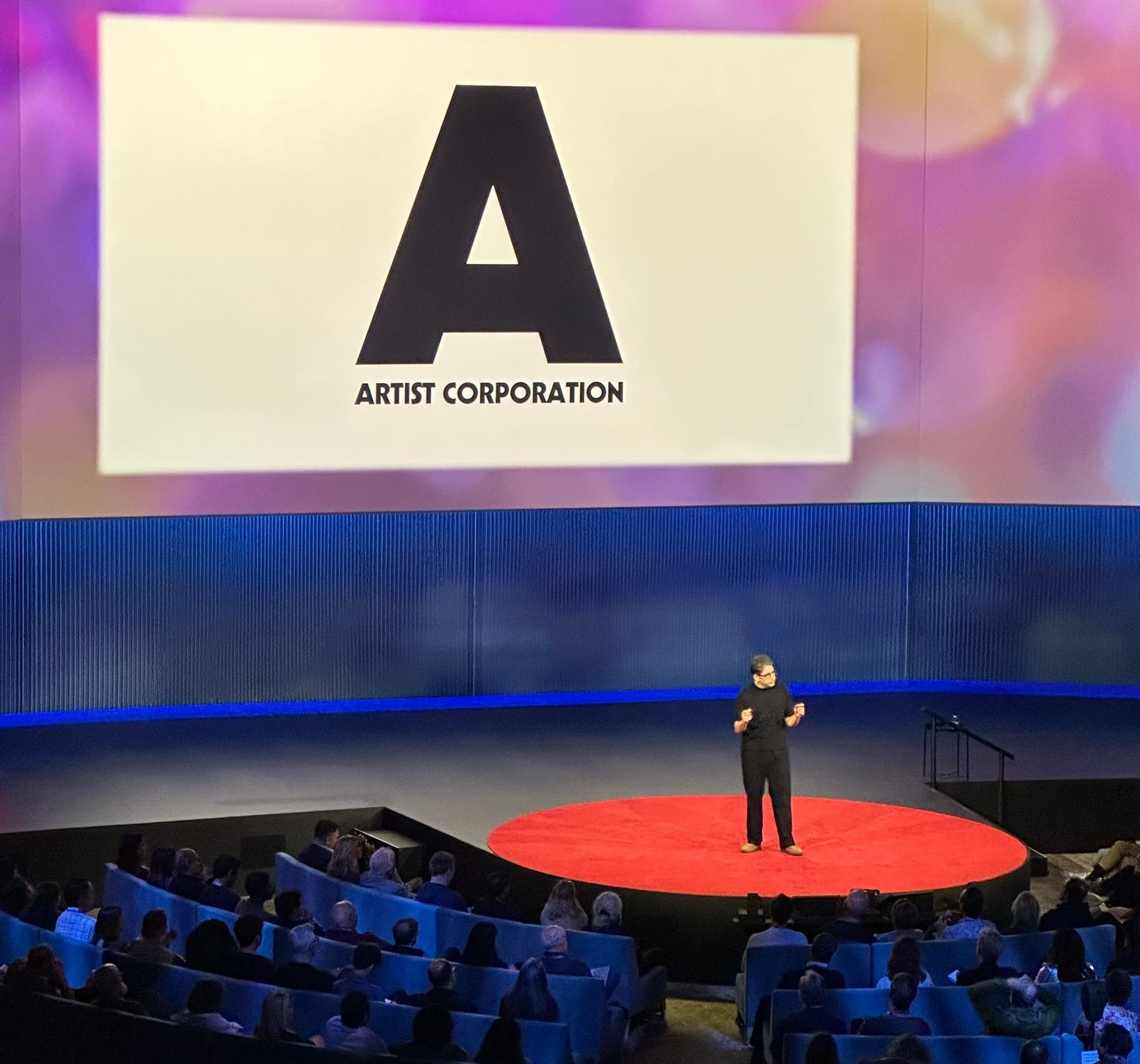
Artist Corporations carries the ownership question into a different arena. Introduced publicly at TED in April 2025, the proposal envisioned structures in which creative people could pool resources, own work together, and build something that survives the next commission. Strickler became the initial executive director of the Artist Corporations Foundation, alongside managing director and artist Lena Imamura.
The Colorado Artist Company Act was signed on June 2, 2026. It authorizes a form of limited liability company with a stated artistic mission and requires artists to retain at least 51 percent of its voting securities. That threshold is the telling number. Outside capital can have a place; artist control has a floor.
The legislative record also gives the undertaking a less solitary shape than a founder biography might suggest. Senators Jeff Bridges and Marc Catlin sponsored the bill with representatives Matthew Martinez and Rick Taggart. Strickler testified for it alongside Colorado arts advocates. The result depended on people who understood legislation, local institutions, and artistic practice finding enough common ground to proceed.
A signed law and a working filing system run on different clocks. In his October 2026 update, Strickler said the first Colorado A-Corps were expected to be able to form in July 2027. He was also working toward legislation in more states. The ambitions remain larger than the present result; the present result is concrete enough to have a bill number.
There is a long distance between recruiting cousins into a Beach Boys fan club and asking lawmakers to recognize an artistic mission. Both involve making a structure around a shared enthusiasm. Strickler keeps changing the size and durability of that structure. The question that follows him into each new room is practical, even when the room contains a governor: who owns what we make, and can we afford to make another one?
The minimum share of voting securities artists must retain in a Colorado artist company.
A statutory floor for artist control