Perry Chen had found a venue. He had contacted the people who could bring the DJs to New Orleans. What he lacked was the money to make the evening happen. In late 2001, planning a show around the following year’s Jazz Fest, he encountered a familiar absurdity of cultural life: an audience might want something, yet the person organizing it still had to find the cash before anyone could attend.
The show never happened. Chen kept thinking about the people who would have gone. Suppose they could pledge in advance, with their money collected only if enough other people joined them? An organizer could discover whether the support existed before committing to the expense. A disappointed concertgoer could do something more useful than be disappointed.
It was a small adjustment to the order of events. The audience would arrive, financially speaking, before the performance. Eight years later, on April 28, 2009, Kickstarter opened. Chen had spent a considerable amount of time trying to get a website made for someone whose original problem was putting on a concert.
The show stayed imaginary
He grew up on Roosevelt Island, in New York’s East River, and attended Tulane University in New Orleans. His working life resisted a tidy job title. He was, at different points, a waiter, a preschool teacher, a day trader, a musician and a gallery owner. There were several ways to pay the bills and several ways to avoid answering the question of what he did.
Music provided a more consistent interest. Hip-hop was part of his New York childhood; drum and bass drew him toward DJing in New Orleans. He began making electronic music on a computer. The machinery served a creative purpose long before he had a company to run.
His art interests also predated Kickstarter. In 2001, at Southfirst, the Brooklyn gallery he co-founded, Virus presented notorious computer-virus scripts in illuminated boxes. The code became something a visitor could stand in front of. An invisible intrusion had acquired a physical frame.
That early installation complicates the familiar picture of a technology founder who eventually discovers art. Chen was already moving between creative forms. A website would become another demanding thing to work out how to make.
A very slow launch
Back in Brooklyn, Chen met music journalist Yancey Strickler in 2005. Charles Adler joined the founding team in 2007. They had a concept, sketches and enough uncertainty to keep them occupied. None of the three knew how to code.
The early designs are a pleasing corrective to the polished launch story. Chen’s 2006 version already included the goal, deadline, rewards and project video. The name was Kickstartr. The missing vowel survived until 2008; at one point there was even a MySpace widget. The internet had time to change its clothes while the founders were still getting ready.
Sunny Bates advised them. Andy Baio helped with the technical plan. In 2008 they hired freelance developers, including Lance Ivy, who joined the team. Progress depended on finding people who could do the parts the founders couldn’t.
Three backers funded Drawing for Dollars.
Perry Chen was one of them.
That first successful campaign supplied a particularly modest proof of concept. The system could bring a small group together around a finite piece of work. A project did not have to make sense to everyone. It needed enough support from the people to whom it did.
Later, recalling the years before launch, Chen described the prospect that troubled him most: doing all that work and never getting the site into the world. The initial achievement was getting it to exist. The demands of operating it followed quickly enough.
- 01A project
sets a goal - 02People
pledge support - 03Goal reached?
Collect pledges
Below the goal at the deadline: backers aren’t charged.
Culture gets a clause
Chen left the CEO role at the end of 2013 and became chair, making more room for his studio work. TIME had included him in its 100 most influential people that year. Recognition had arrived; the question of what sort of institution Kickstarter should become remained unsettled.
During a stay in Florence, where his sister had married a Florentine, he wrote a memo about the company’s purpose. He had been concentrating on art for roughly a year. The founding motivation still bothered him enough to require a document: they had created Kickstarter to help creative projects happen. How could that purpose survive the incentives of running a business?
In 2015, he spearheaded its conversion to a Public Benefit Corporation. The charter gave the mission a formal place in the company’s obligations. Kickstarter remained a for-profit business, with wider responsibilities written into its structure.
The commitments are unusually concrete reading material for a company associated with imagination. They address user data, tax practices and support for less commercial creative work. Five percent of annual after-tax profit is pledged to arts and music education and efforts against systemic inequality. There is also an obligation to report on public benefits.
A charter can’t make every future decision easy. It can establish what a decision must take into account. Chen’s interest in how things are arranged had reached the legal architecture of the company itself.
An archive for the end of the world
His studio work pursued another kind of institutional memory. Computers in Crisis, presented in 2014 with the New Museum, Rhizome and Creative Time Reports, returned to Y2K. The date had become a punchline. Chen gathered the literature that people produced when they still had to decide what to do about it.
The archive contains 155 books in eleven categories. Programming manuals share the larger collection with religious interpretations, survival advice, personal-finance guides and five cookbooks. The end of the world, apparently, still required meal planning.
The books preserve incompatible expectations. Some authors saw an opportunity; others anticipated catastrophe or argued that the alarm was overblown. At the New Museum’s December 2014 Y2K+15 event, people involved in the episode returned to discuss its preparations and legacy.
“It’s easy to laugh at Y2K now, but what are we laughing at?”
Perry Chen · 2015
That question resists the comfort of hindsight. Knowing that a predicted disaster did not arrive doesn’t automatically explain the work done to prevent it, or the limits of the prediction. Chen treated the material as something to examine. The archive left room for more than one reading.
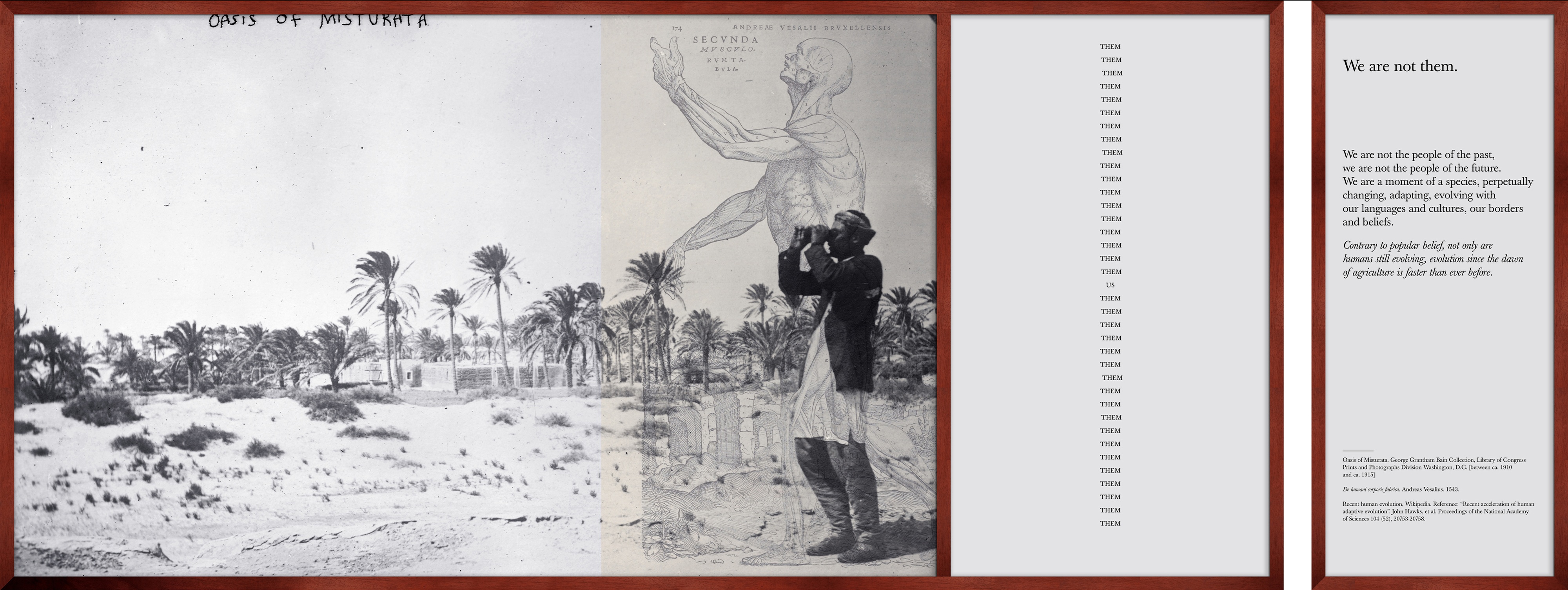
He would return to uncertainty in Perpetual Novelty, the exhibition that opened online through Nature Morte in January 2021. Archival imagery, scientific ideas and text became material for thinking about a world that keeps producing unfamiliar situations. The website allowed a visitor to encounter the work without first getting to a gallery.
Please come in. You needn’t buy anything.
Between these investigations, Chen helped create a room with a different set of rules. The Club operated in Greenpoint, Brooklyn, in 2016 and 2017. It could be a reading room, an artist’s studio, a performance space or a dance floor. It had no fixed hours, signage, promotion or online presence.
Someone could activate it for a noncommercial cultural activity, provided the door was open to whoever arrived. Buying something was optional. Sitting, reading and talking were sufficient reasons to be there.
The project began with conversations about how to use the space. Ideas accumulated on the walls for the next person to consider. Furniture came from studios, collaborators and secondhand shops. Whoever opened up would put aside drink money, restock the fridge and clean up. Rent was paid in cash each month.
This was a very physical experiment in participation. It depended on a door, a room and people willing to take care of them. The invitation carried a clear condition: if you wanted to use the space, you had to let others in.

The music keeps returning
His experiments also produced lessons about what people would decline to do. Drip, Kickstarter’s attempt at recurring support for creators, failed to gain traction and was passed to the people behind XOXO. Chen’s explanation in 2019 was practical: backing a particular work once asks something different from subscribing to its maker indefinitely.
He also defended artists who kept another job. Teaching, for instance, might support both the bills and the work. A creative life did not become more valid merely because it came with a single source of income. His own collection of occupations gave that position some texture.
Chen returned as Kickstarter CEO in 2017 and handed over daily leadership in 2019. His studio biography now places him in Paris. Across the projects, the questions remain recognizable: how people support each other, how rules affect participation, how to act without knowing exactly what will happen.
In February 2026, music collectibles platform and journal Wax Poetics announced a $1 million funding round that included Chen among its investors, alongside founders from WhoSampled and Mixcloud. His individual contribution wasn’t disclosed. His accompanying comment emphasized community, trust and curation.
The record leads back to music. There is a long distance between trying to stage a New Orleans show and investing in a platform for music collectors. There is also a familiar concern running between them: people care about this work. What would let them support it?
Chen’s answer has taken the form of a website, corporate rules, an archive and an open door. The concert is still absent from his list of completed projects. It supplied a fairly productive evening’s worth of disappointment.
Keep following the questions
Work, conversations and a few places to go next.