The first obstacle was knowing where to look. When Erine Gray’s mother developed encephalitis, the illness left her with lasting cognitive damage. Later, helping care for her in Austin, he struggled to discover what assistance existed. Programs were out there. The route to them was obscure. A family could need help urgently and still have to become an expert in finding it.
- For individuals: free searches for local food, housing, transportation, and other assistance.
- For organizations: paid tools to screen needs, coordinate referrals, and track what follows.
- The catch: finding a program does not guarantee eligibility, capacity, or a completed application.
Gray eventually built a company around that predicament. Findhelp.org lets people enter a ZIP code and look for free or reduced-cost services. Behind the public site sits a software business serving institutions that encounter the same problem repeatedly: hospitals, health plans, governments, schools, and community organizations. The person needs a ride. The institution needs a reliable way to arrange one and see what happened.
The first database was an Excel file
In 2010, Gray founded Aunt Bertha, the company now called Findhelp. His account of its early database is refreshingly uncinematic. He rented a small office near home, researched Austin programs, and entered them into Excel. Python scripts moved the records into the database. He was doing the programming and the data entry. Before the network could connect anyone, somebody had to type.

Erine Gray, whose early job description included programmer and program researcher. Company portrait.
That detail explains something about the product. A resource directory depends on small, perishable facts: whether a program still operates, whom it serves, and how someone should approach it. Findhelp’s support documentation says its target is to review programs every six months; organizations can claim listings and update them between reviews. The company also acknowledges that information can change between checks. Maintenance is part of the service. A useful listing must explain the next action, too. Findhelp’s documentation distinguishes programs that want a visitor to arrive in person from those that require a call and an intake conversation. That specificity matters when someone has limited time, limited transportation, or little room for another unsuccessful attempt.
The name changed through a similarly practical discovery. During the pandemic, Aunt Bertha launched Findhelp.org for people seeking resources. According to its rebranding account, the new name was easier to remember. The public sites consolidated, and the company adopted Findhelp in 2021. Asking somebody under pressure to remember an unfamiliar aunt’s name was an avoidable extra task.
Free at the front door. Paid behind the desk.
Findhelp is a for-profit public benefit corporation. Its public search and program listings are free. Organizations buy the coordination layer: branded sites, reporting, screening, and connections to their existing software. A person looking for groceries and a health plan managing thousands of members are using different parts of the same system.
The published general plans run from $5,400 annually for Basic to $24,000 for Pro, $50,000 for Enterprise, and $75,000 upward for Enterprise+. Licenses include unlimited users, searches, and referrals. Sector pricing applies to healthcare, government, United Way/211, and K-12 buyers; implementation, support, extra features, and additional states can add cost. A listed subscription is a starting point for budgeting.
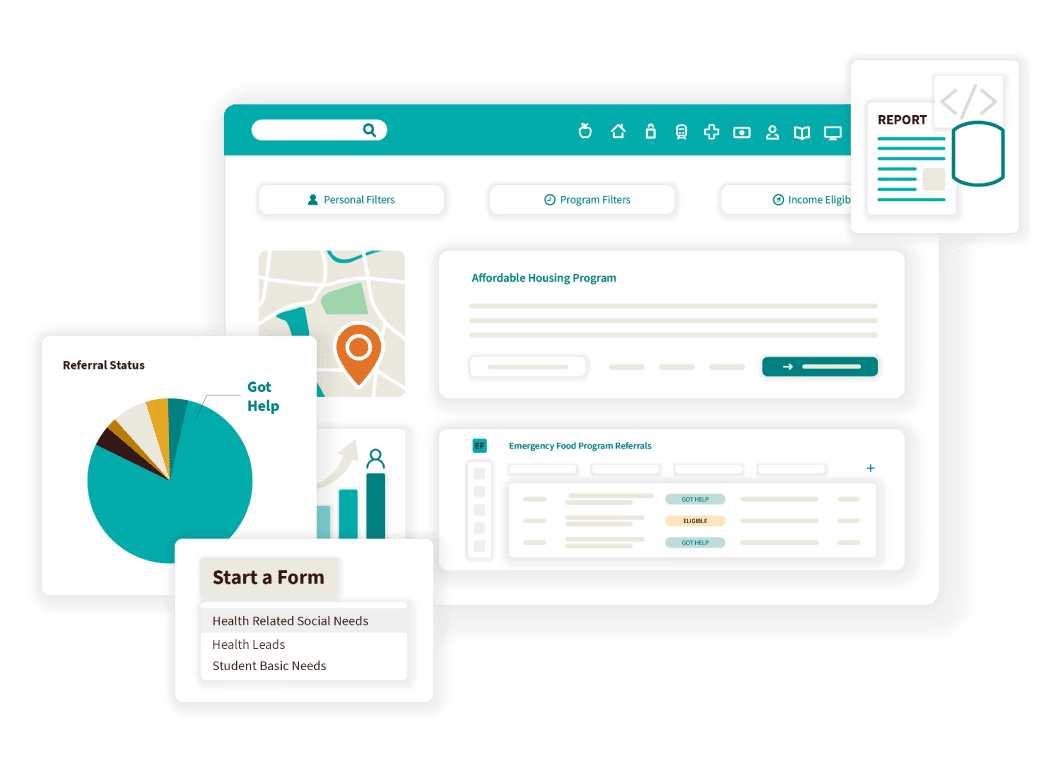
Findhelp’s platform illustration brings referrals, assessments, and reporting into view. The pictured chart is illustrative.
This puts Findhelp in the social care software market alongside Unite Us, which also offers screening, referrals, and outcome reporting. Local 211 services offer another route, with human specialists helping people navigate resources; they can also partner with Findhelp. Its particular proposition combines an open public doorway with organizational workflows. The directory and the case-management desk share infrastructure. Integrations with electronic health records make that proposition more concrete: staff can search and refer from systems they already use. Findhelp offers several integration approaches, including native connections, launch links, APIs, and webhooks. The practical question for a buyer is which approach fits its staff and local partners.
A referral is a beginning
Consider Tennessee. Findhelp’s account of Community Compass describes a statewide platform linking TennCare, managed care organizations, providers, and community groups. It supports screening, referrals, authorizations, data exchange, and payments. In its first three months, the company reported 13,455 screenings and 4,031 referrals. Those figures show activity. They do not establish that every referral produced assistance or improved someone’s health.
Company-reported Tennessee activity, first three months. These are separate measures, not a conversion rate.
The implementation also involved the Rural Health Association of Tennessee engaging community organizations. That is an important qualification to the software story. A network requires people willing and able to receive requests. Connecting databases cannot supply a vacant apartment, an available appointment, or another volunteer shift.
“The problem we’re trying to solve is the information gap.”Erine Gray, speaking to Salud America! in 2020
The paperwork becomes the product
In October 2025, Findhelp acquired Uno Health, adding benefits eligibility, document collection, applications, and renewals. Its explanation identified a familiar stopping point: someone receives a referral, then gets lost in enrollment paperwork. The acquisition moved the product further into that unfinished task. In July 2026, Findhelp announced free eligibility screening across all 50 states and Washington, DC.
Capital followed the broader ambition. Warburg Pincus led $27 million in financing in 2021. In March 2026, TPG announced an approximately $250 million investment through The Rise Funds. By October, Findhelp’s behavioral health integrations included capabilities from MiResource, SonderMind, and SimplePractice, bringing availability and scheduling into the workflow. Each extension tackles another point where a useful search can stall.
The company’s mission does not settle every internal question. An NLRB record documents employees voting 95 to 52 for union representation in 2023. For a business built around care, working conditions belong in the picture too.
Put the doorway where the problem lives
One of the most useful details comes from Idaho. Findhelp reports that Boise prints QR codes for Find Help Idaho on utility bills. Someone confronting a bill encounters a route to assistance in the same place. It is a modest distribution choice that other services can copy: introduce the next step where the need becomes visible.
The larger lesson is to reduce the work between discovering an option and using it. Keep records current. Fit tools into staff routines. Ask whether a referral reached an organization with capacity. Where those conditions are missing, a faster search can still end in disappointment. Findhelp’s business depends on how much of that journey it can make easier.