At Yanay Ofran’s childhood dinner table, a question could interrupt the meal and recruit the room. A book would come out. Then another. Someone might consult a dictionary. The answer was worth an argument, and the argument was worth the trouble. He remembers a household that gave questions more weight than answers. It is a useful place to begin with someone whose career has involved repeatedly deciding that the question in front of him required a different sort of answer.
Today, Ofran is the founder and CEO of Biolojic Design, co-founder and chief scientific officer of Aulos Bioscience, and co-founder and chairman of Ukko. The titles suggest a settled professional identity. His route to them was less orderly. He moved through linguistics and neuroscience before completing a doctorate in computational biophysics. Along the way, he also acquired a television credit. A tidy biography would have its work cut out.
“We placed more emphasis on questions than on answers.”
YANAY OFRAN, ON HIS UPBRINGING
The degree came after the detours
His undergraduate years were at the Hebrew University of Jerusalem. The academic record places them between 1994 and 1998; his studies combined physics and biology, with philosophy alongside them. That combination gave him several different ways of approaching a problem before he had committed to a professional vocabulary.
Language drew him first. Doctoral work in linguistics gave way to neuroscience, where his research concerned handwriting and motor control. Eventually he chose biophysics. The completed doctorate came from Columbia University, with distinction, in Molecular Biophysics and Biomedical Informatics. The university research record dates the award to September 2004.
Changing disciplines is expensive in a currency that rarely appears in company announcements: time already spent learning how to belong. Each field has its own literature, assumptions and ways of deciding whether an answer counts. Ofran’s route required learning more than one of those systems. The resulting career is easier to understand if the abandoned routes remain visible.
Before the AI headlines, six kinds of contact
One early piece of work supplies a concrete example of the questions he eventually stayed with. In January 2003, Ofran and computational biologist Burkhard Rost published a study of six types of protein-protein interfaces. Their concern was the point of contact: whether different sorts of molecular relationships left recognizable patterns in the sequences involved.
They used data mining and an analysis based on information theory to distinguish those interfaces. The work compared, among other things, contacts within and between structural domains, and contacts that were permanent or temporary. The distinctions mattered because treating all interfaces as interchangeable could conceal useful information.
For a reader outside the field, the title sounds forbidding. The underlying habit is familiar: look closely enough to discover whether things filed under the same label actually behave alike. Classification comes before prediction. A useful model needs to preserve the differences that matter.
Ofran and Burkhard Rost examined how molecular contacts differ. A small window into a long-running interest: finding patterns that make prediction possible.
This is also a reminder of the calendar. His computational research was under way long before today’s AI company vocabulary became fashionable. The later business belongs to a longer intellectual history, with collaborators, papers and specific problems attached.
A classroom, then a camera
A 2006 conference tutorial proposal catches Ofran in another role: teacher. Based at Columbia’s bioinformatics center, he was preparing to explain computational approaches to protein function with Marco Punta. His record included undergraduate and graduate courses, as well as earlier tutorials with Punta and Rost.
The proposal includes a wonderfully unglamorous number: an average student evaluation of 4.6 out of five for an introductory bioinformatics course. Executive biographies tend to prefer financing rounds. Here, the audience had been students trying to understand a difficult subject, and they had been invited to mark the performance.
Teaching belongs in this story because technical work has to travel between people. A method that can be explained can be examined, challenged and used. Research produces an answer; a classroom asks whether anyone else can follow how you got there.
In the same period, another audience encountered Ofran through Did Herzl Really Say That? He co-hosted the documentary series with Oren Harman. The 2006 catalogue describes seven episodes of fifty minutes, in Hebrew with English subtitles, directed by Ido Bahat.
Their subject was Israeli identity: the relationship between inherited visions and contemporary lives. Religious, national, personal and cultural boundaries supplied the material. The title itself begins with an invitation to check a familiar assumption. It is an unusually apt credit for a scientist with an interest in how questions are framed.
There is no need to pretend that documentary hosting and molecular research are the same activity. Their coexistence is interesting enough. Ofran’s working life had room for both a technical tutorial and a public conversation about the society around him.
The company in the basement
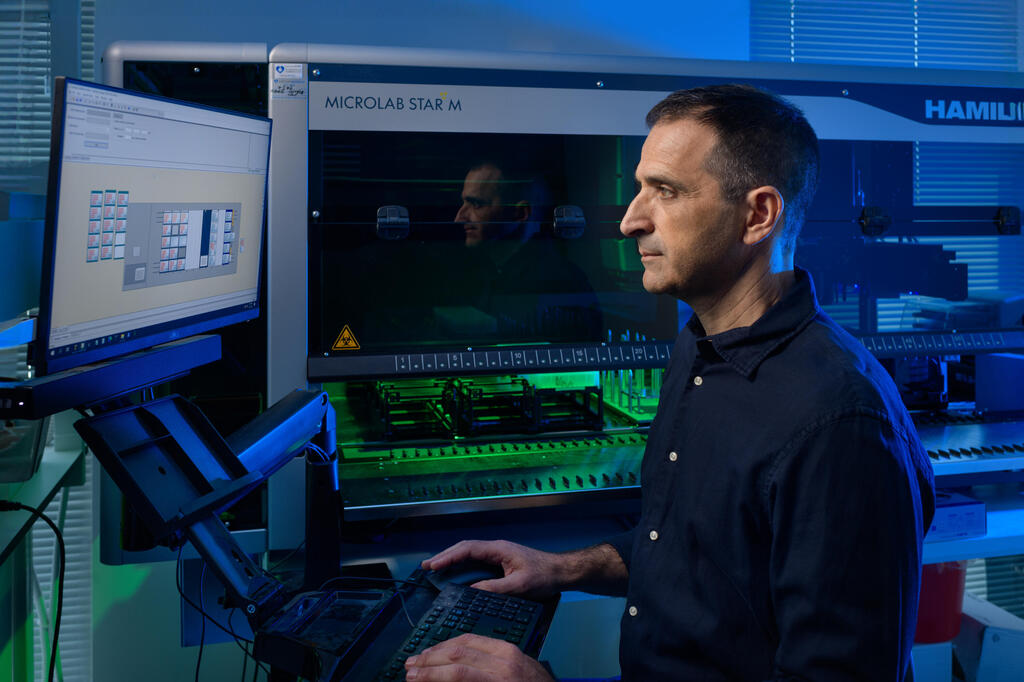
Biolojic Design began in the basement of Ofran’s laboratory at Bar-Ilan University, near Tel Aviv. His description of the origin puts the company close to the research, in a physical as well as an intellectual sense. The work concerned molecular recognition: how particular proteins bind to particular targets.
That origin makes the founder’s task unusually concrete. A research question had to become a design process. The process needed people, equipment and a way of keeping the work going. The move from laboratory to company added obligations around the science rather than removing the science from view.
His Bar-Ilan laboratory combined computational methods with experimental tools. Its interests included biological networks and molecular interactions, along with methods for predicting and designing those interactions. Computation and experiment sat inside the same research programme. The model proposed something; physical work supplied another way to examine it.
The combination gives the photograph its interest. There is a computer, but there is also a substantial machine beside it. A prediction has somewhere to go after it leaves the screen. The equipment is a useful corrective to the idea that a computational business necessarily exists entirely inside a laptop.
When the customer’s question became too small
The company did not arrive fully formed in its present shape. Founded in 2008, Biolojic initially operated as a service business. Other companies brought projects; Ofran and his colleagues worked on the requested designs. It was a way to apply their capabilities to problems someone else had chosen.
By his 2021 account, that arrangement had become restrictive. The team was depending on its customers’ imagination to determine the work. Several years earlier, Biolojic had given up that source of income and begun building projects of its own. Financing from aMoon helped support the new direction.
It was a business decision with an intellectual consequence. Choosing the problem became part of the company’s job. The change also explains why the biography needs more than a founding date. A business can continue under the same name while changing the basic bargain that organizes its days.
The founding CEO hands over the keys
Aulos offers a second example of an organization changing shape around the work. Biolojic Design and investment firm ATP formed it in late 2020. Ofran was its founding CEO. On March 15, 2021, Aulos appointed Aron Knickerbocker chief executive and a board member. Ofran continued on the board.
The handover is worth keeping in the foreground. Founding a company and running it through every subsequent stage are separate responsibilities. Aulos’s announcement identified an incoming executive with experience building companies and partnerships. The organization was assigning those responsibilities to someone whose previous work matched them.
Ofran’s current titles preserve that distinction. At Aulos he is chief scientific officer; at Biolojic Design he remains chief executive. Micah Pearlman appears in the leadership of both organizations as chief operating officer. The names make the institutional connections visible without requiring the founder to occupy every chair.
The same precision helps with the commercial numbers. Biolojic’s June 2024 collaboration with Merck KGaA, Darmstadt, Germany, included an upfront payment in the low double-digit millions of euros, research funding and eligibility for milestone payments of up to €346 million, plus royalties. Those milestones were contingent payments. The agreement described a programme of future work.
That is where a founder’s job acquires its less cinematic texture: arranging teams, funding and responsibilities so a technical idea can keep moving. The announcement supplies the terms. The organization has to do the work.
A life larger than the job description
Ofran lives in Tel Aviv. His public reflections on leadership include a firm objection to calling a company a family. It is a boundary he asks his human-resources teams to respect. Professional importance, in his account, has limits; family relationships occupy another place.
The distinction suits a career that resists compression into a single title. There is the researcher studying molecular contact, the lecturer explaining function, the host examining inherited stories, and the founder deciding which organization a project needs. Each role asks something different of him.
The dinner-table question makes a fitting beginning because it leaves the rest open. A question can take you to a book, a laboratory, a television studio or a board meeting. Ofran has spent a working life following several of those routes. The interesting part is how often he has been prepared to reconsider the destination.