The first XX house had two bedrooms and one bathroom. Four startup teams moved in. In San Francisco, where introductions can function like a private currency, this was an unusually literal way to bring people into the same room. The accelerator had selected six teams altogether. The arrangements were cramped. The ambition was to give promising founders the capital, advice and company they needed to get moving.
- XX paired first checks with small cohorts and experienced founder mentors.
- Its original program ran from 2018 to 2021, beginning with female founders and expanding internationally.
- A 2020 public demo day let everyday investors participate from $100.
XX developed at Wefunder, the equity crowdfunding platform. Its early customers, in the practical sense, were people trying to turn a young company into something that worked. Its product bundled investment, feedback and access to other founders. The interesting question was how early that bundle could become useful.
01 / The invitation came first
Jiwon Moon’s account of building XX begins with conversations. She talked to founders and investors, and came away convinced that money alone would leave too much unfinished. Founders needed advice from people slightly further along. They also needed relief from the fundraising cycle that kept pulling them away from their products.
Moon and Jacqueline Hoang helped assemble the first program. Early recruitment was uneven: direct emails to founder organizations disappointed, and publications declined to cover it. Meeting people in Atlanta proved more productive. That detail matters. A program designed to reach beyond established networks had to leave its own neighborhood to find some of its participants.
The Female Founder Fund’s public thesis made the destination explicit: help women at the beginning, concentrate on building products and talking to users, and prepare them for Y Combinator. XX was proposing an earlier rung on the ladder. A subsequent program focused on immigrant founders, with housing and pro bono immigration advice among its promised support.
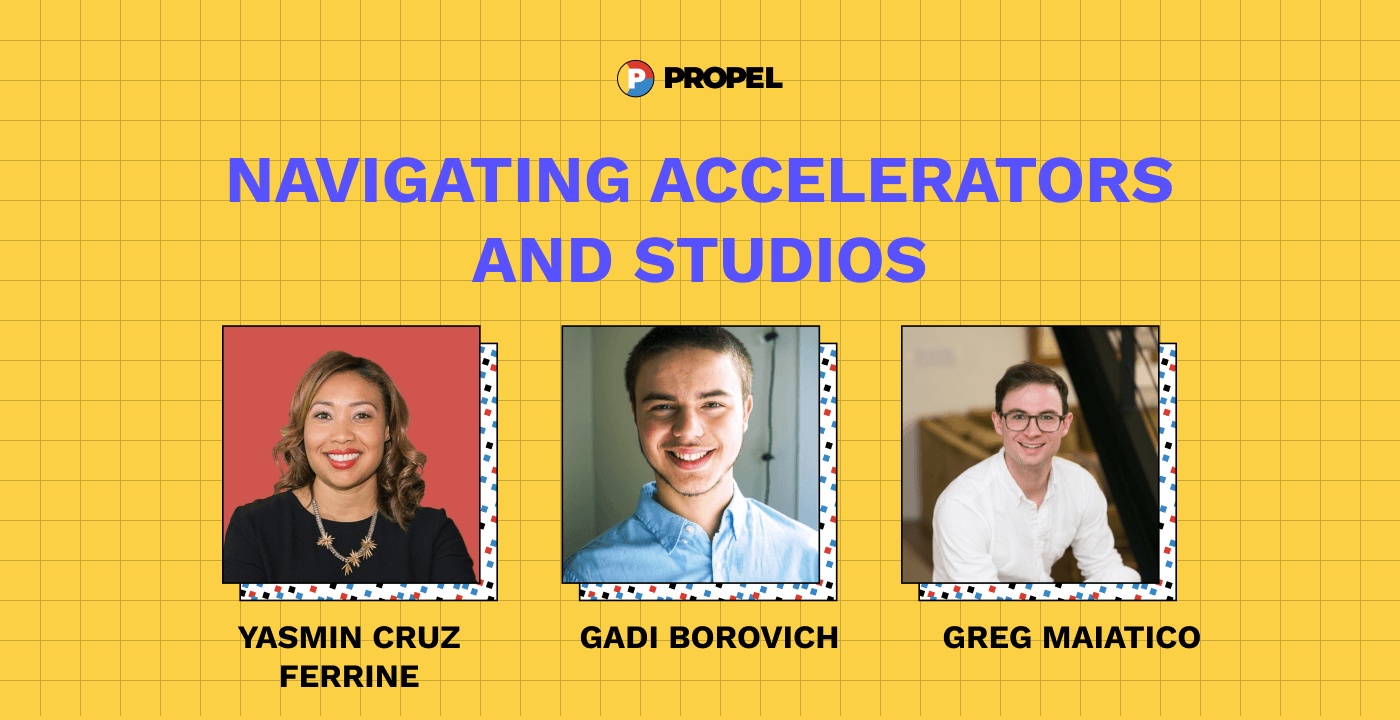
“Ultimately we just don’t want to waste founders’ time.”
Gadi Borovich · Propel interview, 2021
02 / A week with something to show
By 2021, partner Gadi Borovich described an internationally oriented program working with very early teams, typically with at least one technical co-founder. The operating rhythm was deliberately spare: partner calls, group show-and-tells, mentor office hours and conversations with experienced founders. The goal was progress toward product-market fit over twelve weeks.
A participant writing as Ardy supplied the calendar’s texture. Tuesdays brought a ninety-minute workshop. Thursdays included a ninety-minute show-and-tell, with six minutes to present each startup, followed by questions and feedback. Thursday dinners brought further conversations and introductions. This was a schedule built around returning to work with something specific to try.
The useful mechanism is easy to borrow. Put a few builders together, give each a recurring deadline, and ask for a demonstration. Peers can remember last week’s promise. Advice becomes easier to examine when everyone can see what happened after it. That is an interpretation of XX’s format, rather than proof that the format caused any particular company’s success.
03 / The check had a price
Ardy’s account also makes the economics tangible. His cohort received $70,000 through a SAFE capped at $3.5 million, described as roughly 2% of the company. He reported that the following cohort’s offer was dropping to $50,000 at a $2.5 million cap. Those figures belong to that period and those cohorts.
Relocation carried another bill. He found a room with a private bathroom for $1,450 a month and put his own living costs around $8,000 for the stay. Last-minute planning complicated finding accommodation. His initial skepticism eased after meeting the team and receiving the investment. The same firsthand account contains both the endorsement and the friction.
For XX, the business model involved taking an investment interest in startups. For founders, the calculation included dilution, living expenses and time. That makes the fit fairly concrete: someone unable to relocate for an in-person cohort would face a different proposition from someone already living nearby. Access to a useful room still depends on being able to enter it.
04 / Small room, open demo day
The pandemic changed the setting. XX moved its work online and backed companies responding to COVID-19. In July 2020, Wefunder announced that seventeen selected startups had received $50,000 each, with thirteen ready for that month’s public demo day. The companies addressed problems ranging from health to remote work and delivery.
Fight the Virus · July 2020 · A readiness snapshot, not a survival rate.
People outside the usual investor invitation list could participate through Wefunder. Selection remained concentrated; participation in the financing widened. For a founder, the combination offered initial backing followed by a route to a larger community raise. For the public, it opened an investment opportunity normally encountered much later, if at all.
Immersed, the virtual-reality workspace company, offers a concrete example. Wefunder reported in February 2021 that the XX participant raised more than $1 million in a day and passed $2 million shortly afterward. That is one campaign’s result. It shows what the financing route could do without turning every accelerator admission into a prediction.
The market position was unusually specific. XX could help a team too early for a conventional venture conversation, while the crowdfunding platform offered another financing step afterward. Mentors contributed operating experience; peers supplied repeated exposure to the actual work. The combination depended on a founder having a product problem that advice and iteration could improve. A company needing years of expensive research would still need capital and expertise beyond what a short cohort could supply.
05 / The room is the lesson
The XX Fund page reports $2 million invested in forty-eight companies across five cohorts. In April 2025, Wefunder CEO Nick Tommarello revisited the original thesis, dated the program’s run to 2018-2021, and said the company was returning to something similar. His memo positioned XX as preparation for founders who might eventually reach YC.
Borovich’s advice gives the experiment its sharpest edge: do not confuse a successful fundraising conversation with a successful business. An investor sees a fraction of what a founder knows. The habit worth carrying away from XX is the weekly return to evidence: a product, a user conversation, a change someone can inspect. Start with people who will pay attention. Give them something to look at next Thursday.