Imagine looking for a document you know someone sent you. You remember the person. You remember the conversation. The filename, naturally, has vanished. Your computer would prefer that you remember the filename. This is a small disagreement about how memory works, repeated across millions of working days. Xobni built its first product on the person’s side of the argument.
- The trick: turn correspondence into searchable profiles, complete with conversations, attachments and social information.
- The audience: people whose work depends on remembering other people, initially inside Microsoft Outlook.
- The price: free basics, a $29.95 search upgrade in 2009, then subscriptions that connected products and devices.
- The ending: Yahoo bought Xobni in 2013. Its hosted services closed in 2014; related features moved into Yahoo Mail.
01 / FOLLOW THE PERSONThe person was the filing system
Founded in 2006 by Adam Smith and Matt Brezina, Xobni belonged to Y Combinator’s Summer 2006 batch. Its name was “inbox” backwards, a suggestion from Paul Graham. The available domain cost $8, according to the company’s naming history. An economical beginning for a business that would eventually raise roughly $42 million.
The name also supplied an accidental usability lesson. The team initially pronounced it with a long “o.” Users preferred a short one, and the company yielded. Even the vowel had to survive customer testing.
Its Outlook plug-in placed a sidebar beside the messages people were already reading. Select a sender and you could see the surrounding relationship: previous conversations, files exchanged, contact details and connections to other people. Instead of asking users to migrate their working lives into another application, it offered a different view of the material already there.
A revealing endorsement came from presentation designer Troy at TLC Creative Services in 2008. His favourite feature was the list of files a person had sent him. It meant he could retrieve a logo without rummaging through old messages. There is an entire product strategy inside that modest example. “Help me find the logo” is a better starting point than a grand declaration about the future of communication.
Conceptual product flow. Supported inputs and features varied by product.
The distinction mattered commercially. A search utility helps you locate an item. A contact profile helps you understand the person attached to it. Xobni occupied the space between email search, the address book and personal relationship management. Salespeople and other contact-heavy professionals had obvious reasons to care. So did anyone who had forgotten where a useful acquaintance worked.
02 / TAKE THE MEMORY WITH YOUThe address book learns to travel
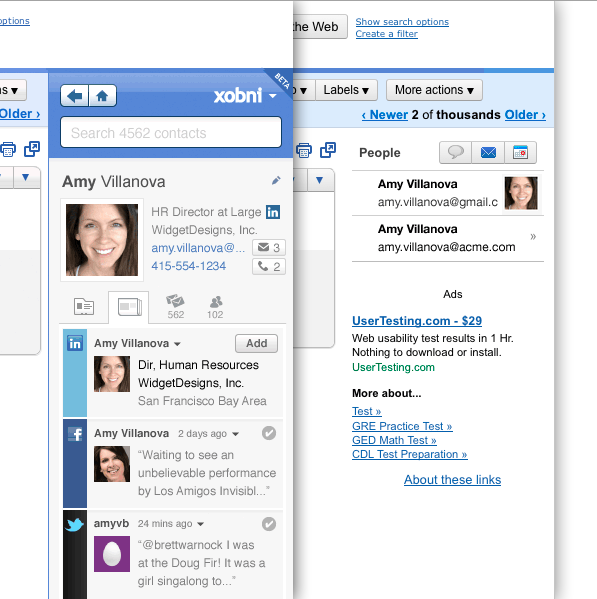
An Outlook sidebar could only remember things where Outlook was available. Xobni’s answer expanded to BlackBerry, Gmail, Android and iPhone. The Smartr products collected contact information and communication context into profiles that could include photographs, job titles, companies and updates from LinkedIn, Facebook and Twitter.
The iPhone app arrived in January 2012. It was free. Its address book ranked people by importance rather than alphabetically, a small rebellion against the notion that the most useful person to call must have a surname beginning with A. An automatic profile could also include someone the user had contacted without ever formally adding them to an address book.
This was Xobni’s broader wager. Communication leaves evidence of relationships. A manually maintained contact list contains only the relationships someone remembered to record. Extracting that evidence saves clerical work; adding shared history makes the result more useful than a directory of names.
It also made Xobni more ambitious than a browser sidebar alone. Rapportive offered a related contact view in Gmail, while native email tools supplied their own search and people features. Xobni argued for an address book that crossed account and device boundaries. The appeal was strongest when your working life crossed them too.
03 / PAYING FOR CONTINUITYA price tag changes the release calendar
Xobni Plus arrived in July 2009 at $29.95 for one computer, with a year of premium support. Its advanced tools included phrase and Boolean searches, conversation filtering and recipient suggestions. The company said those capabilities followed requests from existing users. Basic software remained free: the search upgrade was an attempt to charge for an established habit.
| Offer | Advertised price | Date |
|---|---|---|
| Plus | $29.95, one-time One computer | JUL 2009 |
| Pro | $4.99/month With an annual subscription | MAR 2011 |
| Teams | $5/person monthly or $45/person annually | JUL 2011 |
Different offers at different dates. These are historical prices, not plans available to purchase.
By March 2011, the premium offering had become Xobni Pro, a subscription across supported products. CEO Jeff Bonforte explained the change in practical terms: version licensing encouraged the company to hold improvements for the next paid release and left users on older versions. Subscriptions could fund ongoing releases and simplify access across platforms. The pricing decision changed the engineering calendar.
Teams followed with consolidated billing and transferable licenses. A manager could buy for a small group without procuring a full enterprise deployment. This is a useful distinction: one enthusiastic user installing a plug-in and a department managing twenty licenses are buying different amounts of administrative trouble.
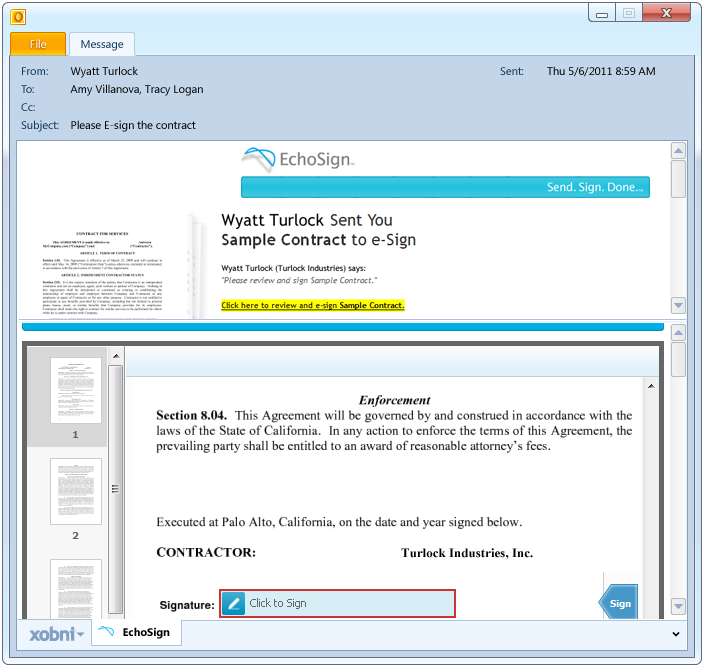
There were ambitions beyond contact cards, too. The EchoSign gadget let someone review and sign a document within Outlook. Nimbb supplied video messaging. These integrations approached the same problem from another direction: email often contains the next task, but completing it sends the user elsewhere. Xobni wanted that round trip to become shorter.
04 / THE HOST GETS A VOTEThe bill inside the sidebar
The attractive simplicity of a sidebar concealed difficult software. In October 2012, co-founder Adam Smith published advice to anyone considering an Outlook add-in. His recommendation was blunt:
“avoid any Outlook addins or desktop software if at all possible”
Adam Smith / engineering advice / 2012
Smith described years of work and millions of dollars, then catalogued the traps: missing archive files, Outlook profiles, object handling and troublesome shortcuts. To a user, the product occupied a narrow column. To an engineer, it occupied a large and awkward collection of compatibility problems.
Performance was an early weakness, and it was not uniformly resolved. A March 2012 business review described freezes and crashes while testing several mailboxes containing about 6GB of messages. Other reviewers reported better experiences. The fair conclusion is that reliability depended on the environment. A tool meant for busy email users could struggle precisely where there was most email to organize.

Xobni’s QA recruiting post treated testing as demanding engineering, with room for creative tools and deliberate attempts to find faults. The affectionate name for the room does not prove the software was dependable. It does show the company understood that making things fail was skilled work.
Browser software offered its own reminder about dependence. In May 2011, Gmail introduced a people widget that overlapped Xobni’s sidebar. Xobni said its engineers corrected the layout within hours. The landlord had rearranged the furniture; the tenant had to adapt. A shared cloud could connect products, but it could not give Xobni control over the interfaces hosting them.

The company also invited outside developers to a Gadget Hack Day in 2011. Building extensions was a way to test what else could fit within the inbox. The gathering made that exploration visible: a room of people trying applications, rather than another list of promised features.
05 / AN IDEA CHANGES OWNERSA feature finds a home
Yahoo acquired Xobni on July 3, 2013. Its annual report placed the purchase within an effort to improve mail across screens. The strategic fit was legible: Xobni brought contact intelligence to a company with an existing email audience. Financial terms were not officially disclosed.
In July 2014, Yahoo closed the hosted Xobni and Smartr services, pointing to features such as recipient suggestions and search centred on people already incorporated into Yahoo Mail. A free Outlook Infinity Edition was offered as a replacement. The standalone service ended; installed desktop software and the underlying ideas had a more qualified afterlife.
For customers who valued one contact layer across several systems, incorporation into Yahoo Mail changed the proposition. The benefit now lived inside a particular provider’s product. An acquisition can preserve a useful capability while narrowing where a customer can use it.
06 / THE USEFUL INHERITANCEBorrow the question, budget for the answer
Xobni’s most portable lesson is to ask what people remember when they need information. Often it is a colleague, client or conversation. Build retrieval around that clue. Another lesson is to inspect the data a customer already creates before asking them to maintain another database. A blank contact form is a remarkably expensive way to forget information the inbox already contains.
The conditions matter. This approach needs accessible communication history, permission to use it and enough reliable infrastructure to turn it into useful results. Frequency of correspondence is also an imperfect measure of human importance. The person who emails you most is not necessarily the person you ought to call.
And anyone borrowing the product idea should borrow the engineering warning. Compatibility, indexing and account connections are part of the work. If the smarter inbox delays the ordinary inbox, the user pays for intelligence in time. Xobni found something worth remembering in old messages. Keeping that memory available was the harder business.