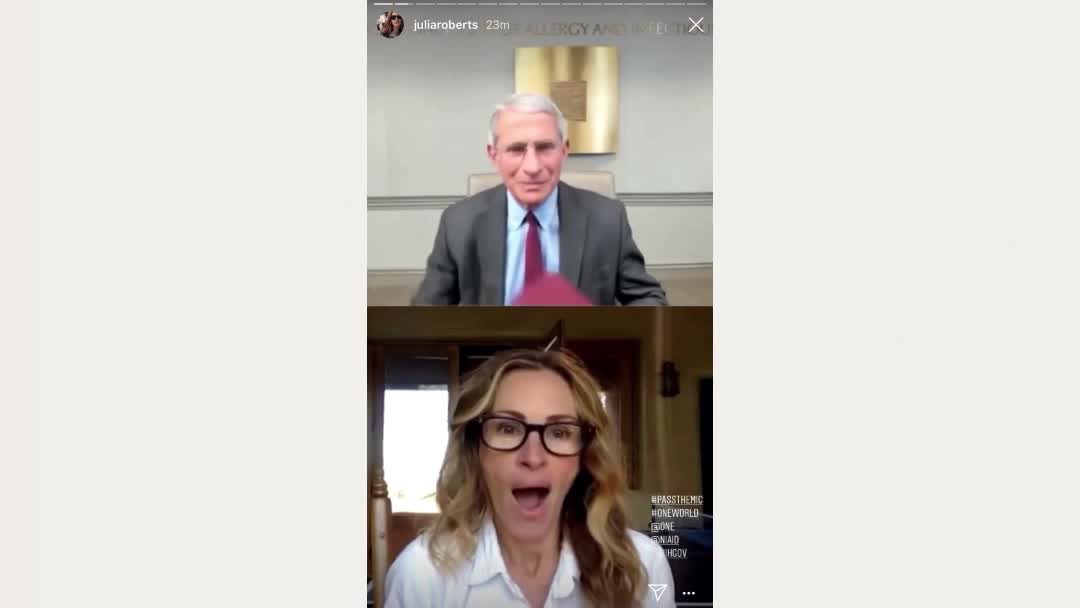
In May 2020, Julia Roberts gave away the most useful thing a movie star owns. Not money. Not an Oscar. She gave Dr. Anthony Fauci her Instagram account. Sarah Jessica Parker turned hers over to a New York emergency-room doctor. Hugh Jackman handed his audience to a public-health expert. For a day, each celebrity became less important than the person speaking through the account.
The campaign was called #PassTheMic, created by WRTHY for ONE during the first bewildering months of COVID-19. Forty-two celebrities handed their accounts to 43 experts. The result was reported as more than 87 million video views, 91 million social actions and 4.3 billion media impressions. Those are advertising numbers. But the idea was almost anti-advertising: fame did not endorse expertise; it got out of the way.
01 / The useful swapThe agency that designs the handoff
WRTHY is a privately held social-impact agency founded in 2017 under the name hive. Its four founders came from adjacent worlds that often meet too late. Jenifer Willig and Sheila Roche had worked at (RED). Erin Thornton had led global policy at ONE. Katie Harrison had spent nearly two decades in brand strategy, including at BBH New York. The group built a company where advertising, policy, advocacy, entertainment and organizational design could sit at the same table before anyone wrote the line.
The company now works across the United States, Europe, Africa and India. Its buyers are foundations, nonprofits, coalitions and companies with a public-interest problem: vaccine inequity, child marriage, online abuse, the racial wealth gap, gender-based violence or climate adaptation. The service menu looks broad - research, strategy, brand building, campaigns, policy, influencer management, new funding models. The connective tissue is narrower. WRTHY finds the person or behavior that can carry an issue farther than institutional language can.
We don't sell anything; it's about taking on complex social problems and getting to something sharp and simple we can communicate.Lew Willig, chief creative officer
02 / Mechanism before messageA ring finger, a game purchase, a listening room
Consider VOW. The problem was child marriage; the available culture was the wedding industry. In 2018, the campaign asked people to post a ring-finger selfie or share a film with #VowForGirls. Brand partners donated a dollar for each action. The first $35,000 target arrived in less than 16 hours. By 2021, VOW had become a stand-alone nonprofit, passed seven figures in contributions and made more than 150 grants to community organizations.
LifePack followed the same logic in a different room. With the Eleanor Crook Foundation, WRTHY created a brand and funding model that invited gaming companies to attach donations for ready-to-use therapeutic food to in-game purchases, creator events and benefits. Gamers did not have to become global-health professionals. They could act through the habits and marketplaces already around them.
The recurring WRTHY move
The model is not limited to donations. For Goldman Sachs's One Million Black Women initiative, the default corporate launch would have been an announcement. WRTHY reversed the direction. Its mantra was: listen to Black women, learn from Black women, invest in Black women, celebrate Black women. Portraits and listening sessions took priority over a self-congratulatory reveal. The financial commitment was Goldman Sachs's - $10 billion in direct investment capital and $100 million in philanthropic capital - while WRTHY's product was the strategy and design that made listening visible.
03 / What changedThe first thing to fail was the default messenger
Across these projects, the discarded idea is usually the conventional campaign itself. In a pandemic, another celebrity opinion would add heat but little light, so the celebrity became distribution. In financial services, another top-down announcement would repeat the problem, so the launch became an exercise in listening. In climate advocacy, another appeal framed only around distant catastrophe risked staying inside the climate audience, so Project Dandelion centered women leaders and Adapt2Win recruited athletes who understand adaptation as daily practice.
That shift matters because attention is not the same as trust. Pandemica used stars to voice an animated world where vaccines were hoarded, but its argument was anchored in a plain global-health fact: an uncontrolled virus keeps circulating. The campaign was translated into 15 languages and nearly 400 creative assets, with a reported $11.4 million in donated media. Scale came from a modular idea that partners could carry, not one expensive placement pretending to be a movement.
04 / The part worth stealingDo not invent a new human behavior
A reader can copy WRTHY's questions without copying its Rolodex. Where has the audience already assembled? Who has earned authority on the issue? What action fits naturally inside the audience's existing behavior? The wedding guest can redirect a gift. The gamer can make a purchase. The sports fan can hear adaptation explained by an athlete. The follower can listen to a doctor without finding a medical conference.
Then comes the unglamorous test: is there machinery behind the gesture? VOW had brand partners funding each social action and community organizations receiving grants. #TakeItDown gave visitors a one-click route to contact policymakers. The public service announcement later entered a Department of Homeland Security school-safety program. Women Moving Millions paired a slogan with a defined capital goal and exceeded its $100 million target by $11 million in nine months. In each case, communication connected to funding, policy pressure, education or institution building.
The catch is structural. Borrowed reach cannot compensate for a vague ask, an unwilling institution or a messenger with no credibility. A celebrity handoff works when the expert is prepared, the audience recognizes the stakes and an accountable organization owns the next step. Without those conditions, impressions remain impressions - a large number describing very little movement.
05 / Where WRTHY fitsToo creative for the deck, too policy-minded for the pitch
The market has ad agencies with purpose practices, public-affairs firms, nonprofit consultancies and influencer shops. WRTHY overlaps all four. Its distinction is not that nobody else can recruit famous people or design an advocacy campaign. It is that senior practitioners from policy, global development, advertising and entertainment are assembled around the same problem, and the answer may be a brand, a coalition, a funding mechanism or a monster-shaped public service announcement.
That breadth can be difficult to explain in a neat procurement box. It is also why the agency's strongest work feels less like a campaign laid on top of a cause and more like new plumbing. Attention flows from the celebrity. Authority comes from the expert or affected community. Money comes from a partner, customer or donor. Public pressure travels toward an institution. WRTHY's job is to connect the pipes without pretending it created the water.
The company remains small - LinkedIn places it in the 11-to-50 employee range - and privately held. It says it donates 10 percent of profits to initiatives that advance gender equality. Its clients include ONE, the Gates Foundation, Wellcome, ChildFund International, Girls Not Brides, Women Moving Millions, Goldman Sachs and the Eleanor Crook Foundation. In 2026, Inc. recognized Willig among its Female Founders 500, citing 60 percent revenue growth tied to new funding models.
There is a revealing humility inside the best WRTHY idea. The famous person is not the point. Neither, finally, is the agency. The point is the handoff - getting the right voice into the room, then making sure the door leads somewhere.