At WASH Multifamily Laundry Systems, most employees did not begin their day at a central office. Field technicians left home, visited customers, and returned home. Asking them how work felt was difficult enough; persuading them that a company survey was confidential was another matter. Earlier reports took weeks or months to arrive. By then, the problem had often changed.
WASH switched to a weekly rhythm with Workday Peakon Employee Voice. It also turned on a feature that let managers respond to comments without publicly identifying their authors. According to Workday's customer account, the language of the feedback shifted from complaints toward constructive suggestions. WASH reported a 71% response rate in a largely field-based workforce and a 37-point rise in employee Net Promoter Score after addressing concerns. Those are the customer's results, not a promise that every company can repeat them. What they show is the difference between merely collecting a verdict and staying in the conversation.
- Peakon sells a loop: ask, interpret, act, ask again.
- Its customers are large employers; employees answer, while managers and HR teams use the results.
- Workday acquired the Copenhagen startup in 2021 for roughly $700 million.
- The software makes signals easier to see. A manager still has to change something.
01 / THE ORIGINFour founders, one missing conversation
The company began in Copenhagen in 2015 with Phil Chambers, Kasper Hulthin, Christian Holm, and Dan Rogers. Three had worked together at Podio, the collaboration software company. They knew that offices had become good at recording tasks and poor at hearing how the people doing those tasks felt. Peakon's wager was that an employee survey should behave less like a census and more like a pulse.

Its timing helped. Employers had spent years conducting large annual engagement surveys, then waiting for HR to clean the data, prepare slides, and hand managers a report. A finding about workload could arrive long after the project that caused it. Peakon offered short, recurring questions and dashboards that updated as responses came in. It launched in 2016, raised a $22 million Series B led by Balderton Capital in 2018, and added $35 million led by Atomico in 2019. The money backed international expansion and product development. In January 2021, Workday announced a cash acquisition valued at about $700 million; the deal closed in March.
“Our accelerated business pace today doesn't allow for once-a-year monster surveys anymore.”Avantor HR leader, describing its move to continuous listening
02 / THE MACHINEFrom a number to a next move
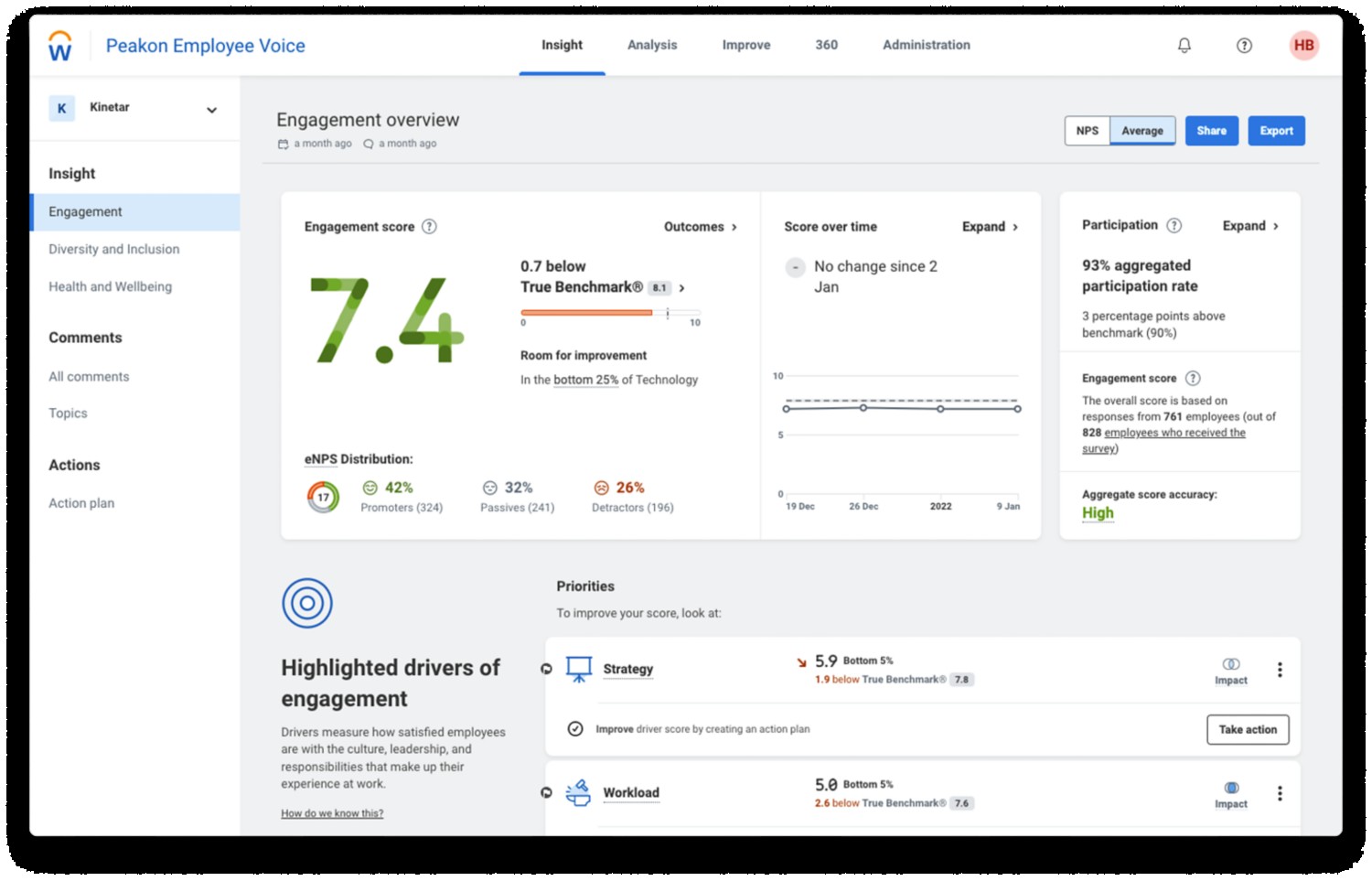
Here is what the product does. Employees receive confidential survey questions on a schedule. Workday recommends weekly automated pulses, though customers can use other cadences. A standard engagement question uses a score from zero to ten; employees can add a comment. The platform organizes responses around drivers such as leadership, strategy, and workload, then shows trends and comparisons to managers and HR leaders. Suggested actions and learning material sit beside the findings. Managers can acknowledge comments and hold confidential, two-way conversations.
The distinction is practical. A survey tool can tell you that six people are unhappy. Peakon tries to tell a manager which issue deserves attention and offers a place to record the response. Its True Benchmark feature puts scores beside comparison groups. Integration with Workday Human Capital Management can keep workforce segments current as people join, move, or leave. Employees can answer through channels including desktop, mobile, kiosk, Slack, and Microsoft Teams. For a company with shop floors and offices across countries, delivery is part of the product, not a minor interface detail.
03 / THE FIELD TESTGetting the factory into the frame
Avantor, a global supplier to science and technology industries, offers a useful example of the product's reach. It started with a global pulse survey, then phased in reporting for executives and managers. The company used translations and kiosk delivery so factory associates could participate. Its HR team connected employee records to Peakon so location and business-unit results stayed aligned. Before that, Avantor said it had waited months for reports; afterward, its leaders could look at feedback as it arrived and adjust programs, including diversity and inclusion work.
Another Workday customer, Suncorp, used the platform to ask targeted questions after a proposed bank sale was announced. The questions were aimed at affected employees rather than the entire company. That is a quieter advantage of continuous listening: when circumstances change on Tuesday, the next useful question need not wait for the autumn engagement calendar.
WASH figures are company-reported case-study outcomes; they are not typical-results estimates.
04 / THE NEW LAYERAI can read the comments; it cannot apologize
Workday has added AI to the reading stage. In late 2024 it announced comment summaries, on-demand analysis by department or location, and rules-based questions for moments such as onboarding and exit. Its AI Topics feature groups comments by meaning, gives clusters a name, and lets leaders look for patterns across segments. The company said its aggregated dataset covered more than one billion responses and 200 million written feedback items from 160 countries. Scale helps a system discover recurring themes; it can also make an executive dashboard feel rather remote from the person who wrote, “I cannot finish this shift.”
The software has guardrails. Workday's documentation describes minimum segment sizes for confidential reporting, and AI Topics requires enough quality comments to generate a useful cluster. These limits matter because a beautifully precise chart about a tiny team may tell a manager exactly who said what. There is a trade-off: the smaller the group, the more tempting the detail and the more precious the trust. The product can protect an aggregate. An employer must still explain the rules clearly enough for employees to believe them.
05 / THE BUSINESSWhy Workday wanted a listening habit
Peakon is now an enterprise subscription product inside Workday's HR software portfolio. A buyer is usually an HR leader or executive seeking a common view of engagement across many teams; managers are the daily operators; employees are the people being asked. The alternatives include Culture Amp, Qualtrics EmployeeXM, Gallup Access, and a company's own survey program. Peakon's particular pitch is the combination of frequent, personalized questions, benchmark data, AI-assisted analysis, and action plans inside a broader Workday ecosystem. Public list pricing is not posted on its product page, so the commercial discussion happens through Workday sales.
There is a sensible way to borrow the idea without buying the software. Ask a small number of useful questions regularly. Tell people who will see the answers and at what group size. Bring one result to a team meeting, choose one change within the manager's power, and ask later whether it helped. WASH's story suggests that response changes the texture of feedback; Avantor's suggests that access for deskless workers must be designed deliberately. Both point to the same unglamorous task: making time for a reply.
The annual survey often failed first at the handoff. Employees spoke, HR summarized, and the report settled into a drawer. Peakon made the handoff faster and easier to inspect. Its most honest measure, though, is not the frequency of the questions or the elegance of the chart. It is whether the next survey finds that someone listened.