On October 28, 2021, law librarians learned that Cheetah, a research platform from Wolters Kluwer, would become VitalLaw the following Monday. A name change sounds like a marketing department’s afternoon. For a librarian, it can mean fixing catalog records, rewriting instructions, and asking IT to approve a new domain. The announcement arrived with a very small weekend attached.
- The business: specialist legal knowledge, sold through research subscriptions and workflow software.
- The shift: help professionals turn information into memos, comparisons, contracts, and compliance work.
- The catch: useful technology still has to fit the customer’s existing working habits.
Jean O’Grady, the law librarian and writer behind Dewey B Strategic, described the concerns. Ken Crutchfield, then the company’s Legal Markets chief, acknowledged that “we could have provided more advanced notice to the broader community.” The research product was expanding. The people responsible for making it accessible were scrambling. Both things were true.
The library was already a system
That episode offers a useful way into Wolters Kluwer Legal & Regulatory U.S. Its customers buy legal information, but they depend on an arrangement: publishers, librarians, lawyers, authentication systems, familiar titles, and reliable links. Change one piece and somebody else acquires a task. A better database must survive that journey before its improvements count.
The U.S. business belongs to Wolters Kluwer, the Dutch professional-information group. Its history includes the parent’s $1.9 billion purchase of CCH in 1996, followed by additions in benefits expertise and software. This is an accumulated publishing and technology business. Its raw material includes specialist commentary and the judgment required to explain a rule’s practical consequences.
VitalLaw launch · November 2021
VitalLaw’s November 2021 launch added comprehensive federal and state laws and regulations, including future effective dates. The rename accompanied a content expansion of more than 40%. Customers retained familiar credentials and workflows. Seen from the publisher’s desk, this was more material in a recognizable tool. Seen from the library desk, the label itself was infrastructure.
An answer needs a way home
Now the interface is changing more substantially. In September 2024, Wolters Kluwer announced generative AI functionality for VitalLaw. Professionals could ask questions, summarize documents, and generate draft checklists or other work product. The familiar progression from query to results list began to accommodate a different progression: question, answer, follow-up, draft.
The distinctive ingredient is the material underneath. VitalLaw’s product page describes contributions from over 1,200 practitioners and 99 Am Law 100 firms. Those are content contributors, not a customer count. The offering pairs primary law with commentary from people who work through its complications. That makes the explanatory layer part of the product’s value.
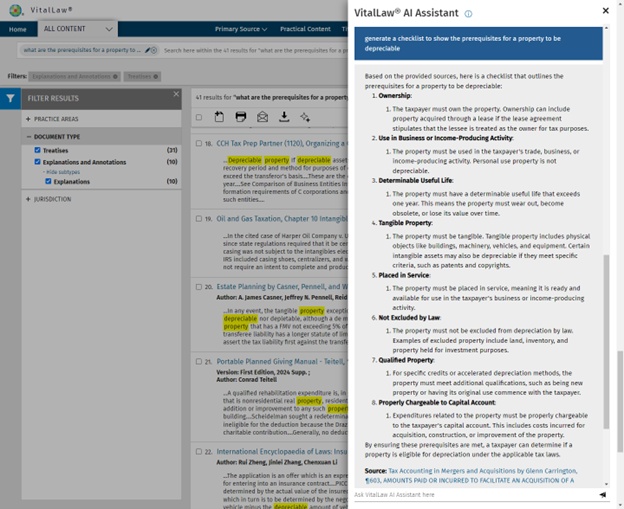
VitalLaw Expert AI adds editorially enhanced questions and answers, conversational research, and practical content generation. Its published features include footnotes and pinpoint citations. These matter because a legal answer must lead back to something inspectable. A plausible paragraph is easy to read. Finding the provision, qualification, or exception that supports it is the professional’s harder obligation.
A legal answer must lead back to something inspectable.
The product test
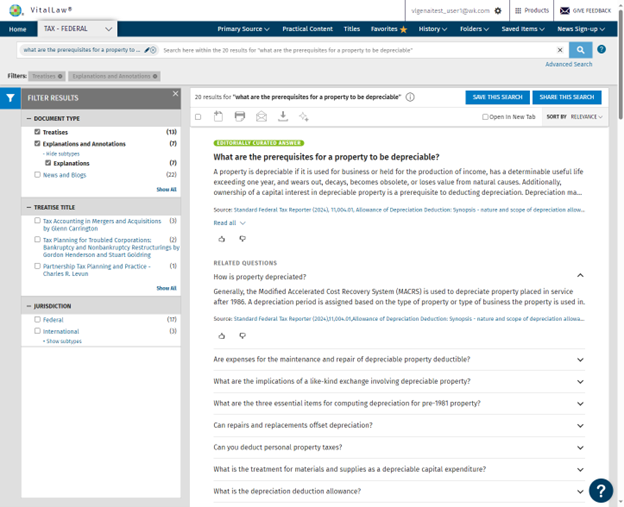
A Brooklyn Law School librarian’s account of a March 2025 demonstration supplies a useful limit: the AI’s answers linked to sources within the user’s VitalLaw subscription. Access defines the research boundary. A buyer should therefore test an actual assignment against the libraries being purchased, then inspect the cited documents. Fluency cannot repair a coverage gap.
Different desks, different jobs
The portfolio reaches well beyond the research screen. Legisway, whose enhanced U.S. version launched in September 2022, helps corporate legal departments manage their own information: contracts, entities, claims, and matters. Its alerts, reporting, document automation, and intake tools address a recognizable problem. The contract exists somewhere; the renewal date needs to reach someone.
Legisway says more than 1,000 corporate legal teams use it worldwide. Its website includes a testimonial from Interstate Waste Services about remote access to files. That is an unglamorous, useful ambition: make legal information available where the work happens. Researching an obligation and locating the agreement that contains it are neighboring jobs, with different tools.
Elsewhere, ftwilliam.com serves retirement and employee-benefits professionals with cloud documents, forms, and compliance systems. MediRegs supports healthcare coding, reimbursement, and regulatory work; Providence Health Plan appears among its published customer testimonials. Kluwer Arbitration supplies specialist international-disputes research. Each product targets a particular professional’s recurring encounter with complicated rules.
The chart has a tomorrow
The clearest recent expression of this approach arrived on June 9, 2026. CCH Jurisdictional Compare addresses research across multiple jurisdictions. According to the launch announcement, the team co-built it with dozens of customers over the preceding year. The product combines scoping, legal comparison, shared review, and indicators showing when underlying sources change.
- 01ScopeDefine the issue and jurisdictions.
- 02CompareExamine meaningful legal differences.
- 03ReviewShare, verify, edit, and retain history.
- 04MaintainSee which answers a source change affects.
The official product page names Newcode.ai as the technology powering the solution. The attraction is straightforward: a comparison chart needs upkeep after delivery. Maintaining the relationship between an answer and its changing legal basis is valuable work. The software’s proposition extends through that maintenance, rather than ending when the first chart looks presentable.
Buy the task, then test the tool
This business earns money from paid information subscriptions, software, services, and content licensing. Costs depend on the product and arrangement. One regional Legisway page advertises annual plans starting at €8,000, €13,000, and €16,000. Those figures are regional starting prices, not U.S. quotes. Buyers also need to account for configuration, adoption, and the time required to review outputs.
Westlaw and Lexis+ are alternatives in legal research. Wolters Kluwer’s case rests on the fit between specialist content and the task at hand. That fit is conditional: a team needs relevant coverage, usable internal records, and qualified reviewers. ftwilliam.com explicitly reserves its document and compliance modules for experienced ERISA professionals. Expertise remains an input.
The lesson readers can copy is modest and practical. Pick one recurring assignment. Follow it from the first question to the checked deliverable. Invite the people who maintain access and records into the evaluation. Test what happens when a rule changes. The librarians understood this in 2021: the product’s real boundary is wherever the customer’s work continues.