In December 2023, Wolter Smit was on the telephone with a local reporter when the conversation acquired an unusually small radius. His office was beside the broadcaster’s studio in Delft. They tried to spot each other through their windows. Here was the co-founder of a software business with offices across eleven countries, discussing a roughly €200 million investment while attempting the oldest communication protocol available: a wave.
The scene suits him. Smit’s business has grown across borders; his explanations tend to stay close to ordinary life. A helpful neighbour. A colleague who answers a question. A pub conversation with a friend. He has spent much of his career turning these modest encounters into arguments about how companies should work. The software can become more elaborate. The person needing help remains a person.
That afternoon, he was explaining why TOPdesk would accept outside capital for the first time. After thirty years of building with its own resources, the company wanted to expand faster abroad. Smit spoke about bringing in experience rather than having to invent everything again. He also had a characteristically expansive idea of ownership. In English translation: “It isn’t only my company. It also belongs to our 1,000 employees.”
A thirteen-year-old with a programming book
Long before the investment announcements, Smit’s father brought home a Commodore 64. At thirteen, Smit preferred burying himself in programming books. He later described his younger self as an enormous nerd, a description offered without the air of someone seeking a more fashionable childhood. The computer gave him something to do with that appetite: he could make things happen by writing instructions.
He studied applied physics at Delft University of Technology. At seventeen, he was already working as a programmer at a small IT business alongside his studies. His friend and eventual co-founder, Frank Droogsma, worked on the help desk. Between them, they encountered both sides of the same difficulty: someone needed assistance, and someone else needed to keep track of it.
This is a less cinematic starting point than a grand prediction about the future. It is also a useful one. A help desk makes the shortcomings of an organisation visible. Questions recur. Information goes missing. Work sits unresolved. Smit could see tasks that software might make easier. Droogsma had experience of the desk where those tasks arrived.
In 1993, development began in an attic in Delft. The first version launched in 1994. By 1997, customers and staff had made the attic too small, and TOPdesk moved into a larger office. The founders had begun with a ticketing tool, a way to record and organise requests. There is something pleasingly literal about a business outgrowing its roof: eventually, even an idea needs somewhere to put the chairs.
Delft attic
launched
for a growing team
The expansion plan began in a pub
In Smit’s recollection, a conversation in a Delft pub in 2004 supplied the next nudge. A college friend with connections in Foreign Affairs asked why he did not set up overseas. TOPdesk already had more than 100 employees and supported more than 1,000 customers in almost twenty countries. The customers had crossed borders ahead of the offices.
Germany became the first international office. Branches followed in the United Kingdom, Belgium, Hungary, Denmark and Norway. Brazil opened in 2013, the company’s first branch on another continent. Further expansion brought offices in the United States, Canada and Australia. Looking back as 2022 approached, Smit noted that more than half the company’s people lived outside the Netherlands.
What interested him was how to carry a way of working into another country. He credited careful choices of the first team and trust in those people to establish the culture locally. The pub question was simple; the answer involved years of people making decisions at a distance. International expansion gives a founder plenty of opportunities to discover whether his favourite principles survive without him in the room.
Brazil added its own lessons. Smit recalled that differences with a reseller’s approach helped prompt TOPdesk to establish its own operation there. A Dutch consultant who spoke Portuguese was part of the opportunity. Smit was struck by the scale of São Paulo and by a warmer style of greeting colleagues. He also challenged the familiar complaint about Brazilian bureaucracy, finding its government portal more modern than some Dutch paperwork habits.
The neighbour theory of management
Ask Smit about workplace culture and he is liable to take you out of the workplace altogether. In a 2019 essay, he described neighbours helping him and his wife go out by keeping an eye on the baby monitor. Nobody negotiated a fee. The favour could be returned later, perhaps by watering plants during a holiday. Trust removed the need to turn every small kindness into a transaction.
Applied to a company, the idea is straightforward: helping someone should not require an immediate reward. A new employee asking a question ought to receive an answer, or an introduction to someone who knows. Knowledge becomes more useful as it passes between people. The neighbour analogy is memorable because almost everyone knows the difference between a street where you can knock on a door and one where you would hesitate.
He is less persuaded by the visible accessories of office happiness. Visitors notice table football and Nintendo Wiis. Smit has written that these gadgets do not explain why people enjoy working somewhere. A games console can occupy a corner. It cannot make a colleague generous with their time, nor persuade a manager to listen. There are limits to what can be purchased from an electronics shop.
“I’m proud to be an IT geek.”
Wolter Smit, 2016
His argument has teeth. In his 2016 writing, he described rejecting talented candidates whose interpersonal qualities did not fit the company’s expectations, even when that constrained growth. He also expected managers to challenge behaviour that undermined cooperation, including keeping knowledge to oneself. Trust, in this account, requires someone to defend it. Friendly principles become much more interesting when they influence an inconvenient hiring decision.
Smit has taken that concern beyond TOPdesk. In January 2021, he became chair of the Delft circle of VNO-NCW, succeeding Joris Kleinveld. He wanted smaller gatherings where owner-directors could exchange experiences and learn from one another. It was a recognisable extension of the same instinct: create circumstances in which people can ask useful questions, then make the answers easier to share.
Thirty years before the outside money
The December 2023 investment announcement put numbers around the scale that this approach had reached. TOPdesk had fourteen offices in eleven countries, more than 1,000 employees and over 5,000 customer organisations. CVC Growth Funds agreed to invest approximately €200 million for a significant minority stake. The founders would retain majority ownership. For a business that had spent decades without outside capital, this was a substantial change in company.
The business at the December 2023 announcement
Smit’s own announcement added that revenue had exceeded €100 million. He emphasised the range of prospective partners and the importance of experience, social responsibility and respect for TOPdesk’s existing character. Money arrived with a question that founders rarely get to retire: how much can change while the organisation remains recognisable to the people who built it?
The ambition was clear. TOPdesk wanted to reach more customers and strengthen its position in other countries. Smit and finance chief Rob Haaring would work with the investor on the next phase. Choosing a minority investment kept the founders in majority ownership, but it also brought another set of people into discussions about the future. His neighbourhood had acquired a financially consequential new resident.
The programmer wants everyone to have a go
In 2017, Smit wrote to the incoming Dutch education minister, Arie Slob, arguing for programming to become part of school education. His own early fascination with code was the personal evidence behind the appeal. He said that understanding programming continued to help him even though writing software was no longer his everyday job.
The argument was broader than recruiting future developers. Learning to program gives someone an encounter with the way a computer follows instructions. It makes an apparently mysterious machine available for experimentation. Smit wanted children to have that opportunity rather than simply consume what appeared on a screen. The teenager with the programming books had become an employer asking schools to open the same door.
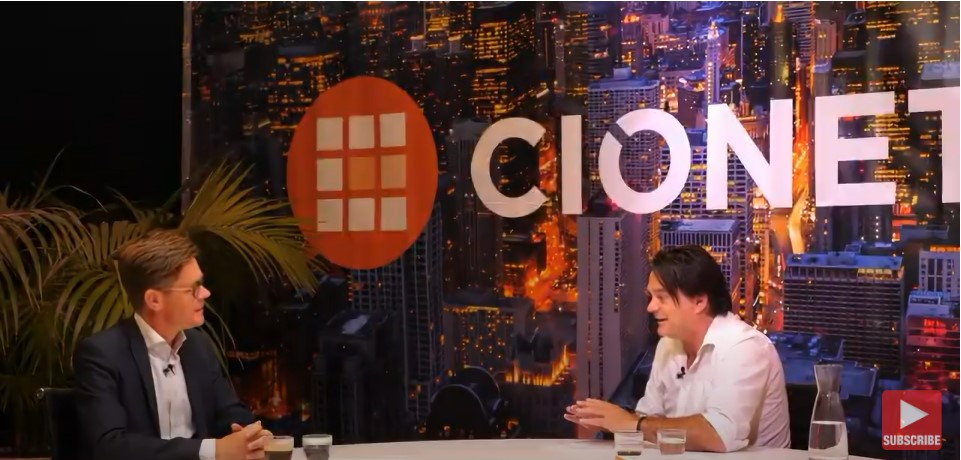
He has also remained a public explainer of the work itself, writing columns on service management and appearing in interviews. In a 2023 conversation with Herman van Bolhuis, the subject was Service Flux: improving service through small, continuing changes and adapting useful practices to the organisation at hand. It is a practical philosophy for someone whose business began by noticing repeated difficulties on a help desk.
AI still needs someone to write things down
On 16 September 2026, Smit took the stage at TOPdesk Unlocked in Utrecht and announced TOPdesk Robin, an AI assistant built around an organisation’s knowledge and processes. More than 500 service management professionals attended, with another 500 watching online. The announced rollout was to begin in October. Searching, summarising and producing first drafts were among the tasks it was designed to assist.
His recent comments about AI return to a familiar concern: information that stays inside one person’s head cannot easily help everyone else. In an October 2026 interview, he described the need to capture organisational knowledge and choose applications that can tolerate uncertainty. He also said he still likes programming in his spare time and sees AI’s capabilities there firsthand.
There is continuity between the attic and the stage. In both settings, Smit is concerned with work that becomes needlessly repetitive because useful information is hard to find. The technology has changed from an early help desk application to an AI assistant. The social task persists: persuade people to record what they know, make it accessible, and leave room for judgement when a situation needs it.
Back at the windows in Delft, a wave was enough to establish a connection. Across an international software company, the arrangements are more complicated. Smit’s career has been an extended attempt to make them simpler. He keeps returning to the person at the other end of the request, and to the colleague who might know the answer. After three decades, he is still finding work for the helpful neighbour.