Wilson Bright found something useful in a cardboard box. After trying digital note-taking tools, he assembled a physical Zettelkasten: index cards, one idea on each, connections made by hand. He described sorting through the box weekly, putting thoughts where he could find them again. A founder working on AI-powered surveys had given himself a decidedly manual way to think.
Bright’s interest in information takes several forms: how it is collected, who controls it, and whether anyone makes sense of it afterwards. A survey can gather thousands of answers and still leave the important question unanswered. A note-taking app can preserve a thought so successfully that its owner never sees it again. Storage has excellent manners. It will accept almost anything.
Bright’s company, BlockSurvey, grew out of a more consequential version of that problem. He and co-founder Raja Ilayaperumal were building software around a basic concern: people should retain control over the data they collect. Today, Bright is the CEO of a platform that combines private surveys with AI. The interesting part of his story is how that concern travelled through the practical business of getting people to use, and eventually pay for, a product.
The tester starts asking questions
Bright studied computer science engineering at Karunya Institute of Technology and Sciences in Coimbatore. Before BlockSurvey, his work included quality assurance at Fidelity Investments and business systems consulting at Wells Fargo Securities. These were roles inside established organisations, dealing with systems that had to work for people beyond the person who wrote the code.
The move into entrepreneurship came with preparation. He has described saving enough money for a couple of years of runway before striking out. His initial BlockSurvey prototype took three days to build during a Stacks hackathon, and he launched it on Product Hunt. The short build makes a tidy origin story. The savings make it a more useful one. Three days of coding can be preceded by years of arranging a life in which those three days are possible.
The problem was close to the work he was already doing. Using surveys to test ideas, Bright wanted encryption that would keep the platform itself from reading the answers. The tool used to investigate an opportunity became the opportunity. It is a pleasing occupational hazard: ask enough questions about your tools, and occasionally you acquire a business.
He had found a familiar category with a different requirement. People already understood online forms. The challenge was persuading them to care about what happened behind the form, after the last field was filled and the polite thank-you appeared.
Sixteen customers, counted carefully
In October 2020, Bright shared a milestone: $500 in monthly recurring revenue. There were 12 personal members and four enterprises. He and Raja had made their hackathon project a full-time undertaking, and the early subscriptions gave them something concrete to build around. The numbers were small enough to fit comfortably in a sentence.
They are also more revealing than a grand ambition. At that scale, growth has names attached to it. A customer’s request can change the day’s work. A subscription provides evidence that a problem deserves a place in somebody’s budget. There is very little distance between the conviction and the invoice.
Earlier that year, Bright had written about winning the first enterprise client. He had been hesitant to take the product to market in uncertain circumstances. Mentors at Afthonia encouraged him to sell and help organisations with employee experience. His announcement thanked those mentors, the Indie Hackers community and Blockstack. The company’s progress involved people willing to advise, encourage and try the thing.
Bright’s hesitation is recognisable. Building a product does not automatically make its builder comfortable selling it. Explaining its value to an organisation requires another set of questions: who needs it, who approves it, and how it fits into work already underway. The first enterprise client was a commercial event and an occasion to acknowledge the people who had helped him reach it.
A survey with a locked filing cabinet
By 2021, BlockSurvey had been selected for YourStory’s Tech50. Bright described a system in which the company did not possess the keys needed to unlock customers’ data. That arrangement came with responsibility for the user: in the original model, losing the keys meant losing access. Ownership had practical consequences, rather than existing solely as a reassuring word on a website.
“We don’t have the keys to all your data.”Wilson Bright, 2021
He also described the first ten paying customers as a significant milestone. Free survey products were already available. Some people nevertheless chose to pay for the privacy proposition. That decision supplied a direct answer to the question hanging over the business: could control of data become a reason to buy?
Think of a questionnaire as a filing cabinet with a friendly interface. The questions are visible. The cabinet’s location, lock and spare keys usually receive less attention. Bright’s approach brought those backstage arrangements into the product’s purpose. An organisation asking people to be candid must consider more than the wording of its questions. It must consider the terms on which that candour is received.
Useful little things at the front door
Bright’s next problem was discovery. In a March 2023 podcast, he described using product-led SEO, drawing on Eli Schwartz’s book of that name. The team made smaller tools and templates that could bring people to BlockSurvey through search. Among the examples were privacy-focused QR codes and email bounce checkers. He described having more than ten micro tools alongside a large collection of templates.
The approach suited a product whose audience could appear in several different settings. A person might arrive needing one modest task completed, rather than looking for a new survey platform. A useful utility could begin the relationship. It gave Bright a way to learn where demand actually appeared instead of deciding the entire audience in advance.
There is a certain civility to the idea. Before asking someone to consider the larger product, help them finish the small job that brought them there. Of course, a free tool still takes work. Bright’s discussion included the need to support users and maintain quality. Giving software away does not spare its maker from answering questions about it.
He later worked with SaaS Growth Agency on conversion and sales processes. Their published account describes refining the path from search traffic to active users and qualified calls. The founder’s work had expanded from making the software to making its usefulness easier to recognise. A busy prospect cannot be expected to perform archaeological work on a signup page.
Keeping the machinery out of the way
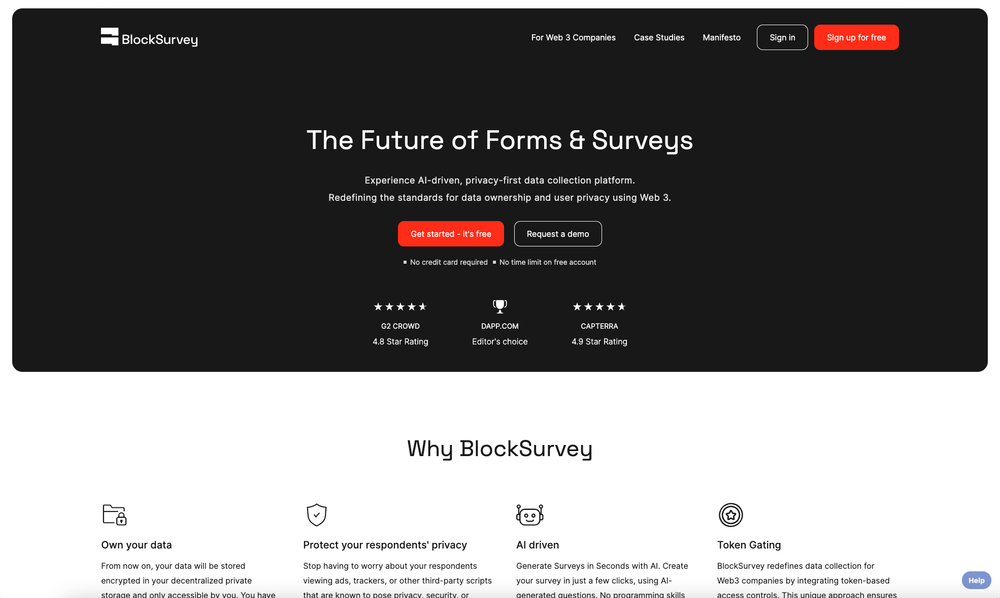
In April 2024, Bright described a ten-person team supporting more than 500 customers. A focus on Web3 brought specific uses, including token-gated surveys across more than ten networks through Quicknode’s infrastructure. For a community, that meant asking questions of a defined group of holders rather than leaving every form open to everyone.
His role included strategic direction and daily operations. Those two phrases cover a wide distance. Strategy decides which customer problem should matter next. Daily operations confront what the existing customer needs today. A founder has to travel between them without expecting either to wait indefinitely.
By June 2024, he reported $15,000 in monthly recurring revenue. In discussing the technology, he also advised builders to emphasise tangible benefits for customers who were unfamiliar with Web3. The machinery could remain in the background. The person using a tool needed to understand what it enabled.
That advice fits the product’s history. The ambition concerned ownership; the experience still needed to be a usable survey. People filling in a form have already agreed to spend time answering questions. Requiring them to take an additional interest in the software’s infrastructure would be a rather expensive courtesy.
The generalist meets the follow-up question
Bright’s interests extend beyond the office. A 2025 podcast profile describes organ playing in a small Bangalore church, philosophy and skateboarding. It also recounts a quiz question about satoshis in 2012 that led him to study Bitcoin. A correct answer became an invitation to investigate further.
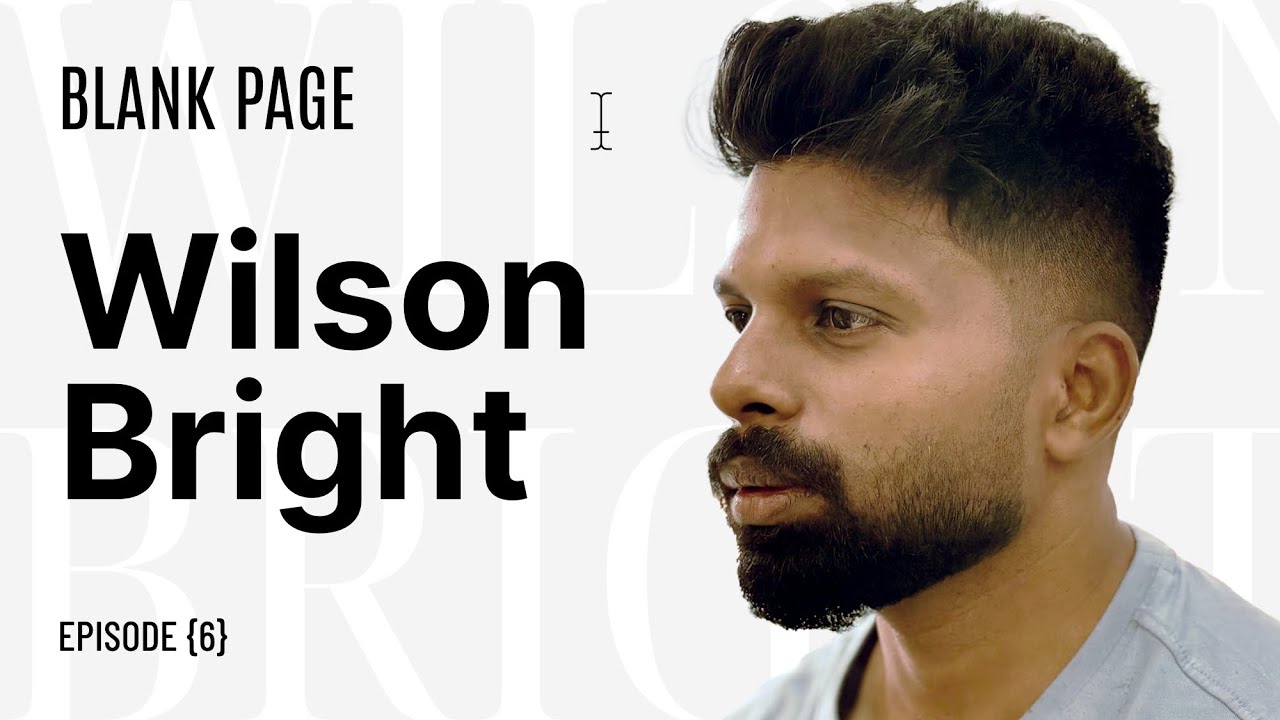
“I’m more of a generalist.”Wilson Bright, Blank Page conversation
In that conversation, Bright discussed a future in which surveys behave more like responsive conversations. AI could help gather and analyse insights, while people retain control of their information. A follow-up question is an appealing possibility because a form usually has to anticipate the respondent before the respondent arrives.
The difference is easy to recognise. A fixed questionnaire can ask whether an experience was satisfactory. A conversation can ask what made it so. The second question depends on listening to the first answer. That is the territory Bright is exploring, with the original ownership concern still attached.
His current author biography focuses on institutional researchers and the combination of ethical data collection with intelligent automation. His personal site adds a weekend interest in building AI for higher education. The setting has grown more specific, but the work still turns on a familiar sequence: ask, protect, understand.
A place to put the answer
BlockSurvey’s company chronology records an AI-agent launch in May 2025. Bright’s work now sits where survey design, automated analysis and research practice meet. The founder who began by questioning the container is also working on what people can do with its contents.
That brings us back to the box. It is tempting to treat handwritten cards as an amusing contradiction in an AI founder’s life. They make sense as another attempt to solve the information problem. A preserved idea needs a route back into use. An answer needs enough context to become meaningful. Both can disappear into a perfectly functioning system.
Bright’s story contains no shortage of software. Its most memorable object may still be the cardboard box: inexpensive, deliberate, and requiring its owner to return. The survey company and the cards ask related questions about what happens after information is collected. Someone must decide how to keep it, connect it and understand it. Bright keeps finding work there.
Continue the conversation
Follow Bright’s work, read the early milestones, or hear him discuss the questions behind it.