Alon Shavit once worked on a rather literal problem of access. A humanoid robot carried an RFID transmitter. A receiver passed information to software written in C#. The software sent commands to a mechanical gate, according to the robot’s location. For his final university project, the future startup operator had assembled a small system for deciding when a door should open.
It is a pleasing place to begin the story of someone who would spend years connecting entrepreneurs with people able to help them. The resemblance is an analogy, of course. A founder is considerably less predictable than a transmitter. A mentor may have excellent advice and an inconvenient calendar. And a gate seldom asks whether its business model needs work.
Shavit is now the co-founder and CEO of Upright Ventures, which runs programs for technology entrepreneurs. He is also a co-founder of Celo Camp, a virtual accelerator within the Celo blockchain ecosystem. His work brings together technical questions, business decisions and the delicate business of getting people to talk usefully to one another.
The robot at the gate
Shavit studied at Bar-Ilan University between 2006 and 2010, earning a degree in computer engineering. His description of the robotics project is unusually specific: assembling and programming the robot, receiving information through a software interface, and connecting that interface to something that moved in the physical world. There was hardware on one side, code in the middle and an observable result at the other end.
That makes an interesting companion to the work he later chose. An accelerator also has parts that must cooperate. Teams arrive with different products and different levels of experience. Technical experts speak one language; investors may speak another. Someone has to understand enough of each conversation to arrange the next useful one.
His GitHub biography describes expertise in blockchain technology and identity management. One public repository, Slingshot, concerns decentralized and transparent accelerators. The subject offers a small clue to the continuity between his technical interests and his organizing work. Even in a code repository, the question of how to help founders appears.
Connect the components.
Bring builders together.
Help the work reach people.
A bootcamp before the platform
In 2019, Shavit was a co-founder and CTO of Libracamp. The project proposed a virtual bootcamp for startups building applications on Libra, the blockchain initiative associated with Facebook. It was independent of Facebook, the Libra Association and the Calibra wallet. Its organizers were making their own wager on the developers who might build around a new financial network.
The planned program connected teams with experts, mentors, investors and technology companies. Here was the organizing idea in an early form: assemble support around entrepreneurs before their applications had become established businesses. The platform attracted the attention; the bootcamp concerned itself with the people trying to do something with it.
By April 2020, Upright was working with Celo on another eight-week virtual program. The first Celo Camp had received applications from 251 teams across more than 60 countries. Eighteen finalists represented 15 countries. Their projects ranged from payments to infrastructure, with teams in Africa, Europe, Asia and the Americas.
That geographic range mattered to the design. A remote program could put founders from different markets into the same cohort. It also made the organizer’s problem more demanding. Advice useful to one payments business might miss the obstacles facing another. A shared blockchain gave the participants common technical ground, while their businesses still had to make sense where their users lived.
The introduction has to fit
Asked about the early program, Shavit described a matching process attentive to the mentor’s interests, particular uses of the technology, geography and the team’s needs. The important word is “matching.” An impressive list of advisers is easy to admire. Its value to a founder depends on what happens when a particular problem meets a particular person.
“A mentor-matching process is used to understand a mentor’s areas of interest, including specific use cases or geographies and a team’s needs.”
Alon Shavit, on the first Celo Camp
The distinction becomes concrete in the experience of Dahlia’s founders, Robert Leifke and Kyle Scott. They met through their university’s blockchain club and entered Celo Camp after their finals. During the program, their initial fixed-rate lending idea changed as they confronted problems involving fragmented liquidity. They shifted toward a different product with guidance from other builders and mentors.
Their account contains the familiar furniture of a young company: a new logo, deployment scripts being rewritten and a deadline approaching. Leifke credited input from Shavit and Rachel Jakob with helping the team secure second place and raise funding. He also named several other contributors. The picture is of work moving through a group, with different people helping at different points.
Another participant, Into The Verse co-founder Elio Jordan Lopes, recalled his first meeting with Shavit as part of a longer experience that included pitching, building and making connections. His account described learning about user research, market fit, deploying products and approaching investors. The range is instructive. A technically capable founder can still have an entire business education waiting for them.
For Shavit, that creates a role with an unusual measure of success. The application belongs to the team. So does the decision to change it. The operator contributes the conditions around those decisions: access to expertise, a place to compare notes and a reason to return with something more developed next time.
The wallet introduces a new question
Celo Camp’s work later included the MiniPay Launchpad, focused on applications for Opera’s self-custodial stablecoin wallet. In July 2024, Shavit and program manager Matt Kenny were listed as hosts of the ninth cohort’s demo day. The event gave teams a place to show what they had built for MiniPay.
An existing wallet changes the founder’s assignment. The product has to fit into a setting where people can encounter and use it. Questions about technical integration sit beside questions about whether the application is understandable, relevant and worth returning to. The demonstration becomes a starting point for a more exacting conversation.
The published plan for Celo Camp’s tenth batch divided the program into two four-week stages. The first emphasized the product roadmap, market strategy, user research and a lean initial product. The second asked teams to refine that product, bring in early adopters and collect feedback. It is a sequence that makes room for discovery before asking for evidence of use.
Shavit’s team also works across several kinds of expertise. Upright names Rachel Jakob as COO, Kenny as program manager and Immanu’el Segol as tech lead. The arrangement reflects the breadth of the job. Organizing entrepreneurs requires people who can keep a program moving while recognizing when a business question has become a technical one, or the reverse.
Research users. Refine the roadmap. Build an initial product.
Bring in early adopters. Gather feedback. Develop traction.
A room in Buenos Aires
Virtual programs have a physical counterpart in Shavit’s calendar of public appearances. At Celo Gather in Berlin in May 2024, he joined a panel with Maria Alegre of Flori Ventures and Pedro Oliveira of Talent Protocol, led by Camila Rioja. The discussion concerned accelerating talent and potential around the world.
Those participants approached the subject from different institutions: a founder program, an investment firm, a talent network and a regional ecosystem. Their appearance together offers a useful view of Shavit’s position. He works among organizations whose interests overlap around founders, even when their responsibilities differ.
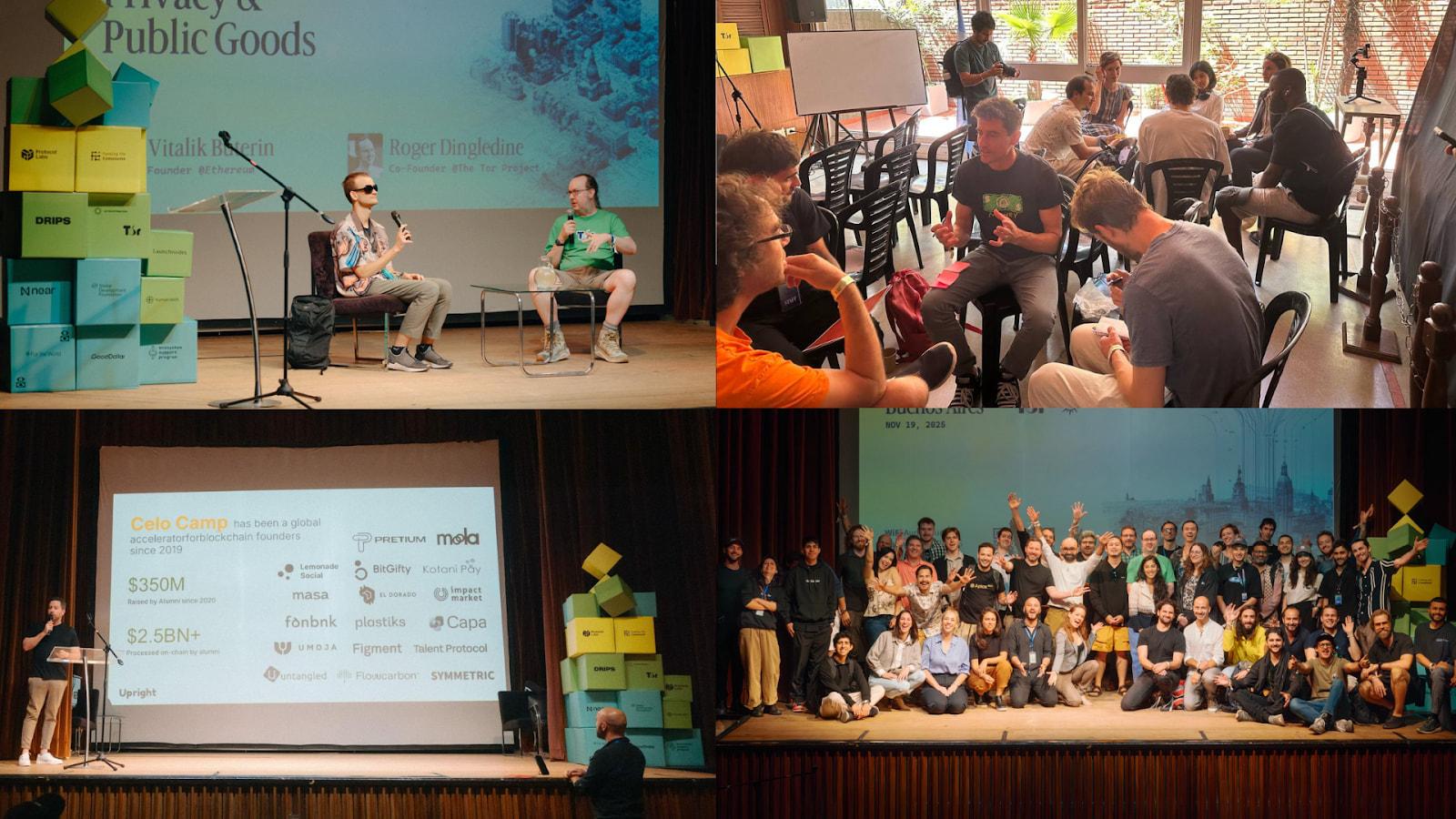
In November 2025, he spoke at Funding the Commons in Buenos Aires. His talk, “New Rails for Global Finance,” highlighted MiniPay and Celo Camp alumni. Upright also ran a workshop on startup presentations. The photographs place the activities side by side: people listening from an auditorium, people leaning into a conversation around a table, and a group assembling onstage.
The company’s January 2026 retrospective reported that 11 teams graduated from the tenth cohort and that each graduate demonstrated a Celo integration. In February, Upright reported investments of $33,334 each in Coinstancy and iExchange. These are program outcomes, achieved by teams and partners together. They give the work a more concrete ending than a roomful of exchanged business cards.
Questions that travel
Shavit’s curiosity also extends beyond the immediate business of accelerators. He recorded a conversation with his friend, AI researcher Dr Elad Liebman, about consciousness, artificial intelligence and the road toward AGI. Sharing it, he singled out Liebman’s ability to combine ideas from different fields and schools of thought.
That interest sits comfortably beside the engineer who began with a robot and a gate. Both involve asking how separate elements can produce something that works. With founders, the elements include ambitions, knowledge and people whose useful contribution may emerge only after someone has brought them into the conversation.
Upright has described a longer-term ambition for its network: alumni becoming mentors, angel investors and clients for one another. A cohort has an end date; those relationships could continue on their own. For Shavit, that is a fitting extension of the work. Open the door, make the introduction, and give the people on either side a reason to keep talking.