On her birthday, Tegan Kline went to encourage a colleague who was wondering whether she belonged in crypto. Noëlle Becker Moreno was new to web3. The vocabulary was arriving faster than she could absorb it. Kline’s advice was to keep asking questions and stay with it. Moreno did. She later helped design the House of Web3, the San Francisco space where an industry devoted to online networks could meet around an actual table.
It is a useful scene to keep in mind when reading Kline’s job titles. Co-founder. Chief business officer. Chief executive. Board member. They sound rather grand for the work of helping somebody through a difficult first week. Yet that small intervention gets close to her particular contribution: making introductions, explaining unfamiliar systems and giving people reasons to keep building.
Her career has taken her from bank trading floors to blockchain infrastructure, with a prolonged argument about who should control the internet along the way. The argument is ambitious. Much of the work beneath it is wonderfully practical.
The ladder she stopped climbing
Kline grew up in Ohio and moved to New York. Her father worked on the railroad; her mother stayed at home. She attended Baruch College, and her early professional life took shape around finance. Bank of America Merrill Lynch and Barclays supplied the sort of recognizable names that make a career easy to explain at a family gathering.
She had accepted a full scholarship to a finance school and approached banking as a ladder to climb. Investment banking came first, followed by sales and trading. By her own account, she was an overachiever looking for the top of the profession. Having a direction, however, was different from having a subject that absorbed her.
She volunteered alongside her banking work while searching for something she cared about more. In 2016, she learned about Ethereum. Its appeal extended beyond transferring money: here was a way to imagine different arrangements for the internet, ownership and financial services. Her experience inside banks gave her a set of inefficiencies against which to measure that promise.
She joined Orchid in 2018, working in international business development and OXT relations. The project was developing decentralized infrastructure for internet access and privacy. Her work put her among investors and an international community of builders. She has described visiting more than 26 countries in less than a year during that period. Banking had offered a fairly legible career map. This one required rather more boarding passes.
The move carried a continuity that the change of industry can obscure. She still needed to understand a product, work with capital and judge the people involved. Her personal account of choosing projects emphasizes technology, practical execution and the values of the team. The tools had changed. Those questions remained useful.
An internet with a filing problem
By 2020, Kline was working on the business side of The Graph. Its central problem was easy to underestimate: public blockchain data can be surprisingly awkward to retrieve. Being able to inspect a record does not automatically make it convenient for an application to find, organize and display the information it needs.
A blockchain records transactions. An application might need something more particular: a user’s transfers, a history of activity or information drawn from several contracts. Reconstructing that picture repeatedly is expensive work. The Graph provides infrastructure for organizing the data so developers can ask useful questions of it.
One of its tools is the subgraph, which defines the information to index and how to turn it into structured data. Independent operators called Indexers help serve that information. In ordinary language, the application needs an answer without having to rummage through the entire filing cabinet each time somebody opens a screen.
A simplified view of the work between a public record and a useful application.
Kline’s role was to help the world outside the engineering team understand why this mattered. The comparison with Google became a shorthand: organizing information so it could be accessed. Like most analogies, it carried only so far. The Graph’s decentralized network was intended to distribute the work rather than put a single company in charge of serving it.
Fundraising was another part of that translation. In 2023, Kline said she had helped raise a cumulative $77.5 million. That figure describes fundraising she reported helping with; it is not a personal fortune or one company’s single financing round. The achievement lies in persuading people to support infrastructure that most users will encounter only indirectly.
She co-founded Edge & Node in 2021 with members of the team behind The Graph. The company became one of the protocol’s core development teams. Kline served as chief business officer before becoming CEO in June 2023. By then, the challenge was moving more applications onto the decentralized network. The company needed people to use what its engineers had made.
A room with actual chairs
Meanwhile, Edge & Node had opened a second kind of infrastructure. In October 2022, the House of Web3 arrived in San Francisco’s Presidio: 13,000 square feet of collaboration space, with meeting facilities, a recording studio and an auditorium. A project about distributing information had acquired a very definite address.
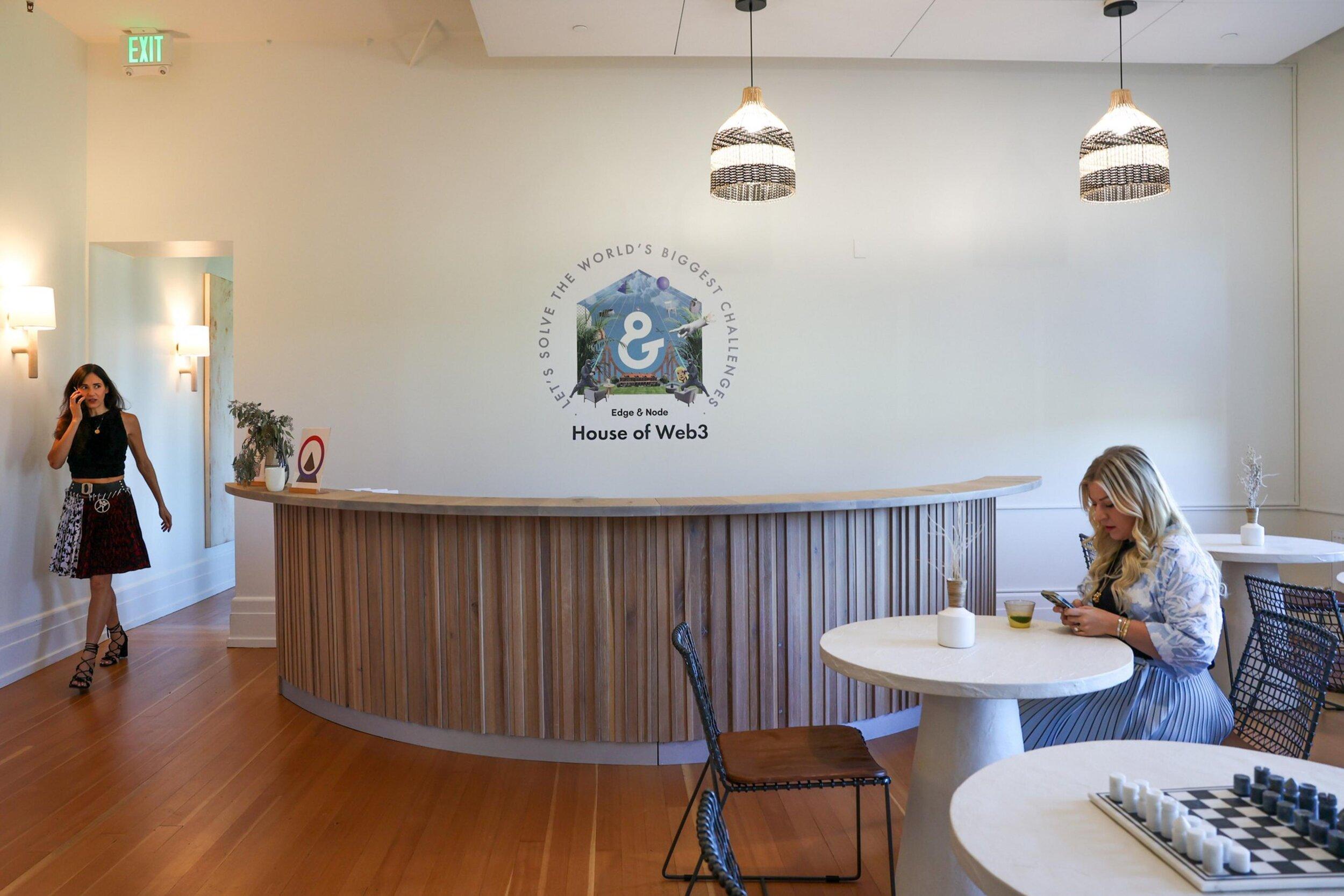
Moreno helped design the space. The colleague Kline had encouraged was now helping shape the room other people would enter. A newcomer’s uncertainty might sound like a minor problem beside the technical ones. But an industry needs people to stay long enough to find work they can do well.
At its opening, admission was being planned around applications demonstrating a contribution to the ecosystem. The arrangement gave the otherwise abstract idea of participation a practical test: what could someone bring to the work?
Kline also appeared among the hosts of SF Crypto gatherings alongside Jane Lippencott, Maria Shen and Manasi Vora. One event listing put the House of Web3 at the center of that community. These are small details beside a protocol launch, but they describe a recognizable occupation: finding the people, introducing them and creating the conditions in which another conversation can happen.
The awkward work of taking off the training wheels
The decentralized network still had a practical complication. The Graph had used a hosted service while the broader protocol was being developed. Moving applications away from that arrangement required an organized transition. A commitment to decentralization had to survive developers’ reasonable desire for their software to continue working.
As CEO, Kline led Edge & Node through work on the Sunrise of Decentralized Data initiative. The name suggested a pleasant natural event. The delivery involved deadlines, payment options, support and migration tools. Sunrises in software have considerably more project management.
In April 2024, the ecosystem opened an upgrade window ending June 12. Users were offered 100,000 free queries a month, payments by credit card or GRT and gasless upgrades for hosted-service subgraphs. Each feature addressed something a developer might otherwise have to stop and solve. It was the less glamorous side of an argument for a different internet: make the next step manageable.
More questions reached the network.
When the June 2024 milestone was announced, more than 6,000 subgraphs were live on the network. The Graph reported 991 million queries over the preceding 30 days, compared with 89.8 million in the corresponding period a year earlier. The figures describe the network’s activity, built by an ecosystem of teams and participants. They should not be mistaken for one person’s output.
For Kline, the important development was the shift away from dependence on centralized hosting. A philosophy about access had become a set of operational choices. Developers could make use of a network of independent Indexers. The claim now had to hold up inside working applications, where a slow answer or a complicated bill can be more persuasive than an elegant speech.
The title changes. The question stays.
In January 2025, Edge & Node announced that Rodrigo Coelho would succeed Kline as CEO. An early member of The Graph team, Coelho had worked across its community and operations. Kline remained on the board. The handover announcement recognized her leadership around Sunrise and placed the next stage of the company’s work with a colleague who already knew it.
Her interests also extend to what people do with the resources crypto creates. In November 2024, The Giving Block recognized her as a founding member of the Crypto Giving Pledge. Her public-facing work has included hosting interviews for The Defiant and speaking about data access, blockchain and the future of the internet.
“Do no harm. Take no bull. Change the world.”
Tegan Kline’s public motto
The motto has three instructions and very little patience for committee language. The career beneath it is more complicated: a finance education, an international business role, the patient explanation of technical infrastructure and a term leading a development company. There are negotiations in that work, and compromises over how to get from an idea to something another person can use.
The birthday visit remains a helpful measure. Kline did not remove the complexity of web3 for Moreno. She helped her stay with it long enough to contribute. A usable network and a welcoming room ask for related skills: understand what is getting in somebody’s way, then do something specific about it. That is a human-sized job, even when the ambition is an internet.
Keep the conversation going
Explore Kline’s work, interviews and the projects in this story.