Halliday raises $20M Series A led by a16z crypto Total funding $26M "Build applications in hours, not years" First agentic workflow protocol Stanford CS '23 - left to build Never write a smart contract again Halliday raises $20M Series A led by a16z crypto Total funding $26M "Build applications in hours, not years" First agentic workflow protocol Stanford CS '23 - left to build Never write a smart contract again
Founder Dossier / Web3 Infrastructure

Griffin
Dunaif

He left Stanford so that you would never have to write a smart contract again.

ROLECo-Founder & CEO, Halliday BASEDSan Francisco BACKED BYa16z crypto
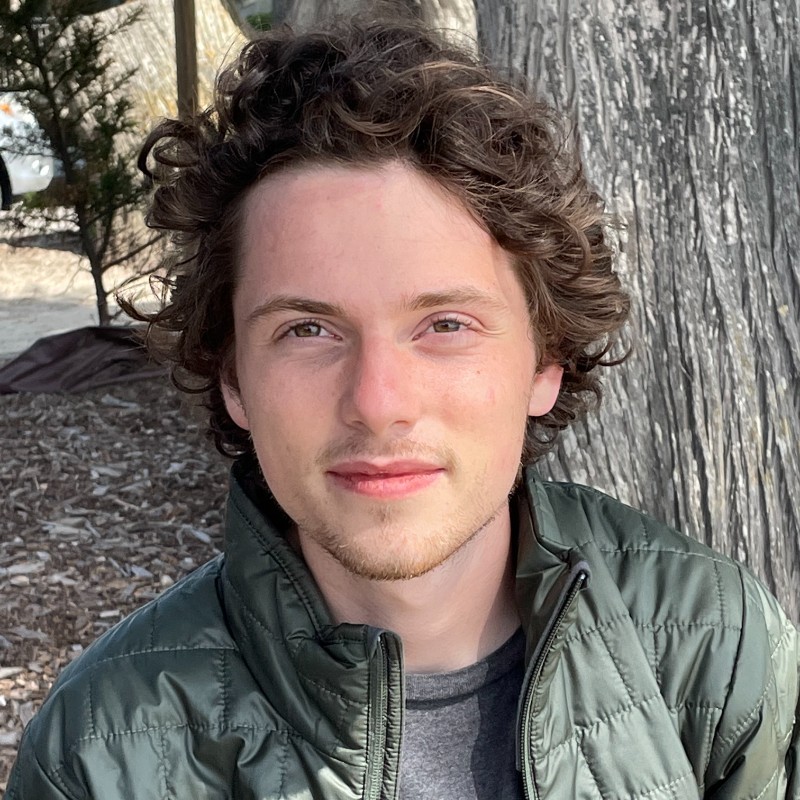
On The Record Griffin Dunaif, co-founder and CEO of Halliday
Griffin Dunaif - the ever-caffeinated builder turning years of blockchain engineering into an afternoon.

A protocol that deletes the hardest part of the job

Griffin Dunaif runs Halliday, and Halliday makes a promise that sounds like a dare: you will never write a smart contract again. That single line is the company's product, its pitch, and its philosophy. Smart contracts are the part of blockchain development that takes the longest, breaks the most often, and scares away the people who would otherwise build. Halliday's wager is that you can hand that work to autonomous systems running inside strict, immutable guardrails - and get the same result in hours.

The technical name is the agentic Workflow Protocol. The plain version: developers describe what they want to happen onchain, and Halliday handles the plumbing underneath - bridges, decentralized exchanges, data translation, multi-chain execution. A whole sequence of transactions collapses into a single call. AI agents can run those sequences on their own, but only inside boundaries a business can see and control. Dunaif's framing is that crypto already had the culture; what it lacked was the business infrastructure to move value reliably. He is building the plumbing.

In March 2025 that bet got a serious vote of confidence. Halliday raised $20 million in a Series A led by a16z crypto, with the Avalanche Blizzard Fund, Credibly Neutral, and Alt Layer joining. Total funding reached $26 million. a16z, which had also led the seed, called the protocol potentially "one of the biggest unlocks for web3 since programmable ledgers." For a company that started life as a buy-now-pay-later button for gamers, that is a remarkable distance traveled.

What makes the claim land is the demo underneath it. Halliday's first showcase of the Workflow Protocol is Halliday Payments - a single interface that connects onchain commerce to credit cards, ACH, and tokens from any chain, then routes the money to the right destination automatically. No bridging by hand. No manual token swaps. For the user it is one click; for the developer it is one call that hides a tangle of integrations. That is the whole thesis in miniature: take the parts of crypto that are genuinely hard, and make them disappear.

Dunaif is careful about the word "agentic," which has become the most overused term in software. His version is specific. An agent, in Halliday's world, is something that executes a high-level workflow on its own - but only inside boundaries that cannot be changed mid-flight. The protocol guarantees the whole sequence finishes even if an individual step fails, and it lets a developer rewrite onchain logic without redeploying a contract. The promise is web2 iteration speed with web3 settlement.

Our vision is to bring about the software era of blockchain, enabling developers to build applications in hours, not years. - Griffin Dunaif, to The Block
Filed under:
One founder. Two pivots. A college lecture that wouldn't let go. And a protocol named like something out of a sci-fi novel.
$26M
Total Raised
$20M
Series A (2025)
2022
Halliday Founded
~30
Team Size

The Spark

A slide in CS251 did the rest

Most origin stories start with a problem. This one starts with a sentence on a projector. In Stanford's CS251 - the cryptocurrencies course - a professor put up a slide that read: "Cryptocurrency or blockchain is the intersection of distributed systems, cryptography, and behavioral economics." Dunaif has pointed to that moment as the hinge. Three of the most interesting fields he knew, braided into one.

He went deeper than the syllabus. He studied zero-knowledge protocol design and ran protocol experiments alongside a professor - the kind of work that usually leads to a PhD application, not a Series A. Instead it led him out the door. He finished his computer science degree in 2023, but by then Halliday already existed; he had started it in 2022, before the diploma, with co-founder Akshay Malhotra.

The lesson he took from distributed systems was less about cryptography than about reliability. Systems fail. The interesting question is what happens when they do. That instinct - guarantee the outcome even when a step breaks - is exactly what Halliday now sells as "fault tolerance across multi-hop workflows."

a16z's read on him is worth quoting back. When the firm met him, it described not just "incredible technical talent" but a rarer combination: someone who could sell, build product, and pick the right technical abstractions all at once. That last skill is the quiet one. Plenty of engineers can write the code; far fewer can decide which complexity to hide and which to expose. Halliday is, in a sense, one long exercise in that judgment - figuring out the smallest set of things a developer should ever have to think about.

It is also a company assembled from people who have shipped at scale. Halliday's team draws from Stanford, Harvard, and Penn, with prior stints at the likes of Meta, Netflix, and Samsung. The company runs lean - roughly 30 people - which is part of the point. If the protocol really does turn years of engineering into hours, a small team should be able to do disproportionate damage to the status quo.

EXHIBIT A

The slide that started a company

"Cryptocurrency or blockchain is the intersection of distributed systems, cryptography, and behavioral economics."

- Shown in Stanford CS251, recalled by Dunaif as the moment he was hooked.

From "buy now, pay later" to the plumbing of web3

Halliday version one was almost playful: a browser extension that let gamers buy in-game assets and use them immediately while the company held custody until payment. Skip a payment, and Halliday simply took the asset back - no credit agencies, no collections, no drama. It raised $6 million in seed from a16z crypto, Hashed, and a_capital on that idea. Then Dunaif went deeper into the stack and concluded the bigger problem wasn't lending to gamers. It was that crypto had no dependable way to move value and transfer assets at all.

CHAPTER 01

BNPL for gamers

2022. Buy the sword now, pay later. Halliday holds custody; default just returns the asset. A clever consumer wedge into onchain commerce.

CHAPTER 02

The realization

Crypto had culture in abundance and infrastructure almost nowhere. The pain wasn't payments for players - it was reliable value transfer for everyone.

CHAPTER 03

The Workflow Protocol

2025. Describe the outcome; Halliday wires the bridges, DEXs, and multi-chain execution. AI agents run it inside immutable guardrails.

In shifting the paradigm from smart contract development to agentic workflows, we are bringing blockchain into the agentic era. - Griffin Dunaif, on launching the Workflow Protocol

Letting an AI agent touch money without breaking it

Here is the uncomfortable truth Dunaif keeps returning to: an AI agent that can move funds onchain is also an AI agent that can lose them. One bad line in a smart contract is a breach. So Halliday's pitch isn't only speed - it's oversight. The guardrails are immutable, the boundaries are visible, and the business stays in control of what its automations are allowed to do.

It is a defensive argument dressed as a growth story. The companies he wants - banks, fintechs, enterprises - won't adopt onchain AI because it's fast. They'll adopt it when they trust it won't quietly drain a wallet at 3 a.m. Dunaif is selling permission as much as he is selling performance.

The use cases he points to are deliberately unglamorous: recurring payments, B2B transactions, the day-to-day financial logic that keeps a business running. Not casino tokens - payroll-grade reliability. His framing is that workflows, not contracts, are the unit that actually maps to how companies think about money. A contract is a thing you deploy and pray over. A workflow is a process you can watch, audit, and trust. The bet is that the second framing is the one enterprises have been waiting for.

"Halliday handles all the heavy lifting," he has said of the protocol - "protocol integrations like bridges and DEXs, data translation, and reliable multi-chain execution." The subtext is a kind of generosity toward the developer: you should not have to become an expert in cross-chain routing just to accept a payment. Hide the hard parts well enough, and the hard parts stop being a barrier to entry.

For AI to operate onchain, there needs to be robust safety infrastructure where businesses have oversight of AI-enabled automations. - Griffin Dunaif

The Paper Trail

How he got here

'22
Halliday is born. Co-founded in San Francisco as buy-now-pay-later for gamers. Raises $6M seed led by a16z crypto, with Hashed and a_capital.
'23
Degree in hand. Graduates Stanford with a computer science degree focused on distributed systems - the company already running.
'24
The turn. Pivots Halliday from gaming finance toward broad onchain business infrastructure and the Workflow Protocol.
'25
The breakout. Launches the first agentic Workflow Protocol (Feb). Raises $20M Series A led by a16z crypto (March). Speaks at Consensus 2025. Total funding hits $26M.

Games and chains already running on it

DeFi Kingdoms

One of web3 gaming's best-known worlds - an early proving ground for Halliday's onchain workflows.

ApeChain

The chain in the Yuga / Bored Ape orbit, plugging into Halliday's payment and execution rails.

Core Wallet

Wallet-level integration, the kind of distribution that turns a protocol into infrastructure.

Things that don't fit the pitch deck

"Ever-caffeinated" is how one profile described him - the founder who turns complex tech into things that ship.

a16z first met him three years before the Series A, while he was still a junior at Stanford.

On X he goes by @griffintier, usually trailing a wave emoji.

Halliday is named and headquartered in San Francisco - though company records also list a New Jersey address.

The company's first product wasn't infrastructure at all. It was a way to buy a virtual sword on credit.

He studied zero-knowledge proofs before most people could spell them, then left school to build instead.

The goal is simple to say and hard to do: give blockchain its software era, where building onchain feels as fast and ordinary as building anything else.

Share Griffin's story