Vivek Bhaskaran remembers the first customer check. It was for about $3,000. Looking back, he wishes he had framed it, or at least taken a photograph. At the time, however, he needed the money. A founding artifact is lovely. A founding artifact that pays the bills is rather more useful.
That little choice suits the founder of QuestionPro, a business built around asking people questions. His own working question has remained remarkably practical: how do you keep this thing going? He has answered with customers, software, small acquisitions, and a refusal to make selling the company the inevitable final chapter.
In his recollection of the early days, servers went into a Seattle garage. He wanted to get away from the feast-and-famine rhythm of consulting and build a product. He has also been candid about wanting freedom from a boss. The origin has the ordinary messiness of a working life, rather than the tidiness of a pitch deck.
An engineer takes the long route
Bhaskaran was born in Margherita, in Assam, and spent much of his childhood in Kolkata. After school, his route to an American technology career went through Russia. It was an unusual itinerary for someone eventually associated with online surveys, but it gave him a life before the company, and a map larger than Silicon Valley.
He lived in Russia from 1995 to 1997 before moving to the United States. At Brigham Young University in Utah, he earned a bachelor's degree in computer science. Then came Seattle and technology consulting. In his account, graduating during the dot-com boom meant a choice of more than ten job offers. Employment was readily available; enjoying the arrangement was another matter.
Working for large clients, including Washington Mutual, left him feeling that his job involved apologizing for other people's decisions. In fall 2005, after his commute home to Issaquah, he told his wife, Kalpana, that he would quit and run QuestionPro. She asked about the mortgage. He had six months of savings. They went home, made dinner, and, in his telling, incorporated the next day.
Growth comes with landings
QuestionPro made the Inc. list in 2008, placing 172nd overall and 25th among business-service providers. Recognition arrived early enough to give the garage story a satisfying sequel. The years afterward demanded a less photogenic kind of work: improving the product, appointing managers, and learning how to run a larger organization.
The progression had pauses. A quick climb to $1 million was followed by team and product work on the way to $4 million. Later, flatter periods required management and repeatable processes before the business could reach $10 million. Further growth depended on executive leadership and expansion abroad. Each new size brought a different job for the founder.
Bhaskaran's tenure also had a break. He says he ran the company from 2005 to 2010, worked on other startups, then returned to running QuestionPro in 2015. The story therefore includes a departure and a return. It leaves room for a founder to change his work without making the company disappear from his life.
The numbers deserve dates. In February 2023, he reported $30 million in revenue for 2022, compared with $20 million for 2019. Those figures describe those years. They are useful because they show a business getting larger through a long stretch of operating, rather than through a single spectacular announcement.
Buying a little more room
By that 2023 interview, Bhaskaran counted between five and seven acquisitions. His shopping list followed three kinds of enterprise buyer: consumer-insights teams, customer-experience teams, and human-resources teams. The logic was recognizably that of a product builder. A purchase could bring something useful into the range of problems the company already understood.
One example was SuiteCX, acquired in October 2022. Bhaskaran described an initial cash exposure below $700,000. He also said he intended to rewrite acquired code bases rather than carry multiple technology stacks indefinitely. The deal and the engineering work belonged to the same decision. Buying software did not remove the obligation to make it fit.
In a separate account, he described buying Enprecis for $800,000 in cash, with an offer to close in 30 days. He preferred opportunistic deals and uncomplicated communication about the numbers. There is a certain comedy in a software founder approaching acquisitions with the impatience usually reserved for a broken login screen.
Underneath that impatience sits a constraint: cash matters when you finance your own growth. Smaller transactions can expand a company without requiring one enormous bet. They still need judgment, integration, and customers willing to use the result. Bhaskaran's accounts keep returning to those practical details.
The question a survey cannot ask
QuestionPro was only part of his work in listening software. In 2009, he joined Jessica Day, Josh Folk, and Rob Hoehn in launching IdeaScale. Its proposition gave people a place to submit ideas and vote on them. A survey starts with a question someone has chosen. An idea community lets the participant suggest what deserves attention in the first place.
That distinction opened a door in government. During IdeaScale's first year, 23 federal agencies adopted it alongside the Open Government Initiative. For a young company, participation on that scale carried opportunity and a problem familiar to anyone who has ever been offered exposure instead of payment.
Hoehn later recalled an early government conversation with Bhaskaran on the call. The work would be unpaid. Their answer was to keep the company's branding on the communities. It was a negotiation over recognition, with a small supplier trying to make a public opportunity economically useful. Government subsequently became an important part of IdeaScale's business.
A global company needs several calendars
International growth can look wonderfully neat on a map. Working across countries is less neat on a Monday morning. Someone is waiting for a reply; someone else is observing a national holiday. In 2022, Bhaskaran argued that a company operating around the world should respect the calendars of the people working in it.
He described giving regional leaders in Mexico, India, Europe, the United Arab Emirates, and Canada freedom to set holidays according to local customs. The arrangement required colleagues elsewhere to accept that a person on holiday might actually be away. Even a software company must sometimes concede that a calendar entry has a meaning beyond availability.
This is a concrete version of independence inside an organization. A founder who dislikes being directed has to decide how much discretion to give others. Regional holidays are one answer. They let the company operate across borders without asking everyone to adopt the same country as their cultural headquarters.
His mother changed the arithmetic
There was another measure of scale closer to home. Bhaskaran has recalled a phone conversation in which his mother asked how many people worked for him. At that point, he told her, there were 80. Her response turned his attention toward the responsibility attached to all those livelihoods.
In the account he published in November 2025, he described a team of more than 400 people across continents, including Austin, Pune, Berlin, and Mexico City. He also wrote about being a father to two daughters. The company, viewed from either direction, involved people whose futures could be affected by his decisions.
That is a substantial addition to a founder's arithmetic. Revenue still pays for the enterprise. Headcount also represents rent, plans, families, and careers. His mother's question gave the familiar business number a different weight. It explains why a conversation about independence can end up being a conversation about obligations.
80 employees. One question from his mother. A different way to count.A recollection of responsibility
Three wheels, several helmets
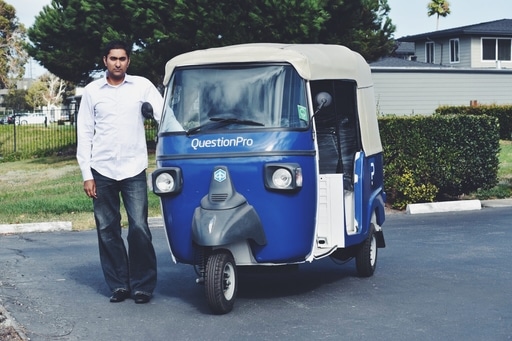
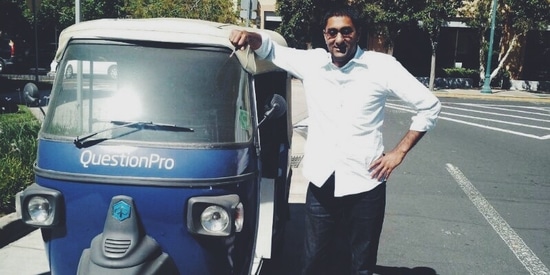
And then there is the auto-rickshaw. Bhaskaran's enthusiasm for the vehicle began in childhood in India. Years later, QuestionPro brought rickshaws to California. Getting one through the administrative process took persistence; it was registered as a three-wheeled motorcycle. Helmets became part of the onboard equipment.
The rickshaws appeared at Dreamforce in San Francisco in 2017, with Bhaskaran and Hoehn giving rides. The vehicle also became part of QuestionPro's event life. A research-software company can spend considerable effort explaining its product. A blue three-wheeler has the advantage of making people curious before anyone begins the explanation.
Motorcycles belong to the same appetite for movement. Bhaskaran has described riding to Saudi Arabia's Edge of the World, navigating unfamiliar borders on rented bikes, and salvaging a trip after a breakdown by finding replacement machines. His personal challenge is to ride in 100 countries. That is a goal, not a completed tally.
In his account, the attraction is the need to make decisions, adapt, and keep learning. The connection to entrepreneurship is his own. A journey is allowed to go differently from the original plan. He seems willing to bring that permission into the office, occasionally accompanied by a vehicle that makes an excellent conversation starter.
Still close to the product
By March 2026, Bhaskaran was still deeply involved in QuestionPro's product work, acting as both CEO and an informal chief product officer. He had chosen to keep building when private-equity firms and prospective acquirers called. The company had grown through roughly ten small acquisitions without venture capital.
Artificial intelligence was part of the next set of experiments. He pointed to the usefulness of AI in the cumbersome work of responding to proposals and compliance questionnaires. He also anticipated a role for synthetic respondents in early research. Those were applications and expectations under discussion, rather than a reason to declare the old problems solved.
His test for continuing was personal as well as commercial: did he enjoy the work, and did he enjoy the people around him? “There is just one life,” he said. After years of running the business, those questions had become part of the operating logic.
There is something pleasingly appropriate about that. A founder who sells tools for asking questions still has questions worth asking himself. The next revenue milestone will require work. So will the next product decision. Keeping ownership gives him the chance to choose both, and to leave enough room in the calendar for a ride.
“There is just one life.”Vivek Bhaskaran