The website took two days to build. Getting it to behave across browsers, devices and operating systems was another matter. In 2011, Ritesh Arora and Nakul Aggarwal were putting together a site for their technology consulting business. Aggarwal did the building; Arora took on the testing. Then the supposedly small job began swallowing the large one. A website is an excellent invention until it meets somebody else’s computer.
They looked for a way to make the checking easier. What they found was a problem shared by other developers: producing a page and knowing that it worked everywhere were two very different jobs. That discovery became BrowserStack. The business they had been trying to advertise supplied the occasion for a different business altogether.
Arora now runs BrowserStack as co-founder and CEO, with Aggarwal as co-founder and CTO. His base remains Mumbai. The work reaches much farther. The company gives software teams access to browsers and real devices through the cloud, sparing them the job of assembling and maintaining the testing infrastructure themselves. The original nuisance has proved remarkably durable. Computers have improved their manners in many ways; agreeing with one another remains a work in progress.
Before the browsers, two false starts
The partnership began at IIT Bombay. Arora and Aggarwal studied computer science and graduated in 2006. They lived in Hostel 6, a detail that would acquire financial consequences nearly two decades later. For now, they were students with an appetite for starting something.
Their first attempt, begun in 2005, involved sentiment analysis. Arora studied machine learning and natural language processing while working on it. The founders could build the technology, but they struggled to find a route to customers. They took jobs, then tried an internet information-aggregation venture. That attracted interest without yielding a workable business model.
Those are useful complications in a founder’s biography. A degree provides evidence that someone can learn difficult things. It does rather less to establish that strangers will pay for them. Arora and Aggarwal had encountered both problems before BrowserStack: getting a product into people’s hands, and turning their interest into a business. When the browser-testing problem appeared, it came with something their earlier ideas had lacked: an irritation they could recognize immediately in their own work.
There is no need to turn those ventures into a tidy apprenticeship. At the time, they were ventures that did not work out. Their significance is that the two founders continued working together and eventually found a task whose inconvenience travelled well beyond their own desks.
A recommendation travels farther than a pitch
The early BrowserStack helped developers test and debug websites across browsers, particularly Internet Explorer. A recommendation from John Resig, the creator of jQuery, helped bring roughly 10,000 beta users in three weeks. It was the sort of introduction a developer product wants: someone known for making developers’ work easier pointing to another tool that might do the same.
The economics followed the usage. BrowserStack reached about $20,000 in monthly revenue within four to five months, and $1 million in annual recurring revenue at the end of its first year. Arora and Aggarwal were still a team of two, working from a Mumbai coffee shop. The office was small enough to order another round.
The company’s subsequent product history shows how the task widened. Automate arrived in 2013 for cloud-based JavaScript and Selenium testing. The global device cloud followed in 2015. App Live and App Automate arrived in 2017. Each addition moved BrowserStack into another part of the work developers already had to do.
That progression matters for understanding Arora’s career. He had found a business whose expansion could follow the customer’s next problem. A team might begin by checking a website manually, then need repeatable automated tests, then need to check a mobile application. The relationship could continue as the work changed.
The investor who kept coming back
Accel first met the founders in 2012 and tried to invest. BrowserStack kept building without outside funding. The eventual courtship involved coffees, international flights, Mumbai rainstorms and meetings with much of the investment team. A venture capitalist may have a sophisticated financial model; sometimes the essential equipment is patience and an umbrella.
The wait ended in January 2018. Accel invested $50 million for a minority stake in BrowserStack’s first financing. By then, the company was profitable, had more than 25,000 paying customers and served developers in 135 countries. More than half its customers were in North America. It also announced a North American headquarters in San Francisco.
That order of events gave the funding announcement a different texture. The founders had already established that developers would use the product and customers would pay. Arora described the next phase in terms of improving the testing suite and expanding the company’s ability to sell to enterprises. Money arrived with a job to do.
The numbers also put Mumbai in perspective. Arora had built from a city in India for users scattered around the world. Software testing did not become an entirely new problem at the border. A developer elsewhere could recognize the inconvenience without requiring a translation of the founder’s surroundings.
Series A$50M
Series B$200M
The button works. But does it look right?
In May 2018, Arora made his case for treating software quality as an executive concern. Bugs could damage customer confidence, erode a brand and cost revenue. His argument brought the consequences of testing into the room where budgets and priorities were set. A broken application does not politely confine its effects to the engineering department.
The product strategy broadened too. In July 2020, BrowserStack acquired Percy, a visual testing and review platform. Percy captures screenshots, compares them with a baseline and highlights changes. Functional testing asks whether an action works; visual testing examines what has happened to the interface around it. Both matter to the person trying to use the result.
The acquisition joined visual testing to BrowserStack’s manual and automated functional testing infrastructure. It also showed how Arora’s ambition could become concrete. Making more of the testing process available in one place required additional capabilities, including ones that another team had already spent years building.
In June 2021, BrowserStack announced a $200 million Series B led by BOND, with Insight Partners and Accel participating. The transaction valued the company at $4 billion. Arora said the funding would support acquisitions and investment in product and engineering teams. The valuation belongs to that funding round; the practical ambition was to cover more of the developer’s testing work.
“We want to achieve our vision of becoming the testing infrastructure for the internet.”
Ritesh Arora · June 2021
Profit gets a second job
A later announcement gives the profitability story a more personal audience. In January 2026, BrowserStack announced a $125 million employee stock option and share buyback program, benefiting more than 500 current and former team members and early investors. It said the program was funded entirely from profits. Across its buybacks, the total reached $275 million.
Employee equity involves an awkward wait between a promise of ownership and a chance to sell. A buyback creates one such opportunity for eligible participants. In Arora’s company, the cash generated by the business was now helping some of the people who had built it realize the value of their holdings.
The same announcement described a business with 21 products, 21 global data centers and more than 30,000 real devices and browsers. Those are January 2026 figures. They show how much machinery had accumulated behind the original desire to check one website. The browser window visible to a customer rests on a considerable amount of equipment, software and maintenance.
An expanding platform also changes a founder’s job. The early question was whether one tool could remove a frustrating task. The later question is how a growing collection of tools fits together well enough to remain useful. Arora’s public emphasis on the customer’s work gives those two stages a common reference point.
Funded from profits. More than 500 current and former team members and early investors benefit.
Back to Hostel 6
In 2025, Arora and Aggarwal pledged ₹100 crore toward student residential facilities at IIT Bombay. The plans included rebuilding Hostel 6, where both had lived, and supporting Project Evergreen’s work on Hostels 7, 8 and 21. Part of the contribution came from BrowserStack through its corporate social responsibility initiative.
Arora described IIT Bombay as the place that shaped their vision and provided the foundation for BrowserStack. The choice of student housing made that connection tangible. Universities contain lecture halls and laboratories; they also contain rooms where people meet, talk, work late and decide to attempt things together. This particular partnership had passed through one of those hostels.
It would be too neat to claim that a new building can manufacture another BrowserStack. It can provide the living and learning conditions for students whose eventual work nobody can predict. The pledge commits money to that possibility without prescribing what they ought to build.
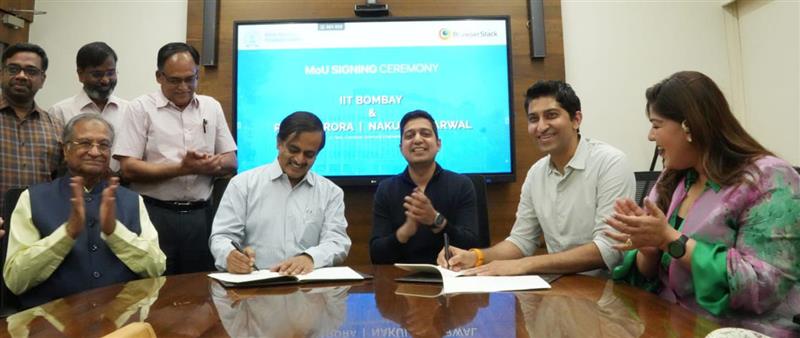
The signing photograph brings the story down to human scale. Arora sits at a table with documents in front of him, alongside institute representatives and his co-founder. After years of selling access to testing infrastructure, the founders were supporting infrastructure of a more familiar kind: places for students to live. Hostel 6 had stayed in the story.
The unfinished job returns
Arora’s interests extend to mathematics, science and space. His public work, however, keeps returning to a thoroughly earthly frustration: the distance between making software and knowing it behaves as intended. In 2026, he was discussing that gap again as AI coding tools accelerated development.
BrowserStack’s Test Companion brings AI-assisted testing into development environments. It supports work such as authoring, executing, debugging and maintaining tests, and connects with frameworks including Playwright, Cypress and Selenium. A March 2026 toolkit release added agents for generating test cases and API tests, checking webpage content and filling forms. The company is applying new tools to the old expense of checking things carefully.
There is a familiar risk in making any task faster: the next task becomes conspicuous. A website built in two days exposed slow testing in 2011. Faster code generation has given Arora another version of that imbalance to address. The details have changed considerably, but he is still working on the part that prevents a finished piece of code from becoming finished software.
His career contains two ventures that failed to settle into businesses, a partnership that endured, a long wait before outside investment and a return to the hostel where that partnership took shape. The thread is easy to overlook because its subject is so ordinary. Arora found something that people were tired of doing badly, and kept finding more of it. The website was eventually tested. The work it revealed is still going on.