The answer to NASA's problem was sitting 300 yards away. An agency team expected to spend about $1.3 million and four years developing a way to measure liquids in microgravity. It posted the challenge to NASA@WORK, an internal community powered by IdeaScale. A colleague in another group already had a prototype built for a different purpose. The platform did not invent the cylinder. It made the hidden connection visible. NASA's account says the shortcut saved more than $1 million and four years.
That anecdote is almost suspiciously perfect for IdeaScale, a small software company built around a large organizational comedy: the bigger an institution becomes, the easier it is for an answer to exist and remain undiscovered. Email knows who you know. Surveys answer the questions management thought to ask. Meetings favor whoever got invited. The good answer may belong to a mechanic, a customer, a policy analyst, or an engineer one building over.
IdeaScale gives that answer a place to surface. An organization creates a community or campaign, invites employees, customers, citizens, or experts, and asks for ideas. People submit, comment, vote, and refine. Administrators apply criteria, route candidates, estimate value and cost, assign owners, build proposals, and track selected ideas as projects. What looks from the outside like a clever suggestion box is, at enterprise scale, a permissions-and-decisions machine.
users, according to IdeaScale. The company also reports 25,000+ organizations - from city halls and universities to NASA, Cisco, Toyota, NYU, United Way, and the U.S. Air Force.
The White House opened the door
IdeaScale launched in 2009, timed to an unusually useful market event: President Barack Obama's Open Government Initiative. Co-founders Vivek Bhaskaran, Rob Hoehn, Jessica Day, and Josh Folk were not trying to make another survey. Hoehn had worked in market research and noticed the boundary built into questionnaires. Researchers can collect answers to known questions; they are less good at finding the question nobody in the room considered.
The administration wanted agencies to become more transparent, participatory, and collaborative. IdeaScale offered a cloud service that looked made for the moment. Twenty-three federal agencies adopted it during the first year, according to the company's history, including the Executive Office of the President. By 2010, the count had climbed beyond 36 agencies and enterprise customers.
This was not the standard venture-funded land grab. IdeaScale describes itself as bootstrapped: customers, in its preferred formulation, were the investors. By 2020 the company said revenue had passed $750,000 a month. Supplied company intelligence now estimates about $8 million a year, though the private company does not publish audited figures. Either way, the operating choice matters. Government buyers are slow, particular, and security conscious. Serving them rewards patience and makes fashion a less useful compass.
“If we could help organizations gather ideas, they would start finding answers to questions they'd never thought of before.”Rob Hoehn, co-founder and head of product
A vote is not an outcome
The first thing that fails in an idea program is rarely the submission form. It is the promise implied by the form. Ask 10,000 people for suggestions, collect a bright heap of responses, announce three winners, and then go quiet. Contributors learn that participation creates work for them and applause for management. Next year's campaign arrives to a smaller, warier crowd.
IdeaScale's 2026 writing is blunt about this trap. Most innovation programs are designed to generate and select ideas; few are designed to execute them. The visible part - campaign launches, submission counts, voting, a shortlist - makes dashboards go green. Then the chosen concept disappears into operational noise. Months later, nobody can name the owner, budget, decision, or result. The company calls this the black box after selection.
That diagnosis changed the center of gravity. IdeaScale still sells participation, but it increasingly presents itself as a system of record for what happens next. The platform includes configurable stages, decision matrices, project ownership, proposals, value and cost estimates, portfolio views, integrations, and outcome reporting. Its stated product direction adds AI analytics, workspace-wide views, Kanban tracking, a secure interface for outside language models, and post-launch measurement.
The innovation-theater funnel
An editorial illustration, not IdeaScale customer data: volume looks healthy until ownership and execution arrive.
The company practices a useful version of this in public. Its product-improvement community lets customers, partners, employees, and strangers propose features and vote. In April 2025, IdeaScale reported 650 ideas open for voting, 60 on the roadmap, and 50 implemented. Nick Jain, then writing as CEO, offered the essential governance detail: he submitted ideas too, and not all of them made it. A crowd works only if status does not quietly become the scoring system.
What buyers are actually paying for
IdeaScale does not publish a sticker price. Its current pricing page offers custom subscriptions for enterprise, government, and education buyers, with features, scope, deployment, and services shaping the quote. That obscures easy comparison, but it also reveals the target. This is not primarily software for five colleagues choosing an off-site. It is for organizations where identity, access, moderation, multilingual participation, data boundaries, auditability, integrations, and procurement all enter the meeting.
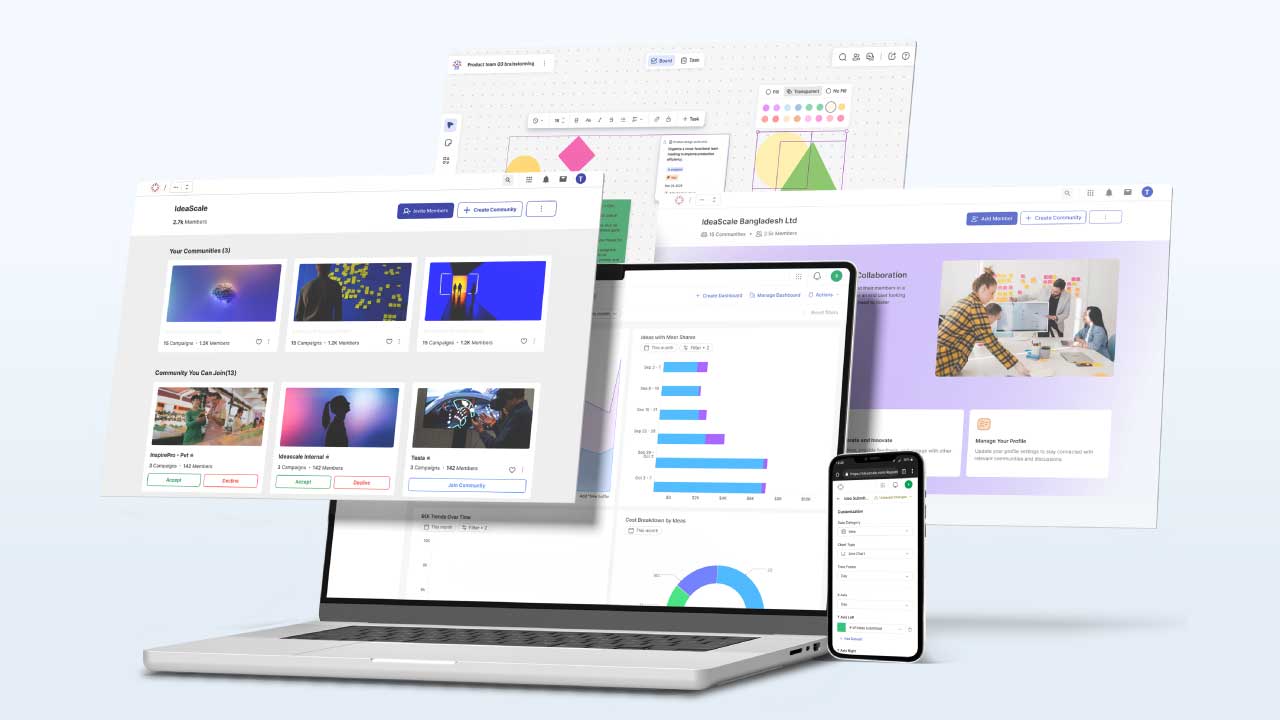
The suite has three visible pieces. Innovation Management is the core pipeline. Whiteboard, introduced in 2023, handles diagrams, maps, live and asynchronous brainstorming, then pushes developed concepts into the formal workflow. Professional services helps customers design campaigns, configure stages, train administrators, and keep communities alive. In 2026, an AI chatbot joined the workspace so administrators and moderators could query community data; IdeaScale says the capability can operate in a FedRAMP-enabled boundary for government customers.
Its alternatives range from direct platforms such as Brightidea, Wazoku, Qmarkets, Planbox, HYPE Innovation, and edison365 to adjacent product-feedback tools such as Productboard and Aha! Ideas. For many teams, the actual competitor is cheaper and less impressive: Microsoft Forms, Slack, Miro, or a spreadsheet. IdeaScale earns its place when the crowd, stakes, workflow, or compliance burden makes those improvised systems brittle.
Start with one consequential question, publish selection criteria, name an owner before voting closes, and report decisions back to every contributor.
If nobody has budget or authority to implement an idea, buying a platform only produces a better-organized backlog of disappointment.
Track ideas implemented, time or money saved, value delivered, and time from selection to decision - not submissions alone.
KANE paired the software with a four-person improvement team and 70 local champions across more than 1,100 employees.
The software cannot supply courage
The copyable lesson is not “install a portal.” It is to build a loop. Define the business problem and the people who might see it differently. Tell them how choices will be made. Give moderators the time to combine duplicates, ask questions, and rescue overlooked contributions. Decide who owns the winner and where funding comes from. Then close the loop with an explanation, especially when the answer is no.
KANE, a logistics company, shows why the operating layer matters. It embedded IdeaScale in onboarding and Lean/Six Sigma work, supported the program with a four-person continuous-improvement team and 70 idea champions serving more than 1,100 employees. A customer case record credits the effort with more than $3 million in savings. The software held the system together; people supplied attention, translation, and follow-through.
NASA's pandemic campaign offers the speed case. On April 1, 2020, the agency asked its workforce for ideas involving ventilation, protective equipment, and monitoring. In two weeks, the community produced 250 submissions, more than 500 comments, and 4,500 votes. That output was useful because NASA had a defined emergency, an expert crowd, a route for evaluation, and institutional capacity to act. Remove those conditions and the same activity metrics could amount to noise.
IdeaScale itself learned a related marketing lesson. A published agency case study says its internally managed paid-search attempts had not worked. In 2016 it let a specialist rebuild campaigns, add remarketing, create focused landing pages, and connect ad tracking to the CRM. The reported result was more than $2 million in sales opportunities and roughly $780,000 in closed business. The cost of the engagement was not disclosed. What changed minds was measurement: impressions stopped being the point once leads could be followed into revenue.
There are conditions under which the whole approach should not work. A tiny team with occasional feedback may be happier with a board and a weekly conversation. An organization that punishes dissent will not become candid because a form has an anonymous toggle. A leader seeking validation rather than surprise will game the criteria. A public campaign without moderation can reward popularity over feasibility. AI can summarize a thousand submissions, but it cannot manufacture trust, executive sponsorship, implementation capacity, or the willingness to publish an unpopular decision.
Ideas are cheap. IdeaScale's durable business is the awkward machinery that decides who owns one on Monday morning.YesPress
The market between listening and doing
That is where IdeaScale fits. Survey companies are optimized to measure sentiment. Collaboration canvases are optimized for a session. Product-management tools are optimized for a roadmap. Project systems are optimized for approved work. IdeaScale sits before and between them, where a large institution must listen broadly without pretending every voice has issued a command.
Its government history remains more than an origin anecdote. Federal work forced the company to care about configuration, access, security, audit trails, and multi-stakeholder decisions earlier than a lighter workplace app might. The same traits travel well into universities, healthcare, global enterprises, and nonprofits. Acquisitions of IdeaVibes, InnovationManagement.se, and Betterific expanded its reach in civic engagement, knowledge, and external crowds.
The tension now is AI. Summaries, coaching, clustering, and conversational retrieval can reduce the administrative tax of a large crowd. They can also sand away the eccentric phrase or minority observation that made the crowd worth asking. IdeaScale's advantage will not come from adding a chatbot that every competitor can add. It will come from preserving governance and provenance while shortening the distance between an overlooked signal and a funded result.
The NASA cylinder remains the cleaner pitch. A useful thing already existed. The person who needed it did not know. The person who had it did not know it had another use. Software made them legible to each other. The distance was only 300 yards, but without a system it may as well have been 300 miles.