The first thing to understand about deep tech is that a good invention can die of administrative causes. A robotics founder may have working hardware but no factory willing to run the first pilot. A university spinout may have a grant, a patent and no idea how to explain either to a venture committee. A corporate innovation manager may know the business problem but be marooned in a spreadsheet containing 600 vaguely relevant startups. SanchiConnect has built a company in the space between those people.
Founded in Noida in 2022 by Dr. Sunil K. Shekhawat and technologist Baltej Singh, the company calls itself a DeepTech enablement network. The phrase is ungainly but accurate. SanchiConnect is not simply an accelerator, a software vendor, an investment bank or a founder club. It is a compact attempt to make all four functions reinforce one another. The free community draws startups, investors, mentors, universities, corporates and public bodies. Programs turn that crowd into curated cohorts. Advisory helps certain companies raise money. Software records applications, evaluations, milestones and outcomes.
Its customers sit on both sides of the table. Founders use the network to find money, first customers, technical guidance and pilot opportunities. Investors seek filtered deal flow. Corporates, incubators and governments buy help designing innovation programs, scouting technologies and keeping the whole procession visible. SanchiConnect says its network includes more than 4,000 stakeholders. LinkedIn lists about 30 employees - small enough that the operating model matters more than the org chart.
01 / The quiet failureThe spreadsheet broke first
SanchiConnect began broadly, trying to simplify access to investors, mentors and enterprise networks. Then the company narrowed its attention to deep tech. The change was practical. Compared with a conventional software startup, an IP-led hardware, biotech, robotics or climate company tends to need more kinds of proof, more patient capital and more institutional cooperation before revenue arrives. A warm introduction is helpful; a sequence of validation, diligence, pilot design, procurement and financing is better.
The company says its early community work exposed the limits of traditional accelerator operations. Innovation teams were spending much of their time on manual administration. Live tracking was weak. Reporting was stitched together in Excel. Programs produced demo days, but the pilots that followed could stall before deployment. That observation changed the product: SanchiConnect began building Powerconnect, a white-label management platform, then expanded the stack into SanchiAPP and the video-first PowerPitch.
“Strong ecosystems are built when all stakeholders work in sync.”Dr. Sunil K. Shekhawat, CEO and co-founder
SanchiAPP now promises a single place for application intake, role-based governance, portfolio data, KPI reporting and the full incubation lifecycle. PowerPitch lets a technical founder submit a video rather than trusting a ten-slide PDF to demonstrate a machine, device or process. Live Pitch handles the synchronous version. None is an exotic invention by itself. The differentiation is context: the tools sit beside a community and a delivery team that already know what the program is meant to accomplish.
02 / Scarcity as a featureFive founders, not fifty
The clearest expression of SanchiConnect’s method is its 90-day pre-seed accelerator. It advertises only five places and one dedicated mentor for each founder, ending with a Delhi demo day in front of more than 100 investors. The point is not curriculum by the yard. It is concentrated help on the fundraising narrative, investment-committee deck, pricing and first-customer roadmap. The offer was unusually clean: no fee and no equity.
Other programs are larger and tied to capital partners. Velocity, run with YourNest VC in 2024, sought five to eight near-commercialization companies building core-IP hardware or software. It promised a $500,000 to $1 million term sheet within 30 days, followed by 60 days of go-to-market work. SanchiConnect says 1,282 companies applied and eight ultimately received a combined ₹48 crore. The funding was milestone-based. The program charged no fee, though its terms reserved a right to invest through partly paid equity.
MaXcel, launched with Capital-A in 2025, made the model sector-specific: 1,925 applicants competed for five or six places in a manufacturing and hardware cohort advertising ₹3-4 crore per selected startup. Pulse, operated with Thinkuvate, applies a similar structure to AI-driven fintech, with ₹2-3 crore advertised for selected companies and a 24-week program. These are not blank-cheque promises. Every funnel includes screening, technical and financial diligence, legal work and investment terms.
03 / Who paysA free front door, paid machinery
SanchiConnect’s business model is easier to see once the community is treated as distribution rather than the entire product. Membership is free. The monetizable work surrounds it: software subscriptions for organizations that manage startup portfolios; fees for designing and operating corporate or government innovation programs; and advisory revenue from fundraising, co-investment and transaction execution. Public pricing for SanchiAPP and managed services is not posted.
What does it cost?
Community: free to join and consume.
Pre-seed accelerator: advertised as no fee, no equity.
Velocity: no program fee, with a reserved right to invest through partly paid equity.
SaaS, programs and advisory: negotiated; no public rate card.
That mix distinguishes SanchiConnect from the obvious substitutes. A corporation can buy generic accelerator software, hire an adviser, sponsor an event and maintain its own CRM. A founder can use a broad platform such as F6S, approach a conventional accelerator or contact funds directly. SanchiConnect’s argument is that deep-tech commercialization is too interdependent for a stack of disconnected suppliers. Its advantage, if it holds, is not any one feature. It is the accumulated map of who can evaluate, fund, pilot and buy a difficult technology.

04 / Evidence and limitsThe purchase order is the real demo day
There are early signs that the machinery can produce outcomes. The company says its investment-banking unit helped warehouse-robot maker Anscer Robotics grow funding from $500,000 to $2 million over ten months. It credits Velocity with helping predictive-maintenance company Presage Insights secure ₹5.6 crore in seed funding, expand its team from eight to 30 and lift client revenue from ₹50 lakh to ₹1.8 crore. Those case figures are company-reported, useful as examples rather than an audited average.
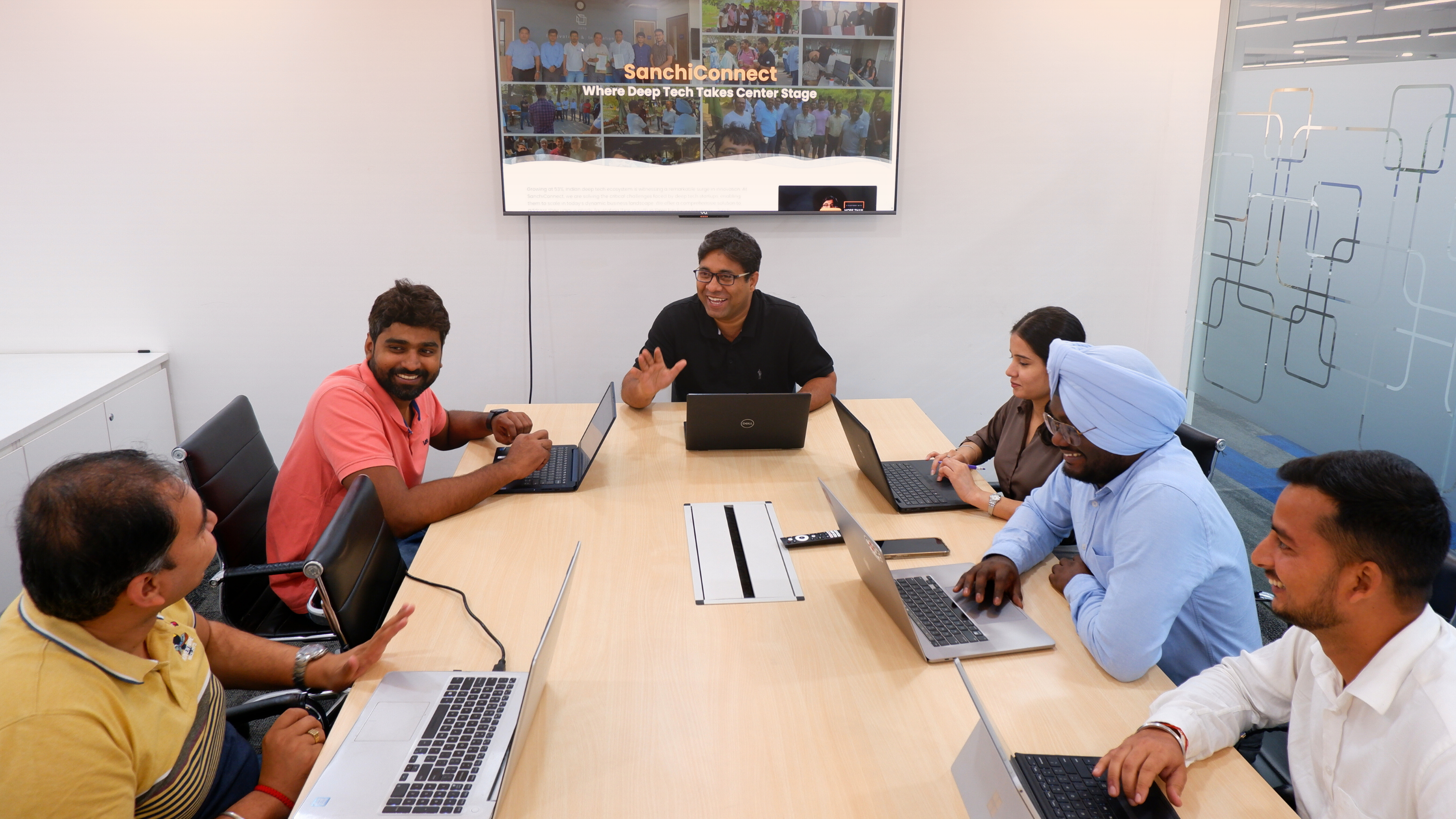
Institutional partners add another kind of evidence. IIM Lucknow’s Enterprise Incubation Centre made SanchiConnect a go-to-market and investment partner in 2022. The company names T-Hub, nasscom and IIT Kanpur as users of its white-label management software. YourNest, Capital-A and Thinkuvate have put investment propositions behind accelerators. A collaboration with the Government of Tamil Nadu and iTNT Hub is intended to extend structured support to deep-tech founders in Tier 2 and Tier 3 cities. In 2026, the company opened a physical DeepTech Hub in Noida - a bet that useful collisions still benefit from chairs, coffee and proximity.
Its own financing remains opaque. A 2024 raise from Baring PE India, Seafund, 8X Ventures and others was undisclosed. In June 2026, Auxano led another undisclosed bridge round, joined by existing investors Seafund, 8X and Arctic Invent and new investor Shashikant Chaudhary. SanchiConnect called it a precursor to a larger round. It also brought in former T-Hub executive Vijay Bawra to lead new initiatives and promoted Ashutosh Srivastava into senior leadership. Capital raised is not the same as business traction, but the repeat participation is a vote to continue the experiment.
What can another ecosystem builder copy? Start with a buyer’s actual challenge, not a celebratory pitch day. Keep cohorts small enough that mentors can own outcomes. Separate discovery from diligence. Make milestones visible to founders, evaluators and sponsors. Most of all, measure the handoffs - applications to evaluations, evaluations to pilots, pilots to deployments, introductions to closed capital. A network becomes defensible when it remembers what happened after everybody exchanged cards.
The approach has limits. It is a poor fit for a founder who wants guaranteed funding, a generic app that needs consumer growth rather than technical validation, or a corporate sponsor unwilling to commit procurement and R&D time after scouting. It also depends on trust: investors must believe the screening, startups must share sensitive technical and financial information, and institutions must use the system consistently. Software cannot rescue a pilot whose customer has no budget or internal owner.
Still, the premise feels sound. India’s laboratories do not need another motivational slogan. They need a route through grants, validation, pilots, capital and markets without starting from zero at every junction. SanchiConnect is trying to sell that route, record it and improve it. The most flattering description is an ecosystem operating layer. The more useful one is a switchboard - modest machinery, relentlessly connecting the call.