Before the first vines went into the ground, Willie Newman's California vineyard was a walnut ranch. He bought the property in 2004. Planting began in 2007. The name, 4 Hearts, referred to his wife and three daughters. For someone whose working life involved the speed and volume of mortgage lending, this was a business with a rather different attitude toward deadlines.
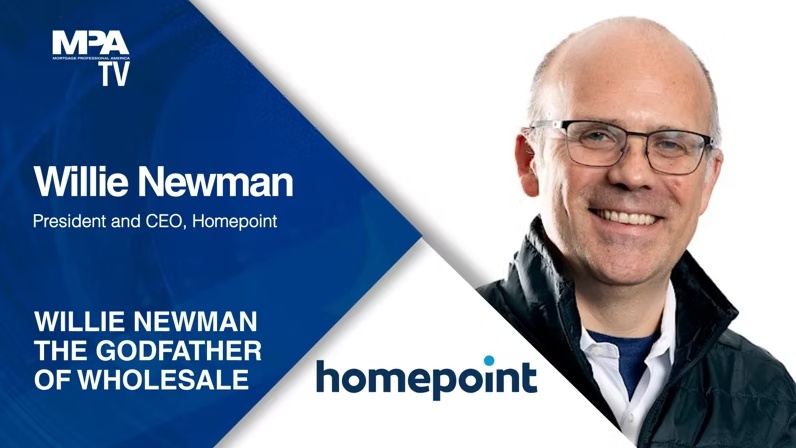
Newman is better known for Homepoint, the lender he founded with backing from Stone Point Capital. It began operating in 2015, grew into a substantial wholesale mortgage business, went public and was acquired in 2023. His work continued after the sale. So did the vineyard, which had been part of his life long before Homepoint opened its doors.
Across his career, he repeatedly backed independent mortgage brokers. He wanted them to compete, retain customers and build businesses that lasted beyond the next closing. Homepoint's ending complicates that ambition. It also makes the ambition worth examining.
Learning the business from the back
Newman entered mortgage banking in the late 1980s. His formal education included a finance degree from the University of Michigan and an MBA in Finance and Business Economics from Wayne State University. His practical education began in secondary marketing, the part of the mortgage business concerned with what happens to loans beyond their initial creation.
That starting point mattered to him. Learning about funding, leverage and financial exposure gave him a view of the machinery beneath the transaction. A mortgage business could look busy at the front while carrying problems farther back. He learned to consider both ends.
He credits an early mentor, Stan, with hiring him, teaching him the business and handing him responsibility. As the organization expanded, Newman was allowed to build functions and make mistakes. The permission came with supervision, but also enough freedom for the mistakes to become useful.
The setting was an industry being rearranged by the savings-and-loan crisis. Displaced loan officers needed ways to continue serving customers. Brokers presented an opening. Newman's mentor saw opportunity in that disruption, and Newman carried the idea forward. It became one of the recurring explanations for his willingness to build again.
“dislocation creates opportunity”
A lesson Newman carried from his early mentor
A computer between the broker and the bank
At InterFirst Wholesale Mortgage Lending, Newman helped develop a business serving third-party originators. The underlying proposition was straightforward: an independent broker could have a local customer relationship while relying on a larger lender for funding and support. Making that arrangement work required connections that were dependable enough for both sides.
His career then ran through ABN AMRO Mortgage Group. Technology became part of the work. Newman led development of Mortgages Online at InterFirst, an early internet-based wholesale lending portal, and worked on rebuilding Mortgage.com as a consumer lending operation. The useful historical detail is the combination: a broker advocate who also had experience with direct lending.
A website could shorten the distance between organizations. It could also expose every awkward step in the process. Newman's later emphasis on workflow and information followed naturally from this earlier work. The broker needed tools that made dealing with a large institution manageable.
After ABN AMRO, he helped establish Cole Taylor Mortgage. Then came another start. In 2014, Newman joined forces with Stone Point Capital to form Home Point Capital. The acquisition of Maverick Funding supplied the operating platform in 2015. He was building within an industry he already knew, with the opportunity to choose his emphasis again.
Keeping the customer after the closing
Homepoint did not begin with a single narrow route to growth. It initially covered several parts of mortgage lending. Over time, Newman and his colleagues concentrated more heavily on third-party originators, especially brokers. He identified 2018 as an important turning point and credited Phil Shoemaker with helping put the wholesale strategy into practice.
The distinction Newman wanted to make involved the years after a loan closed. A broker might do the difficult work of winning a customer's confidence, only to lose contact once payments went elsewhere. Newman's plan brought the broker, borrower and Homepoint's servicing relationship together. The first mortgage would leave information and a connection that could help with the next one.
This was an argument about the kind of business a broker could own. Repeated transactions with people who knew the firm could create something more durable than a succession of isolated sales. Newman used insurance agencies as a comparison when discussing the possibility of building lasting value in a brokerage.
He also imagined a less laborious repeat mortgage. If useful information could travel through the relationship, a returning customer should face less gathering and sorting of paperwork. In a 2021 discussion of Homepoint's work with Doma, he described a future transaction shaped by continuing access to customer data, with transparency running in both directions.
The proposition joined an old-fashioned preference for personal contact to an appetite for better systems. A familiar face was valuable. So was avoiding another request for information the business ought already to understand.
The cost of getting bigger
The business expanded. By the first nine months of 2020, Homepoint ranked third among U.S. wholesale lenders by origination volume. Home Point Capital became a public company in 2021. Those milestones explain why Newman attracted attention. His reflections on them explain more about his temperament.
Asked in 2022 what he would change, he considered whether he should have spent more time earlier on the cultural consequences of rapid growth. Perhaps that would have meant growing more slowly. Perhaps it would have meant more infrastructure. He left the alternatives open instead of offering a conveniently polished answer.
He also had reservations about his younger self. In an earlier conversation, he credited fatherhood with changing how he dealt with people. His advice to younger entrants began with a clear priority: “Who you work with is more important than what you do.” He also emphasized continuing education and the effect of decisions on customers. Even someone working far from the customer, he argued, influenced the experience eventually delivered.
That concern appeared in the company's hiring as well. Homepoint appointed DeAndre Lipscomb to a new diversity and inclusion leadership role in 2021. Newman described opportunities and the treatment of employees, partners and customers as measures of the business and its culture. The ambition was to give those concerns a place in how the organization operated.
Another revealing answer concerned public disputes among lending executives. Newman said he preferred to concentrate on execution and expansion of the wholesale market. Other lenders could benefit from that expansion too. His position allowed competition without requiring a daily quarrel, which must have saved a certain amount of typing.
An ending that belongs in the story
By 2022, the conversation had changed. Lower mortgage volumes and pressure on margins demanded attention to costs and processes. Newman discussed resetting the organization and improving interactions with brokers and consumers. In November, he spoke about building a more resilient mortgage bank through technology, workflows and staffing appropriate to a smaller market.
Homepoint's independent chapter nevertheless ended the following year. In May 2023, Mr. Cooper agreed to acquire Home Point Capital's outstanding shares for approximately $324 million in cash and assume $500 million of senior notes. The buyer said remaining Home Point operations would close after the transaction and customer onboarding. Its completion announcement followed on August 1.
Mr. Cooper acquires Home Point Capital
That ending deserves space beside the expansion. The broker relationships, the servicing plan and the public listing all formed part of a company whose remaining operations were ultimately set to shut. His earlier plans for the company and its eventual sale both belong in the account of his career.
His public work continued. In August 2024, he was identified as principal of Willow Canyon Advisors in an announcement about Polygon Research's analysis of mortgage costs. Willow Canyon and United Wholesale Mortgage supported the study. His interest was familiar: making the case for brokers. The backing gives the research a commercial context; the involvement shows continuity in his professional focus.
There were other connections to maintain. Wayne State thanked Newman of Willow Canyon Advisors for sponsoring its December 2023 Trammell and Parrish baseball camp. It is a small detail in a long business biography, but a specific one: a university he attended, a camp for younger players and support extending beyond a mortgage company.
Four hearts, and time to wait
The California property supplies another thread through these years. Tre Son is the wine label associated with 4 Hearts Vineyard in Paso Robles. Saxum, which has made wines from the vineyard's fruit, describes steep hillside blocks planted to varieties including Petite Sirah, Zinfandel and Cabernet Sauvignon. The vineyard is dry farmed, with head-trained vines.

His Michigan connection is visible in the wine business too. At The Fine Wine Source in Livonia, Tre Son has been poured and discussed with Newman present. A May 2026 tasting account describes several vintages of Zinfandel and a Cabernet Sauvignon that he joined the writer in tasting. It also places his life between Ann Arbor and Paso Robles.
The vineyard had been described as an eventual retirement enterprise. It had already been part of his life for years while he was still building Homepoint. That overlap is more revealing than a sudden escape-to-the-country story. He was tending to another business and another future alongside the mortgage work.
The four hearts in the name give this part of the biography its scale. A national lender can be measured by rankings, transactions and acquisition terms. A vineyard can carry the names of the people an owner has in mind. Newman chose to put his family there. After all the talk of keeping relationships alive, the label seems an appropriate place to finish.
Keep the conversation going
- MPA TV: the full interview
- Watch: Coffeez for Closers with Joe Shalaby
- Listen: mentorship and the broker channel
- Read: the 2024 mortgage research announcement
- Read: the May 2026 Tre Son tasting
- Explore: 4hearts Vineyard at Saxum
- Read: the acquisition completion announcement
Photography: The Wine Raconteur. Interview artwork: MPA TV.