A borrower can earn a living without earning a pay stub. That is an ordinary fact of working life and a surprisingly consequential fact in mortgage lending. A business owner has deposits, expenses and a tax return. A landlord has rent. Somewhere between those records and a house purchase sits a broker, trying to decide which evidence belongs in which application.
- Mega lends through mortgage brokers and correspondents.
- Its menu spans conventional loans, government programs and alternative income documentation.
- Its newer tools tackle the paperwork between a promising scenario and a funded loan.
Mega Capital Funding occupies that middle ground. Established in 1998, the California lender pairs familiar residential mortgages with programs for less conventional financial lives. The practical attraction is choice: a broker can explore different qualification routes within one lending relationship. The harder question is whether the file can survive the journey from plausible idea to approved transaction.
The income is real. Which document proves it?
Consider the distinction between a salaried employee and someone who runs a small business. Their capacity to pay may require different explanations. Mega’s bank-statement programs give brokers a route built around personal or business account records. Its other advertised options include 1099 income, profit-and-loss documentation and asset utilization. Each route changes the evidence the broker brings to the conversation.
For investment property, the starting point can change again. A debt service coverage ratio, or DSCR, program focuses on the property’s cash flow rather than the borrower’s personal income. Mega’s March 2026 webinar makes that distinction explicit. The property becomes central to qualification. A broker with a rental-property client therefore has a different question to investigate before assembling the application.
This is where “non-QM” earns its place in the vocabulary. It describes lending outside qualified-mortgage criteria; it does not erase underwriting. Mega’s October 2026 Simple Elite material requires two years of self-employment and, for business bank statements, at least 25% business ownership. It also warns that the largest loan, highest loan-to-value and lowest credit score belong to different scenarios. You cannot assemble your own mortgage from the most appealing number in every column.
The broker is the customer, too
Mega’s public offering is directed at mortgage professionals. Brokers and correspondents bring transactions; Mega provides lending programs and the underwriting and funding work behind them. Homebuyers, homeowners and investors are the eventual borrowers, but the daily relationship runs through an intermediary who needs answers, conditions and closing documents.
That helps explain the breadth of the menu. Alongside non-QM options sit conventional, FHA, VA, USDA and jumbo mortgages, plus home-equity products. A broker choosing among lenders such as UWM, Rocket Pro or specialist non-QM providers has to weigh the particular file. Mega’s pitch combines program choice with in-house service. Product breadth becomes useful when it saves a broker from starting the search again.
The July 2025 ARIVE integration moves that search into software brokers already use. ARIVE announced access to Mega’s loan programs within its platform, including prospect pricing for brokers awaiting approval. The distribution logic is straightforward: put the lender’s options where the broker is comparing possibilities.
Price deserves the same file-by-file attention. The CFPB’s Loan Estimate framework separates the interest rate, monthly payment and closing costs, giving borrowers a way to compare offers. A quick closing and a flexible documentation route are useful features. Neither tells you the total cost of borrowing. That comparison needs the actual terms of the proposed loan, including the cash required at closing.
Two genies. A great deal of paperwork.
The names invite a double take. MGenius is the loan portal. MGenie is the mortgage AI assistant. Mega’s year-end account of 2025 says it introduced both that year. Their jobs are distinct: one helps move a transaction through its stages; the other helps brokers investigate product and guideline questions.
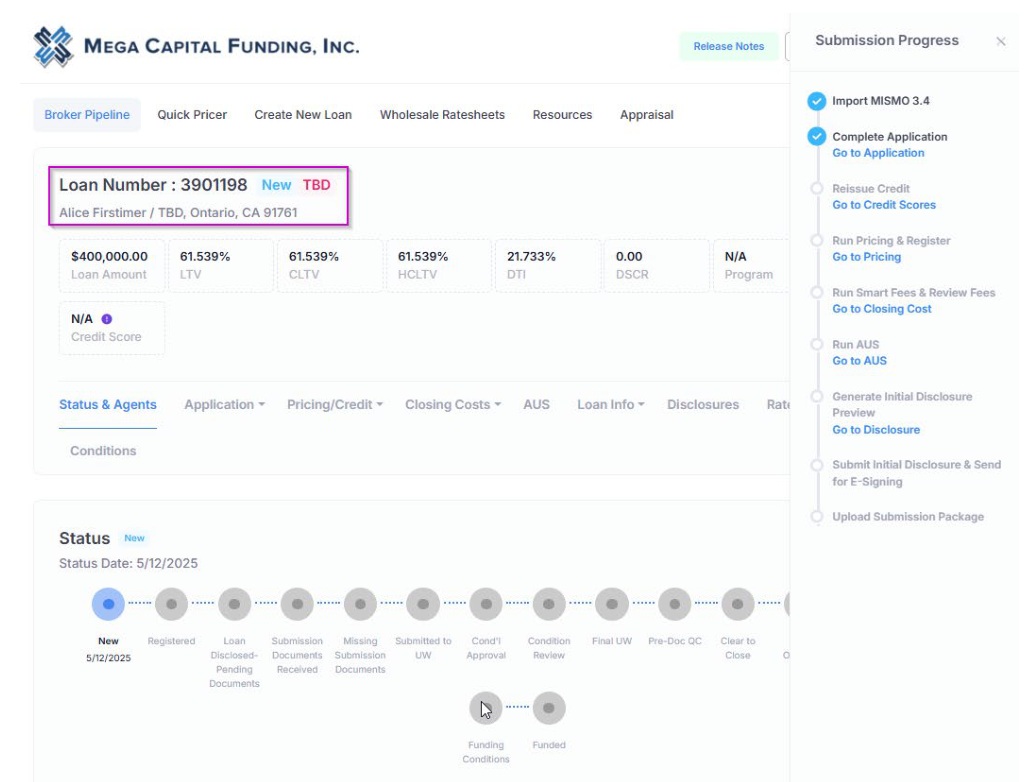
The public MGenius guide is revealing precisely because it is so procedural. Its submission checklist includes importing an application, reviewing fees, running automated underwriting, preparing disclosures and uploading documents. These are the small dependencies that make a closing possible. Software can put them in view, giving the broker a clearer sense of what the file still needs.
There is outside recognition for the broader service proposition. Mortgage Professional America included Mega among its 2025 5-Star Wholesale Lenders. Its methodology asked brokers to score six criteria, including rates, turnaround time, technology and training. That is evidence of broker-rated performance in that survey, rather than a promise about the next loan.
The 18-day loan has a footnote
In October 2026, Mega published a satisfying result: an investment-property purchase funded in 18 days. The loan was $600,000. Now read the other numbers. Loan-to-value was 40%, and the borrower’s FICO score was 778. Those details matter when considering whether another transaction could move at the same pace.
Mega’s own July closing checklist supplies the more transferable lesson. Get the full package first. Prescreen the scenario. Order appraisal and title work early. Return conditions together. Avoid late changes to ownership or loan structure. The broker can copy that discipline. Borrower responsiveness and third-party work still determine how much of the timetable anyone controls.
The limit no portal can remove
The company’s history provides a useful counterweight. During the pandemic disruption in March 2020, Mega suspended non-QM activity, citing financial-market retractions and uncertainty. Its notice tied a return to market stability. HousingWire reported its re-entry in February 2021 with Mega Elite alternative-documentation and DSCR products.
“until market stability returns”From Mega’s 2020 suspension notice
The point is practical. A lender needs capital as well as a workable application. Flexible documentation cannot make market funding available on demand. Likewise, a guideline assistant cannot make an ineligible property eligible or turn incomplete records into sufficient evidence.
For a broker, Mega’s usefulness begins with an accurate diagnosis: what income exists, how it can be documented and which program permits it. Then comes the less glamorous advantage of submitting a coherent file. A borrower’s finances may be unconventional. The case for lending still has to be legible.