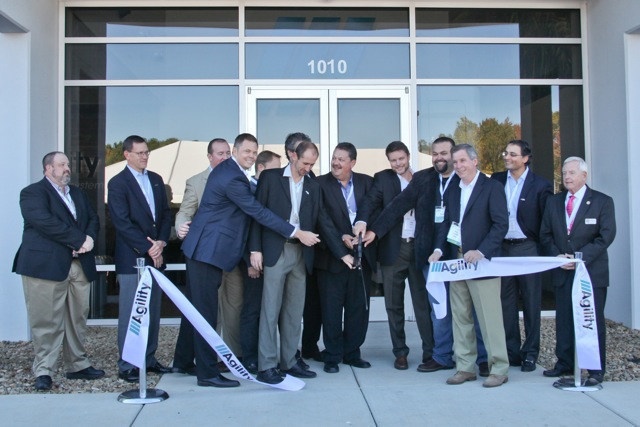
A ribbon is an unusually cooperative management problem. It stays where it is put, requires very little training and yields to scissors on schedule. In October 2015, William Nowicke took part in a ribbon-cutting for Agility Fuel Systems’ new factory in Salisbury, North Carolina. The building beyond the ceremony presented a more interesting assignment: turning an investment in production into fuel systems that customers could put to work.
Nowicke was Agility’s chief operating officer and interim chief executive. More than 300 guests attended the opening. The photograph has the familiar ingredients of industrial celebration: company executives, local officials, an entrance, an obliging ribbon. It captures a public milestone in a career spent largely with the less photogenic parts of a business - manufacturing, operating performance and the passage from one organizational arrangement to another.
Today, he is a Principal in Operations at Platinum Equity. The route between those two roles runs through engineering, automotive factories, turnaround consulting, an electric-car company and natural-gas truck technology. Follow it closely and the everyday details become the story. A production process. A fuel reading. A company entering a new owner’s portfolio. Each puts a business plan through a practical examination.
A ribbon, a factory and an interim chief
Agility’s Salisbury facility represented a $20 million investment and covered 204,000 square feet. The operation brought cylinder production, metal fabrication, painting, assembly and installation into one location. Its equipment and layout were intended to handle different vehicle configurations, with installation bays and fueling available on site.
For Nowicke, the case for the building concerned control over quality, cost and delivery. Those three words describe a demanding relationship: an inexpensive product arriving late creates its own expense; a punctual product of poor quality merely delivers the problem sooner. Putting several manufacturing stages together was Agility’s proposed way of managing that relationship.
The opening also belonged to a wider transition. Manufacturing was to move from Kelowna, Canada, to North Carolina over the following six months, while Kelowna remained a technical engineering center. At the ceremony, Nowicke appeared alongside Shawn Adelsberger, the director of operations and plant manager, and Salisbury and Rowan County officials. Behind the scissors sat a change in the company’s manufacturing geography.
An education in things that have to work
Nowicke’s education spans three connected disciplines. At Oakland University, he earned a bachelor’s degree in mechanical engineering and a master’s in systems engineering. At the University of Michigan, he earned an MBA; his public education record places his Ross School of Business studies in 2001-2003.
Mechanical engineering deals with physical systems. Systems engineering broadens the view to how parts interact. Business education adds questions about resources, organizations and financial decisions. The combination is useful context for a career that has repeatedly crossed between equipment and enterprise. It does not make the equipment any more forgiving.
His early professional history includes senior manufacturing roles at Chrysler, followed by performance-improvement work at AlixPartners. In the latter assignment, his responsibilities included restructuring and turnaround work in manufacturing across automotive, consumer products, aerospace and defense. The sectors differed; the assignment kept returning to how an operation was functioning.
That background also explains the industrial continuity in a résumé that can look varied at first glance. Automotive production, consulting, vehicle technology and private equity operations occupy different places on an organizational chart. They all contain working systems that someone has to understand before attempting to change them.
An electric detour through Oslo
In January 2011, THINK announced Nowicke’s appointment as vice president of global operations. He arrived at the electric-vehicle company’s Oslo headquarters with more than 15 years of automotive leadership and turnaround experience. The assignment concerned expanding operations across an international footprint.
THINK had begun producing vehicles at an assembly facility in Elkhart County, Indiana. European production involved Valmet Automotive in Finland, while the company was developing Asian operations with its Japanese strategic partner, Itochu. Further product-development and engineering facilities in Oslo were planned for 2011. Expansion had a distinctly geographic meaning.
Barry Engle, THINK’s chief executive, connected the appointment to growth in manufacturing and engineering. Nowicke’s own comments expressed interest in developing the company’s technical position and expanding beyond its European base. It was an ambition tied to that particular assignment, in the early commercial life of electric vehicles.
The episode puts an international chapter inside a Detroit-area career. Production partners, engineering facilities and new assembly capacity formed the immediate setting. The next stops in his professional history included North American sales operations at Martinrea and an M&A operations role at Platinum Equity before his move to Agility.
- ChryslerManufacturing
- AlixPartnersPerformance improvement
- THINKGlobal operations
- AgilityOperating leadership
- Platinum EquityPortfolio transitions
Four months in the chief executive’s chair
Nowicke’s interim CEO assignment at Agility began after Barry Engle’s departure at the end of July 2015. It lasted until Kathleen Ligocki became chief executive on December 3. He then returned to his chief operating officer position. The distinction matters: the temporary leadership assignment was one chapter within a longer operating role.
Agility’s chairman, Michael Gallagher, thanked him for leading the business through the transition. During that interval, the company opened the Salisbury factory. There was a change in leadership and an important manufacturing milestone at the same time, giving the interim assignment a concrete event by which to remember it.
An interim title comes with an awkward clock. It announces that a person is responsible now, while also announcing that the arrangement will change. Customers, employees and production schedules have little reason to adjust their expectations to that grammar. The role has to be occupied while the organization prepares for the next occupant.
In Nowicke’s case, the sequence is clear: operating chief, temporary chief executive, operating chief again. It is a useful corrective to reading a career as a collection of titles without dates. The work continued through the handover, with a new production facility already part of the business.
The dashboard gets a vote
By May 2017, Nowicke was chief operating officer and president of Agility’s Fuel Systems business unit. The company had begun shipping production units of Blue iQ, a system developed with Cummins. His explanation of the product centered on vehicle performance, diagnostic capability, uptime and return on investment.
“Our customers are looking for a better-than-diesel driving experience and Blue iQ delivers.”
William Nowicke, May 2017
Blue iQ brought fuel-system information together with engine data and Cummins service tools. Its dashboard gauge included a vehicle-range monitor. Other features addressed fuel economy, low-fuel operation and cold starts. For a driver or fleet manager, the subject was immediately legible: how much useful travel remained, and what happened when something needed attention.
A dashboard instrument is a modest object to place in an executive biography. Yet it brings the customer into view. A fleet adopting natural-gas vehicles needed the truck’s behavior to be understandable to drivers and service teams. Product development had to address those working relationships as well as the machinery.
At the 2017 ACT Expo, the company showed a vehicle equipped with Blue iQ and an interactive demonstration. The display offered another kind of examination for an operating executive: could a technical development be explained through a problem that the customer recognized?
How far?Vehicle-range information for the driver.
What needs attention?Engine and fuel-system diagnostics.
How does it work day to day?Fuel-management features and service-tool integration.
A place at the commercial table
The operational questions reached beyond the dashboard. At the same industry exhibition, Nowicke discussed natural-gas truck economics, including his view that such vehicles could outperform conventional diesel models on a cost-per-mile basis after five years. It was a claim about a period of ownership, made in the market conditions of 2017.
The surrounding discussion included higher initial vehicle costs, uncertainty about residual values and uneven fueling infrastructure. Range, maintenance and purchase price were parts of the same decision. A customer could like a technology and still need its arithmetic to cooperate.
Nowicke’s role also touched the commercial organization. In October 2016, Agility appointed Eric Bippus senior vice president of sales and marketing, responsible for global revenue growth. The announced reporting relationship ran to both Ligocki and Nowicke. Operating leadership and the sales function were connected in the company’s structure.
His industry appearances placed him in discussions with fleet, fuel and policy representatives. The agendas included market opportunities for natural-gas vehicles and their adoption. Those settings extended the operating conversation into the business conditions surrounding the vehicle: who would buy it, where it would run and how it would be supported.
The work after the acquisition
Nowicke returned to Platinum Equity’s portfolio operations team in 2019 and became a Principal in December 2021. The firm uses Bill Nowicke in his current biography. His responsibilities include managing the transition of newly acquired companies into the portfolio, followed by monitoring and oversight of operational performance at certain businesses.
That last responsibility gives the career its present tense. The transition has an aftermath. A company enters a portfolio, then continues to operate, with performance to examine beyond the initial change of ownership. Acquisition language can make the closing sound like the end of the action. An operations assignment gives the following days their own importance.
The factory opening in Salisbury is an apt place to return. The ceremonial photograph records a moment when an investment became publicly visible. The production work depended on what followed. Across Nowicke’s career, from manufacturing to fleet technology to ownership transitions, that interval keeps appearing: the distance between announcing a plan and making it function.
The ribbon has long since been cut. The operating questions have rather better staying power.