William Armstrong’s working life can look, at first glance, like somebody emptied four desks onto one table. There is the engineer’s laptop, the campaign operator’s clipboard, the community organizer’s sign-up sheet and the founder’s nervous collection of metrics. The objects do not quite match. Armstrong does. Across each project, the recurring subject is movement: how a person enters a group, how information travels through a company, how an idea becomes an interface, how a tool either lightens someone’s day or quietly makes it worse.
That preoccupation has carried him from San Francisco to Boston College and back again. He studied human-centered engineering, added a minor in general business, and graduated in 2026. The degree name is almost too tidy for the work that followed. Armstrong has helped run a mayoral campaign internship program, built a social-club platform, worked on AI automation, organized a run club and joined Vercel as a Solutions Architect. His portfolio calls him an engineer and entrepreneur. A more revealing label might be translator.
He translates between a user’s irritation and a product roadmap. Between a sales team’s raw lead and the useful context hidden inside it. Between software that promises elegance and the decidedly inelegant habits of real people. He is attracted to the joints of a system, the places where one thing must hand responsibility to another without dropping it.
A club is a feeling. It also has a back office.
ClubPack began with an unromantic observation. Social clubs may exist for running, meeting or belonging, but somebody still has to manage the machinery. Events need pages. Members need reminders. RSVPs need counting. Organizers need to know what worked. Armstrong and co-founder Eli Kishinevsky had hosted clubs themselves and saw the administrative sprawl up close. Their answer was a single platform for events, websites, member communication and analytics.
Armstrong’s portfolio says the product has served more than 25 active organizations. Boston College’s Start@Shea accelerator selected ClubPack for its 2026 cohort, listing Armstrong and Kishinevsky together and providing the team with a $1,500 equity-free grant. The useful detail is not the cheque. It is that ClubPack grew from an experienced inconvenience rather than a search for a fashionable category.
The first version, built in React, proved that organizers would use it. Then the code began to resist the next stage. Public club pages needed to load quickly. Routing grew more complicated. Discoverability mattered. Armstrong did something founders often postpone because it produces no celebratory launch photograph: he deleted most of the foundation and rebuilt it in Next.js.
“The first version of ClubPack was about validation. The rebuild was about durability.”William Armstrong, on rebuilding ClubPack
The rebuild took roughly two weeks. Armstrong described it as intense, focused and “slightly obsessive.” More important, it changed what occupied his attention. When a codebase has sensible boundaries, he wrote, the builder can stop fighting the structure and return to users, flows and outcomes. Architecture, in this telling, is not a cathedral for developers. It is a way to clear the room so the customer can be heard.
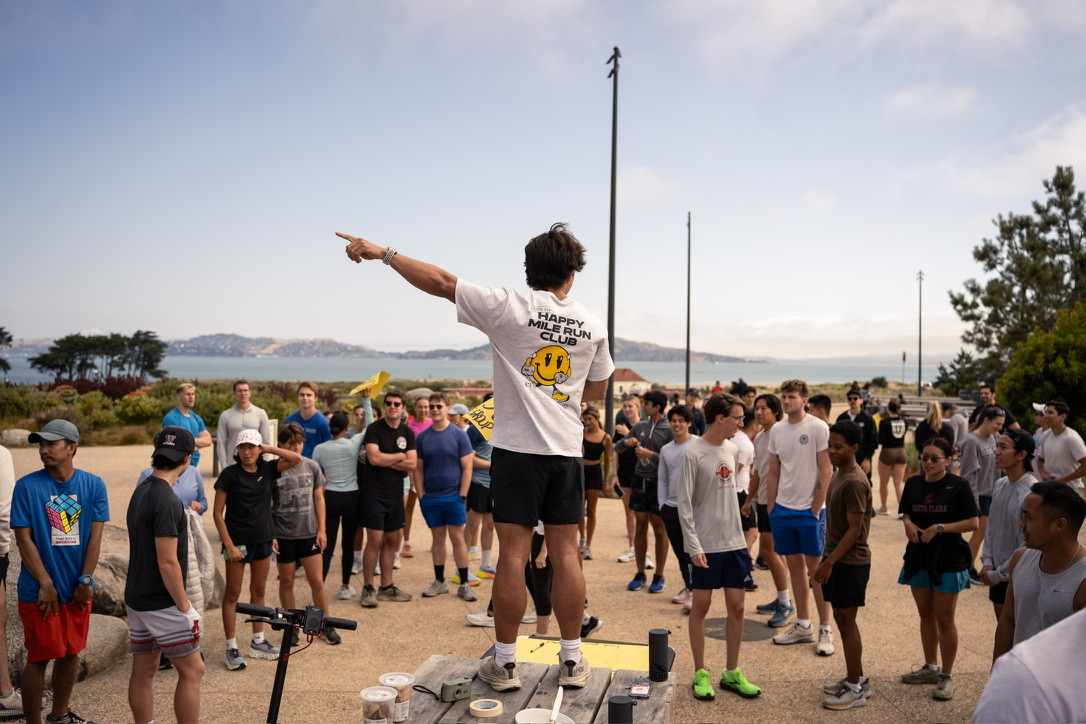
Happy Mile made the interface physical
Happy Mile Run Club gives Armstrong’s systems thinking a human, noisy form. His portfolio describes a free, young and social San Francisco running community that grew beyond 3,000 members and developed a Nike partnership. In a photograph from the project, Armstrong stands on a bench near the bay, pointing over a crowd in running shoes. There is no dashboard in sight, but there is still a user journey: hear about the run, arrive without anxiety, find the group, move together, return next week.
It sits beside other experiments in his portfolio. Destination Drifters, an outdoor travel brand started during his first year of college, collected more than one million views and sold merchandise. Mod Brew turned coffee into a speakeasy-style campus pop-up, with more than 1,000 customers reported across its run. Different objects, same operating rhythm: notice a gap, make participation easy, watch how people respond, adjust.
That rhythm also appeared far from campus. In the summer of 2024, Armstrong led operations and strategy for a team of more than 60 interns on Mark Farrell’s campaign for San Francisco mayor. Scheduling, resource allocation and daily field work turned political ambition into a queue of practical decisions. Armstrong says the tracking systems and workflows improved campaign efficiency by about 30 percent. Campaigns are temporary organizations assembled under public pressure. They expose weak handoffs quickly.
Armstrong’s recurring build loop
Thirty iterations and a very old piece of software
The cleanest demonstration of Armstrong’s method arrived in a decidedly untidy job. A small business was spending hours moving data between QuickBooks and an operations program that had been in place for 15 years. Another company had spent months scoping a solution and billed tens of thousands of dollars without making it work. The legacy system had no proper API. Its old assumptions were embedded in file formats, routines and the institutional memory of its users.
Armstrong’s first version worked on the basic case. Within an hour, the client found three exceptions. So he rebuilt it. More exceptions appeared. He rebuilt it again. With deployments taking less than a minute, the client could click through a workflow while Armstrong changed the code, then reload and test the correction. The feedback loop shrank from days to minutes. After about 30 iterations over three days, he says the automation was saving roughly $50,000 a year in manual labor.
“The real problem lives in the exceptions, the workarounds, and the habits of the people who have been living with the friction long enough to stop noticing it.”William Armstrong, on legacy systems
There is a modesty hidden inside that conclusion. Software people enjoy imagining that the old system persists because nobody had the courage to replace it. Often it persists because it has become an organ of the business. Employees have built reflexes around it. Armstrong’s solution succeeded by entering that reality rather than demanding a cleaner one.
Learning below the abstractionThe little cloud in the apartment
For somebody now working at a cloud platform, Armstrong has a healthy suspicion of invisible machinery. In 2026, he bought a $55 Raspberry Pi and built a small home server. He installed Docker for containers, Tailscale for a private network, n8n for automation, Home Assistant for connected devices, Immich for photo storage and Caddy as a reverse proxy. The computer draws about five watts and fits in a hand.
The exercise did not persuade him that a Raspberry Pi should host serious production applications. It clarified why managed cloud services earn their fees: redundancy, global delivery, uptime and the experts awake at three in the morning. Running the hardware himself made each abstraction physical. A server could lose power. A network could disappear. A backup had to exist somewhere. His conclusion was characteristically balanced: use local hardware when a task must be always on, physically present or private; use the cloud when reliability and scale matter.
“The cloud is not a category of technology. It is a set of tradeoffs.”William Armstrong
He wants to go lower still, into Zigbee radios, software-defined radio, GPIO pins and local network traffic. That curiosity has the cheerful danger of a person discovering that every floor contains a trapdoor. It also explains the breadth of his work. Armstrong is not collecting tools for display. He is trying to feel where the abstraction ends.
A title for the intersectionEngineering, business, people
Before Vercel, Armstrong worked at AdviserGPT on a technical platform that connected customer acquisition, AI enrichment and internal automation. He built pipelines with n8n, Supabase and Slack, and helped turn an LLM prototype into a production content workflow. A screened profile from that period describes him as curious, hands-on and a careful listener who could explain new technical work to customers. The pattern is visible again: the value was in the handoff between model, interface, team and user.
Armstrong found a name for part of this territory in GTM engineering. The discipline sits behind sales and marketing, wiring together lead capture, enrichment, classification, routing and useful context. He likes it because it refuses the old choice between “technical” and “commercial.” The system is technical. Its purpose is to help a person have a better conversation.
Growth and operations work at Orangetheory Fitness turns onboarding into an early lesson in customer flow.
A San Francisco mayoral campaign puts him in charge of operations for a 60-plus-person intern team.
ClubPack, Happy Mile and AdviserGPT bring product, community and AI workflows into the same year.
He graduates from Boston College, joins the Start@Shea cohort and becomes a Solutions Architect at Vercel.
AI has accelerated Armstrong’s output, but his public writing pushes against confusing generation with judgment. He argues that as code becomes easier to produce, taste becomes more consequential: what should exist, where a user feels friction, when an interface has become needlessly heavy, whether a system’s foundation can survive growth. “AI amplifies output,” he writes. “It does not replace discernment.”
That belief ties the projects together better than any job title. The run club needs a welcoming ritual. The campaign needs information to reach the right volunteer. ClubPack needs organizers to spend less time on administration. A legacy workflow needs to respect habits accumulated over 15 years. A Vercel customer needs architecture that connects a business outcome to working software.
Armstrong is early in his career, which makes grand conclusions premature and slightly rude. The evidence so far suggests a useful direction. He keeps choosing the seam rather than the silo. He builds where one discipline has to understand another. Connective tissue is rarely the glamorous part of a body, but without it the limbs are merely a collection. Armstrong seems content to work on what lets the whole thing move.