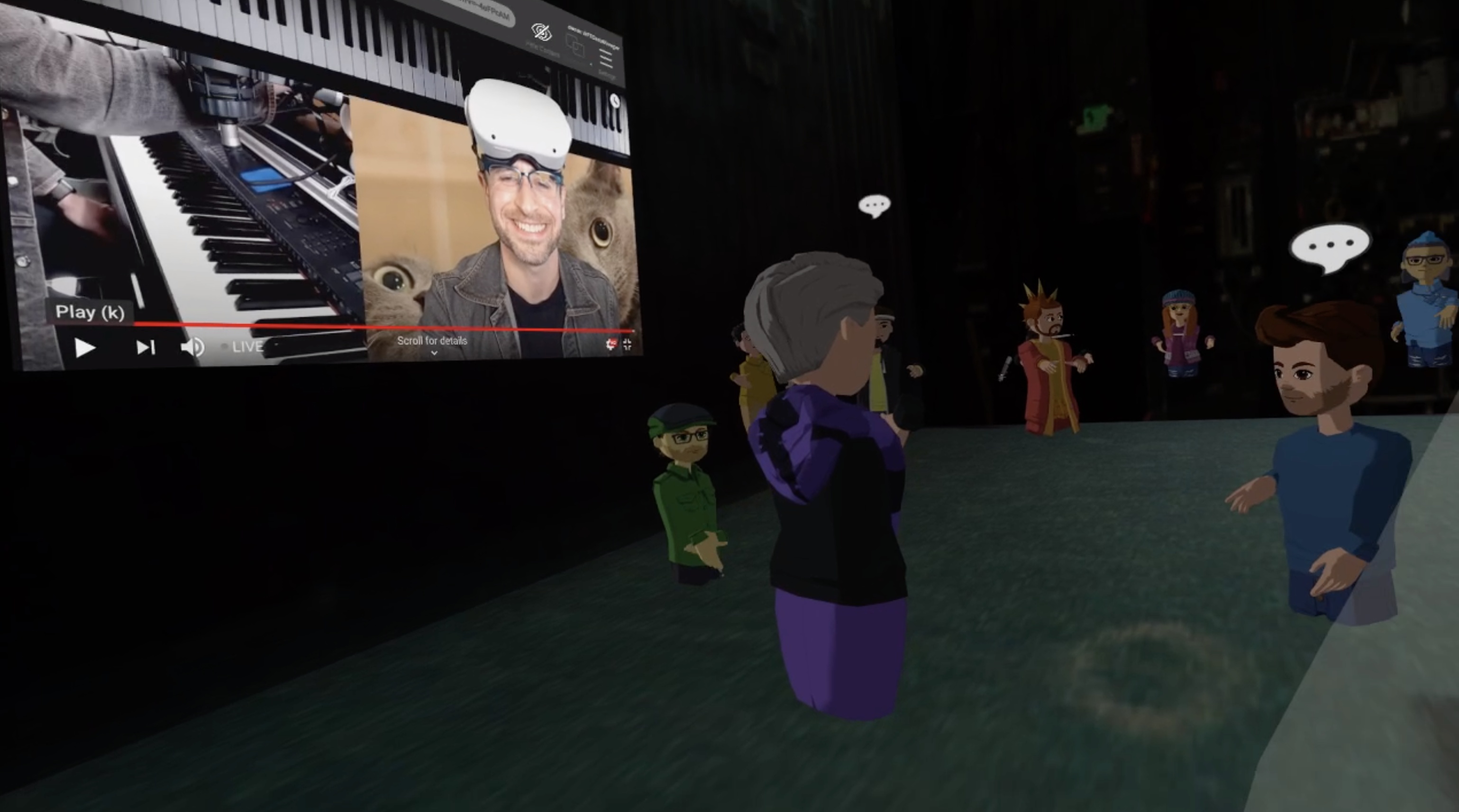
In the photograph, Will O'Brien is red. Beside him stands an avatar of the pianist Greg Spero; behind them, a screen shows the musician in human form. A jazz performance has become a meeting between people, their digital representatives and a rather improbable piano. The venue is NFT Oasis. The year is 2021. Even the after-show conversation has acquired a new address.
O'Brien helped found the place. He was also a pianist himself, with a first album, IĀNUAE, released that January. For a founder previously associated with securing Bitcoin, a virtual concert might look like a substantial career detour. Yet both projects involved a practical question: how do people enter an unfamiliar digital environment and feel able to do something there?
That question has followed him into Provenonce, where he is co-founder and CEO. The company now builds infrastructure for coordinating AI systems across existing business tools. Its vocabulary has changed from virtual worlds to governed workflows. O'Brien's current ambition concerns agents doing work that another person, business or machine can accept. Somewhere between the concert and the corporate software sits the same awkward little matter of trust.
A game that could follow you home
Before the wallets and avatars came the business of getting software into people's hands. O'Brien studied computer science at Harvard, then earned an MBA at MIT Sloan. His early career included real-time trading technology at Random Walk Computing and a general management role in social games at TrialPay. Those jobs put him near the machinery that makes a digital interaction commercially useful: transactions, payments and distribution.
At Big Fish Games, where he worked from 2010 to 2013, cloud gaming supplied a particularly concrete version of the problem. A game would run on remote servers. A player could reach it through a device, with progress saved elsewhere. The attractive part was immediate access. The difficult part was making immediate access affordable and dependable.
In 2012, as a vice president and general manager of cloud gaming, O'Brien was explaining Big Fish Unlimited's economics. Casual games could share lower-end server hardware, he said, and the service could support basic broadband connections of one to two megabits per second. The detail is revealing: an ambition to change distribution still had to squeeze through somebody's home internet connection.
Unlimited reached Android tablets after its PC launch, with a premium subscription priced at $7.99 a month and a limited advertising-supported option. Game progress could follow a player between devices. A cloud platform, in this version of O'Brien's career, meant something pleasantly ordinary: you could put down one screen and pick up another without starting again. The future had a monthly bill.
The key was having more than one
By 2014, O'Brien was explaining a different kind of access. As BitGo's co-founder and CEO, he was helping build security for Bitcoin users and businesses. The digital asset could move across borders, but the ability to move it was also a vulnerability. Whoever controlled the necessary credentials controlled the funds. A technological promise had acquired a very old problem: who gets the keys?
BitGo's multisignature design distributed control. The wallet architecture described at the time used three keys, with two needed to authorize a transaction. A user held one, BitGo held another, and an offline backup provided a recovery route. The arrangement made shared authorization part of the product. Spending limits and corporate policies added further controls around the act of signing.
In June 2014, BitGo raised $12 million in a round led by Redpoint Ventures. O'Brien described the purpose in terms of team, credibility and international scale. Former VeriSign CEO Stratton Sclavos joined the board. The comparison with early internet commerce was explicit: unfamiliar transactions needed security infrastructure before larger organizations would comfortably participate.
At the end of that year, O'Brien wrote about the movement from multisignature wallets toward controls spread across users and institutions. His discussion included treasury protections, standards, auditors and insurers. These were unusually sober guests at a Bitcoin party. They were also the people whose participation could help turn an experiment into a business system. Years before his AI work, the question of delegated authority was already occupying the page.
Signatures required to authorize a transaction.
A founder with a piano album
The music complicates any tidy reading of O'Brien as a security executive. He studied piano under jazz musician John Mastroianni and released IĀNUAE in January 2021. A few months later, NFT Oasis offered artists an environment for performances and exhibitions. The founder had a personal connection to the work being put on the virtual stage.
An early Spero performance drew roughly 200 attendees represented by avatars. The spectacle had its comic advantages: a jazz audience could gather in a customized digital room, then linger to talk while the musician existed both on a screen and as an animated figure. The accompanying image catches the social experiment better than a paragraph of metaverse vocabulary could.
O'Brien joined fellow founder Patrick Booth Jr. for a discussion of plans to help artists learn about NFTs and use the platform. Education belonged alongside the venue itself. An artist who could perform still needed to understand the new arrangements for ownership, access and exchange. Giving somebody a stage did not automatically give them a workable business.
The aspiration was large, but the activity was specific. A company formed in March. By July, NFT Oasis said more than 200 artists and musicians had presented work in VR since April. It announced $4.4 million in financing from 32 individuals, family offices and funds across the United States, Europe, the Middle East and Asia. The backers included Brad Stephens, Lemniscap and FlamingoDAO.
“The human experience is driven by stories,” O'Brien said in the financing announcement. His argument linked cultural value with the communities surrounding an artist's work. The proposed venue brought performances, exhibitions and creator economics into one environment. It was an effort to give artists more control over the conditions in which an audience encountered them. The person running it had already made a record of his own.
“The human experience is driven by stories.”Will O'Brien · July 2021
The birthday announcement became a business
Provenonce's next chapter took shape in July 2024, when O'Brien announced its AI pilot alongside the commercial launch of Provenonce Summits. He marked the announcement on his birthday. The company had moved from NFT Oasis toward browser-based immersive events and, increasingly, software for business operations. Its successive products record that change more clearly than any single industry label.
On July 11, 2025, Provenonce announced the commercial launch of its AI-native go-to-market platform. The intended users were revenue teams dealing with scattered customer information and work spread across applications. O'Brien's diagnosis was that teams had plenty of incoming material and difficulty translating it into coordinated action. A useful system had to move work between people and tools.
The company reported that its pilot generated and enriched more than 10,000 qualified leads and shortened some content development cycles by up to 75 percent. Those were Provenonce's reported results. The practical proposition was integration with systems such as HubSpot and Slack, so a customer could introduce agents into an existing workflow.
By 2026, O'Brien was making a broader architectural argument about enterprise AI. His writing on controlled autonomy addressed the difficulty of placing probabilistic agents inside organizations built around predictable procedures. The proposed answer included permissions, memory boundaries, confidence-based controls and routes for human intervention. The vocabulary was technical; the managerial concern was familiar. Delegation requires a way to decide when the delegate should stop and ask.
Artists & virtual venues
A new operating direction
Work across business tools
What comes back when an agent says “done”?
Provenonce now describes its work as a coordination layer connecting AI systems, people and existing infrastructure. O'Brien leads it with JP O'Brien, the company's president and chief operating officer. The business describes an approach intended to let organizations coordinate work without handing over custody of their data or replacing their existing systems of record.
Its Proof of Assurance concept carries the question into verification. A task begins with predefined requirements. Execution produces an evidence bundle. Validators compare that evidence with the requirements, producing an assurance score. The proposal uses Bittensor's incentive structure to connect verified work with rewards. It is a concept focused initially on structured workflows, where requirements can be stated in advance.
O'Brien presented Proof of Assurance at Proof of Pitch during Proof of Talk in Paris. Provenonce says it reached the final, finished runner-up in the live crowdfund and attracted pledges of nearly 300 TAO. It describes continuing work with Bitstarter on a possible launch path. The distinction between a pitch, a pledge and an operating network matters to a project whose subject is evidence.
In his July 11, 2026 essay, The Agent-to-Agent Economy, O'Brien returned to an argument he had made about Bitcoin in 2014. He connected institutional adoption with the infrastructure that lets parties rely on one another. Now he sees agents becoming participants in commerce. His concern extends beyond their capacity to exchange messages to whether another party can accept the work they claim to have completed.
The wallets, the streamed games and the virtual performances give that argument a personal history. Each required people to place some activity in a system they could not entirely see. O'Brien has worked on the controls, the distribution and the gathering places surrounding those decisions. His latest company asks for a record of what happens after permission is granted. The agent may announce that the job is finished. O'Brien wants something you can inspect.
- DefineRequirements agreed in advance
- ExecuteWork produces evidence
- EvaluateValidators score the evidence