In 1900, Frederick Weyerhaeuser and his partners paid $6 an acre for 900,000 acres of Washington timberland. The bill came to $5.4 million. Two years later, the Yacolt fire delivered an uncomfortable lesson: owning a forest and knowing what to do with it were different businesses. Salvaging burned timber helped push the young company into logging and manufacturing. Its education began with a fire.
In brief
- Grows timber, makes building materials and distributes them.
- Sells to builders, dealers, industrial buyers and land partners.
- Looks for additional value in land, including recreation and carbon projects.
That episode makes a useful introduction to the Weyerhaeuser of today. Trees remain the raw material. But the company also sells structural engineering, building supplies, recreational access and land rights. Its next customer might want a floor joist. Another might want space deep underground. Understanding the company means looking past the trunks.
Trees take decades. Builders have deadlines.
Growing a commercial tree can take 25 to 50 years. A homebuilder cannot wait that long for Tuesday's delivery. Weyerhaeuser operates between those two clocks, managing forests while manufacturing and distributing products for people who need predictable materials on a construction schedule.
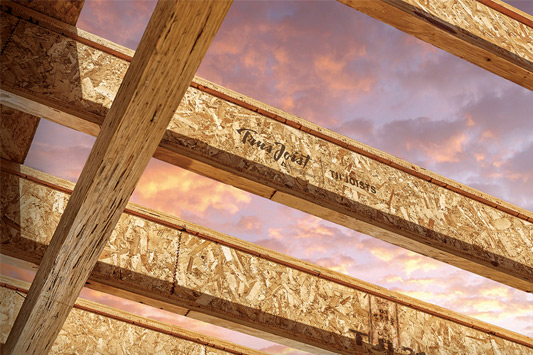
Its customers include lumber dealers, builders, architects, engineers, industrial wood buyers and other mills. The product list runs from ordinary structural lumber and oriented strand board to Trus Joist engineered wood: TJI joists, TimberStrand laminated strand lumber, Microllam laminated veneer lumber and Parallam parallel strand lumber. The names are specialized because the problems are specific: span this room, carry that load, keep this floor from feeling springy.
Take a TJI joist. Its engineered shape and dimensional stability help resist the twisting and shrinking that can contribute to squeaks. Long lengths give designers flexibility; lighter members ease handling. The useful promise is consistency. A builder has enough variables on a jobsite without asking every piece of wood to behave differently.
Weyerhaeuser surrounds that material with instructions, technical support and software. ForteWEB, its free browser-based sizing tool, lets design professionals calculate members for specified loads and geometry. It requires an account and internet access. Nobody receives a universal price for a houseful of products: quantities, specifications, dealer terms and location determine the purchase. The free software is an accessible starting point.
One acre, several customers
The forest itself has several markets. Timberlands supplies logs and seedlings and earns money from recreational leases. Wood Products turns fiber into building materials and distributes products. Strategic Land Solutions, the segment name introduced in 2026, handles real estate, natural resources and climate solutions. Each looks at land through a different set of questions.
A tract might be valuable for its next harvest. Another may command more as property sold for a different use. Elsewhere, the relevant asset could be minerals, renewable-energy access, conservation potential or subsurface storage rights. These choices depend on the tract; an acre does not automatically qualify for every business line.
The distinction becomes wonderfully concrete in Louisiana. In 2022, Weyerhaeuser agreed to lease more than 30,000 acres of subsurface pore space to Occidental's Oxy Low Carbon Ventures for evaluation and potential carbon-storage development. The arrangement allowed working forestry to continue above ground. Trees at the surface; a proposed storage business below. The announcement described a development opportunity, rather than proving that carbon was already being injected.
The business in proportion
Where the sales happen
Q2 2026 / external net sales / US dollars
The $2.2 billion exit
Adding uses is only half the story. Weyerhaeuser also narrowed its portfolio. It merged with Plum Creek in February 2016, then completed the sale of its Cellulose Fibers pulp mills to International Paper that December for $2.2 billion in cash. After-tax proceeds were expected to be $1.6 billion, with much directed toward debt repayment.
The explanation at the time was strategic focus. Chief executive Doyle Simons said the deal “further focuses our portfolio.” That matters when a directory still files Weyerhaeuser under paper and forest products. The modern business deserves a more precise description: a timberland real estate investment trust with manufacturing, distribution and other land businesses attached.
The contrast with competitors is a matter of combination. Boise Cascade also sells engineered joists, laminated veneer lumber, distribution and technical support. Weyerhaeuser's distinguishing feature is the connection of those building products with an extensive timberland portfolio and additional ways to earn from land. Integration provides choices. It does not make product prices or housing demand obedient.
“further focuses our portfolio”
Doyle Simons / then CEO / 2016 pulp-mill sale
Wood fiber meets the steelmaker
In December 2025, Weyerhaeuser and Aymium announced TerraForge Biocarbon Solutions, a joint venture for a facility beside Weyerhaeuser's McComb, Mississippi, lumber mill. It would convert wood fiber into biocarbon for metals production. The first facility was expected online in 2027. Their broader memorandum contemplated a platform capable of producing 1.5 million tons annually. That is an ambition, not an operating total.
The logic is familiar: find another paying use for a resource and a supply chain already in hand. Execution still requires customers, facilities and functioning economics. Likewise, a carbon-storage lease needs suitable geology and a project that can advance through development. Forest ownership alone cannot manufacture demand or secure every approval.
The conventional business keeps experimenting too. At the February 2026 International Builders' Show, Weyerhaeuser previewed ProPanel floor panels and AeroStrand laminated strand lumber with pre-cut openings for building services. Both were described as still in development. A product preview belongs in the future tense until availability is announced.

What is worth copying
There is a practical lesson here for people who do not own a sawmill: understand the asset before deciding how many businesses it can support. Map the rights, identify the customer and test the cost of serving them. Weyerhaeuser's pore-space agreement illustrates how a partner can supply expertise the landowner does not need to build alone.
There are limits to borrowing this approach. Forestry ties up capital for decades and exposes it to fire, weather and biological risk. Manufacturing adds costs that do not disappear when orders soften. The company's 2030 growth plan even includes $500 million of expected Adjusted EBITDA improvement from product pricing. Management's target therefore depends partly on markets, alongside its operating initiatives.
Its stated culture begins with safety, supported by site risk plans and incident investigation. That is consequential in a business involving heavy machinery and long planning horizons. In September 2026, it also committed $1 million over several years to Drayton Valley, Alberta, through its Thrive community program. The continuing question, from the first land purchase to the next partnership, is concrete: what can this particular place support, and who will pay for it?
Explore / build / watch