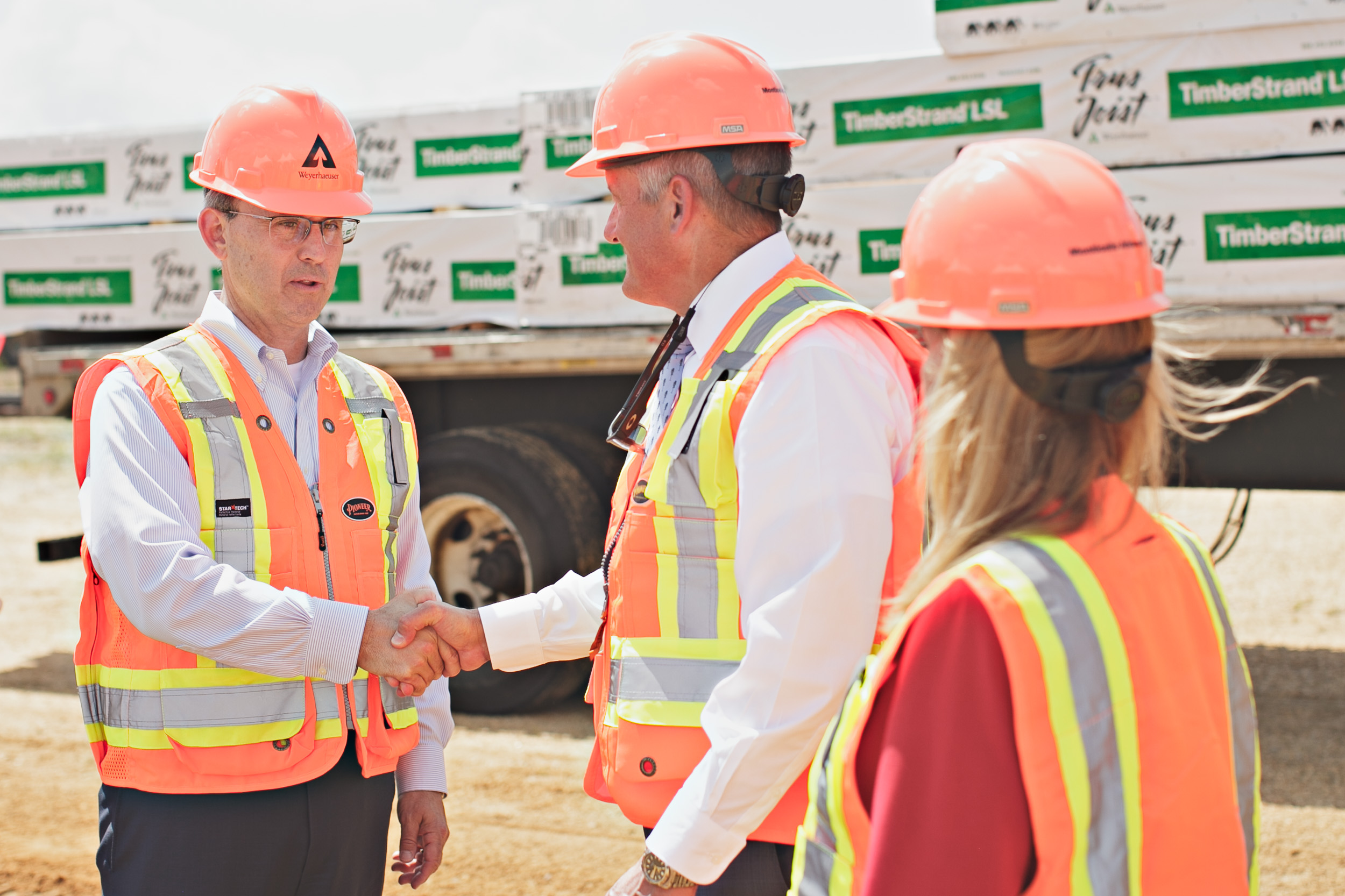
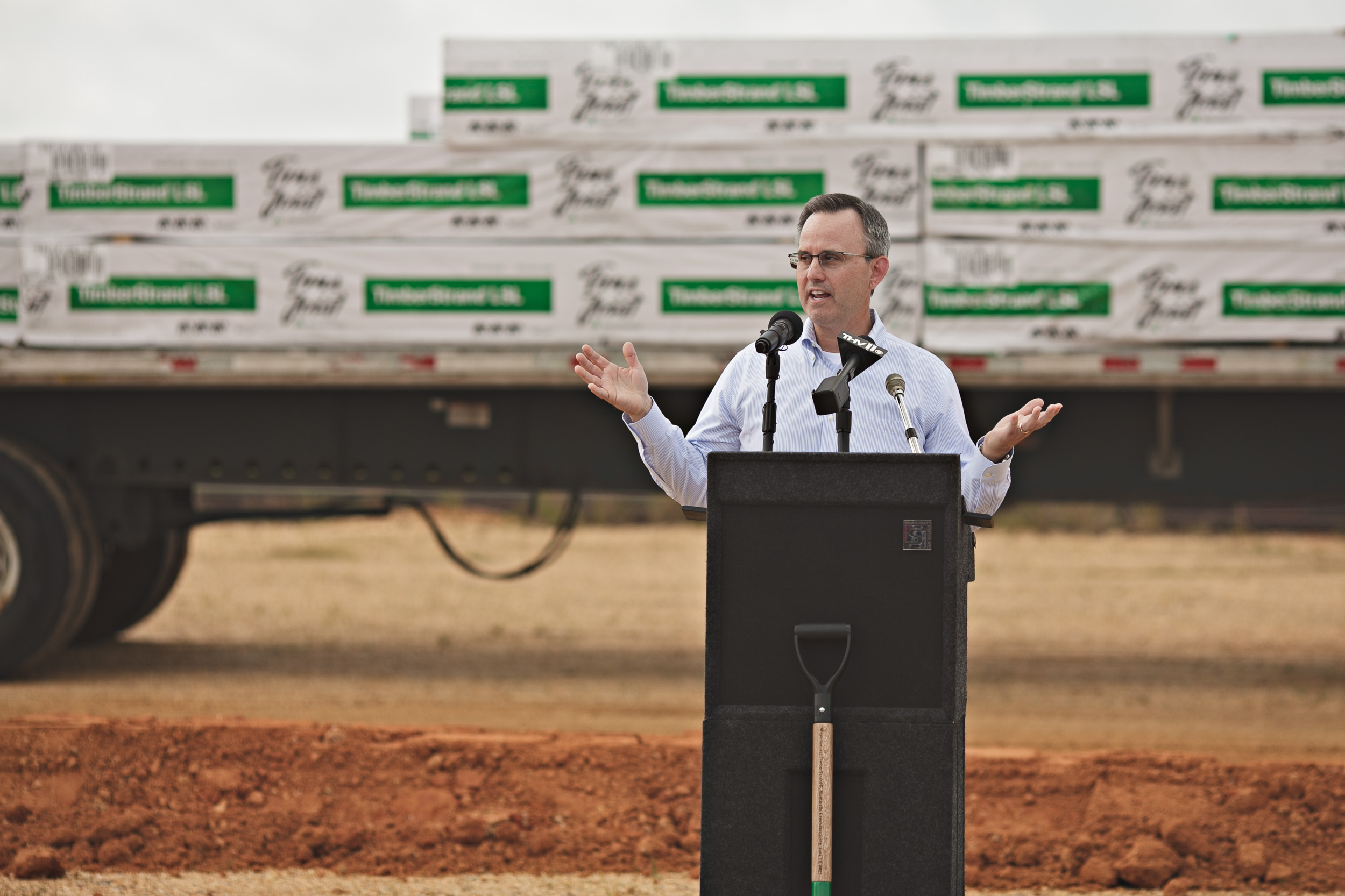
In June 2025, Devin Stockfish stood at the site of a future wood-products factory near Monticello, Arkansas. There were hard hats, public officials and the ceremonial business of putting shovels into soil. More than 150 people had gathered. Stockfish, Weyerhaeuser’s president and CEO, spent part of his remarks thanking the people who had helped bring the project there. A factory may begin with a capital decision in Seattle. Getting it built requires considerably more local cooperation.
The occasion suited a career that has repeatedly moved closer to the machinery. Stockfish began as an engineer, became a lawyer, then took responsibility for forests. Now his work includes deciding where the next factory should go and what the wood entering it might become. His résumé suggests that a change of department can sometimes be more consequential than a change of employer.
The engineer takes the long way round
Boeing employed Stockfish as an engineer from 1996 to 1999. That job brought him to the Pacific Northwest. He holds a mechanical engineering degree from the University of Colorado and a law degree from Columbia. The sequence gives his later career a pleasingly physical starting point: before the contracts, there were things that had to work.
His legal career took him to K&L Gates from 2002 to 2007, Starbucks from 2007 to 2010, and Univar from 2010 to 2013. At Univar, his responsibilities included mergers and acquisitions, corporate governance and securities law. These are subjects that place an attorney close to the decisions shaping a company, even before that attorney becomes responsible for running one.
In March 2013, Stockfish joined Weyerhaeuser as assistant general counsel. He became senior vice president, general counsel and corporate secretary in July 2014. Then came the departure from the expected route. In 2017, he moved into Western Timberlands; in 2018, he took charge of the Timberlands business. The presidency and chief executive role followed in January 2019.
Each move enlarged the assignment. A legal officer advises on what a business can do and how it should do it. An operating leader also owns the result. Stockfish’s progression put both kinds of responsibility within a few years of each other. There is no need to dress that up as destiny. The dates are interesting enough.
A door opened by somebody else
The invitation to run Western Timberlands came from Doyle Simons, then Weyerhaeuser’s CEO. Stockfish later described the move as an enjoyable learning experience. He credited Simons with trusting him and named another mentor, Amy Weaver, whom he had worked for at Univar. His account gives other people a place in a career that could easily be presented as a solo ascent.
When Weyerhaeuser announced the succession in August 2018, Simons made leadership development part of the explanation. Stockfish was taking over after time in both the legal department and the timberlands business. The board had watched him work from more than one angle.
“Keep perspective and trust your instincts.”
Devin Stockfish, on career advice, 2019
That advice has a useful economy. Perspective asks for distance; instinct asks for a decision. An executive needs enough of the first to avoid being consumed by the immediate problem, and enough of the second to act before every uncertainty has been tidied away. Forestry supplies ample opportunity to practice both.
An acre has more than one job
Weyerhaeuser’s business reaches beyond selling logs. Its holdings support wood manufacturing, real estate and energy-related activities, alongside newer climate businesses. In July 2026, the company described its U.S. timberland footprint as more than 10 million acres, with additional Canadian public timberlands managed under long-term licenses. That is a considerable amount of ground over which to ask what else might be useful.
Stockfish has argued for improving the value and productivity of the portfolio, rather than treating acreage alone as the score. The distinction matters. Buying more land adds scale. Improving seedling survival, investing in forestry and choosing which properties to retain can change what existing land produces. The operating details have a way of catching up with the grand strategy.
In 2025, the company’s opportunities included forest carbon credits, renewable energy development and leasing underground space for potential carbon storage. These activities work on different schedules and involve different customers. A forest can sit above a prospective storage project while the commercial and regulatory work proceeds elsewhere. The trees, meanwhile, have their own appointment book.
For Stockfish, this broadens the CEO’s task. Land management, manufacturing and new commercial arrangements have to fit together. His earlier legal work provides relevant experience with agreements and transactions; his operating roles supply another point of view. Neither qualification makes an uncertain market predictable. Both help explain why this particular set of problems has landed on his desk.
The Arkansas wager
The planned Monticello facility gives that strategy a street-level expression. Announced as an approximately $500 million investment, it is designed to produce TimberStrand, an engineered wood product, using southern yellow pine. At the June 2025 groundbreaking, its expected start was 2027, with annual production capacity of 10 million cubic feet. Those are project plans, with the work of construction still to follow.
The product is part of a broader effort to find additional uses for wood. Engineered materials allow manufacturers to assemble wood fiber into products with specified characteristics. The commercial question then becomes whether builders and other customers find those characteristics useful enough to buy. A forest-products business still has to make something somebody wants.
In February 2026, Weyerhaeuser previewed two products at the International Builders’ Show in Orlando. AeroStrand was presented as a floor joist based on TimberStrand technology, with openings to accommodate mechanical, electrical and plumbing systems. ProPanel was introduced as an engineered floor panel with moisture-resistance and drainage features. Both were still in development at the time.
These are modest-sounding construction details with practical consequences. An opening in the right place can save work later. A panel that handles site conditions better can make a builder’s day less troublesome. For a former engineer now running a materials company, the appeal of such improvements is easy to understand.
A new customer for forest fiber
Another proposed outlet takes wood toward metals production. In December 2025, Weyerhaeuser and Aymium announced a memorandum of understanding to build a biocarbon business. Their joint venture, TerraForge Biocarbon Solutions, would begin with a facility beside Weyerhaeuser’s McComb, Mississippi, lumber mill. The companies said the material could replace coal in certain industrial uses.
At full scale, the proposed network could turn more than 7 million tons of wood fiber into 1.5 million tons of biocarbon annually. The announcement envisaged long-term sales agreements and multiple facilities. The arithmetic is a statement of intended scale, rather than a report of existing output. Customers, locations and execution remain central to the idea.
The underlying problem is concrete. When traditional outlets for pulpwood or mill residuals contract, producers need another buyer. A new industrial use can give that fiber somewhere to go. Stockfish’s job is to connect an existing resource with an emerging market without confusing the availability of the resource with proof of demand.
The people beyond the mill gate
The company’s rural footprint makes community investment part of the same discussion. In 2024, Weyerhaeuser committed $1 million through its Thrive program to Raymond, Washington, where it has operated a lumber mill since the early 1930s. The program called for local input, with possible priorities including workforce development, job training and education.
By September 2026, Thrive had reached Drayton Valley, Alberta, its first selected Canadian community. The announced $1 million investment would be shaped with employees and local partners. Earlier communities had chosen different priorities: water infrastructure and ballfields in Zwolle, Louisiana; a workforce housing initiative in Raymond; and discussions about educational opportunities in Buckhannon, West Virginia.
Stockfish’s argument connects a functioning town with a functioning workforce. At an October 2025 working-forests forum, he discussed the pressures created when markets for forest products shrink. His prescription included finding new uses for wood and supporting the places where workers live. The community and commercial agendas meet at the factory gate every morning.
Several clocks, one desk
In January 2025, Stockfish also joined Xcel Energy’s board, initially serving on its Finance and Operations, Nuclear, Environmental and Safety committees. The appointment brought his experience with a capital-intensive company into another industry with long-lived assets, regulation and large investment decisions. His Weyerhaeuser biography also lists forest-owner and housing-policy roles.
At Weyerhaeuser’s December 2025 Investor Day, management set a target of $1.5 billion in incremental Adjusted EBITDA by 2030 against a 2024 baseline. About $1 billion was attributed to identified growth initiatives; the remaining $500 million assumed improved product pricing. The distinction places part of the ambition inside management’s projects and part in the market around them.
There is an ordinary life alongside these expansive assignments. In 2019, Stockfish said he enjoyed hiking and snowboarding, and described following his children’s activities as his main hobby. It is a small detail, but a helpful one. Even a career spanning aircraft, coffee, chemicals and forests has to negotiate the family calendar.
His current challenge is to make the different schedules coexist: a factory under construction, a new customer testing a material, a town planning its future, shareholders expecting results. The engineer, lawyer and operator have all arrived at the same desk. Outside, the next generation of trees is taking its time.
Continue reading & watching
Weyerhaeuser leadershipDevin Stockfish on LinkedInThe 2019 career interviewArkansas groundbreaking photographs2025 Investor Day replayWatch: Stockfish on Mad MoneyThe 2030 growth planWorking forests and rural economiesSeptember 2026: Thrive in AlbertaWeyerhaeuser on XWeyerhaeuser on Facebook