Sarah London had two words on a Post-it Note attached to her computer: “Challenge Everything.” During a 2023 interview, she pulled it off and held it up to the webcam. For the chief executive of Centene, it was a small, portable reminder of business school. It also offered a useful explanation for a career that had passed through literature, Hollywood, analytics, product development, and investing before arriving at the corner office.
The note is an appealingly modest piece of executive equipment. It requires no subscription, has no dashboard, and can be defeated by a light breeze. Its ambition is rather larger. Challenge everything, taken seriously, includes challenging the assumption that the person in charge should already understand everything.
London’s public account of her career keeps returning to that problem. How do you take responsibility for work you cannot possibly master alone? Her answer has involved questions, colleagues, changes of direction, and a willingness to revise her own methods. The interesting part of her ascent is how often she has made room for being a learner.
A reader takes the scenic route
At Harvard, London studied history and literature and played Division I tennis. Her academic interests included Britain and France around the Second World War. She has described enjoying the freedom to assemble her own curriculum and discover connections among subjects. There is a pleasing continuity between that student and the executive who would later work across several different functions.
Still, the first professional turn was a swerve. She declined a Goldman Sachs job and went to Hollywood, a choice she remembers as “deeply horrifying my father.” A young person’s interest in poetry and business had found a place where the two might conceivably meet. Family approval would have to catch up.
Her early employers included Creative Artists Agency and the Kennedy/Marshall Company. The latter’s credits include Seabiscuit and The Bourne Identity. Those are company credits, rather than a claim that London made either film. Her own experience was the less glamorous business of learning how work gets done.
She spent two years in the film industry before returning to Boston. She liked movies, she later explained, but lacked the consuming interest needed to build a career there. Leaving was its own useful decision. A first job can be an experiment with a salary attached; discovering that it does not fit is information worth having.
The education after the education
London’s next chapters included fundraising at Harvard and nonprofit work, followed by an MBA at Chicago Booth. Her father, John McGinty, was a Booth graduate himself. When she graduated in 2010, he attended the ceremony 40 years to the day after his own graduation. A family connection had become a shared milestone.
The inheritance was intellectual as well as institutional. London has described her father’s enthusiasm for an education that developed the way a person thinks. It is a distinction that matters when the next job brings unfamiliar questions. A remembered answer has a limited shelf life; the ability to examine an assumption can travel.
She graduated with High Honors. Earlier, she had graduated magna cum laude from Harvard. The honors supply the conventional evidence of academic accomplishment. The movement between subjects supplies something more interesting: she kept placing herself in situations where a strong academic record could not relieve her of learning the local language.
For a literature graduate entering analytics, that language includes numbers, products, clients, and operational detail. A literary education does not confer technical expertise. It can, however, make a person attentive to context and competing explanations. In London’s career, the two kinds of work sit alongside each other. Neither needs to be dressed up as the other.
- 2010Chicago BoothMBA with High Honors
- 2016Optum AnalyticsChief Product Officer
- 2018Optum VenturesOperating partner and investor
- 2020CenteneTechnology innovation and modernization
- 2022The CEO appointmentMarch 22, effective immediately
Learning the business from several seats
Her professional education continued in analytics at the company now called R1 RCM, then at Humedica, where she led client services and operations. Humedica’s acquisition brought her into Optum. By March 2016, she was chief product officer of Optum Analytics; in May 2018, she moved into an operating and investing role at Optum Ventures.
These jobs offer different views of the same organizational puzzle. A client services team hears what customers are struggling to use. Operations turns promises into repeatable work. A product leader must decide which problems deserve engineering time. An investor asks whether an idea can become a durable business. Moving between those seats changes the questions a person can ask.
That is an interpretation of the sequence, rather than proof of a secret career plan. The documented progression is enough. Before London became a chief executive, she had worked close to clients, managed operations, taken responsibility for products, and evaluated ventures. Her preparation came through several doors.
Centene hired her in September 2020 as senior vice president for technology innovation and modernization. An executive vice presidency followed in March 2021, then the vice chairmanship in September. On March 22, 2022, the board named her chief executive, succeeding Michael Neidorff. By then, her responsibilities had expanded to include corporate strategy, internal audit, compliance, and risk management.
to the CEO appointment
September 2020 → March 2022
Career dates, rather than a claim about a promotion formula.
The corner office has more than one chair
A succession after a long-serving leader raises a delicate question: how much of the old organization should the new person keep? London inherited a company shaped by Neidorff’s more than 25 years as CEO. Respect for that history came with decisions about what the next version of the business should look like.
During her early tenure, Centene sold businesses and abandoned plans for an East Coast headquarters in Charlotte. Those decisions gave her leadership a visible shape. Strategy could involve subtraction. An organization can accumulate commitments for years; deciding which ones still make sense is a different assignment from adding the next one.
London initially kept a low media profile. She said her priority was connecting with employees, partners, regulators, and investors. The instinct is understandable: the audience for a new chief executive includes people whose daily work depends on decisions made long before an interview appears.
She also reconsidered her own approach. Looking back on her first months, London described responding to more responsibility by simply working harder. By early 2023, she had concluded that this crowded out her family and failed to improve her work. She began talking about prioritization and shared leadership. More hours were a poor substitute for deciding what deserved them.
In a February 2026 conversation with Julia Boorstin, she put executive accountability in unusually plain terms: a CEO should “get all of the blame and none of the credit.” It is an austere compensation plan for the ego. As a description of responsibility, it makes the team’s contribution difficult to ignore.
“Get all of the blame and none of the credit.”
Sarah London, on the CEO’s responsibility, 2026
A detective belongs on the reading list
London’s reading tastes provide some welcome relief from the solemnity of executive biographies. She reads mysteries and romance, as well as books about business. Her 2024 selections included Rebecca Yarros, Kaliane Bradley, John Sandford, William Thorndike, and Louise Penny. The shelf leaves room for both corporate capital allocation and dragons.
She has singled out Penny’s Inspector Gamache as a character she quotes when discussing leadership. His vocabulary of admitting error, requesting help, and acknowledging uncertainty fits the approach London describes at work. The connection is hers. Nobody needs to invent a management seminar hidden inside every novel.
There is something refreshing about a chief executive declining to turn recreational reading into an intellectual dress code. A novel is allowed to be enjoyable. A reader is allowed to move from a business book to a mystery without issuing a statement about personal development. London’s bookshelf makes her curiosity look lived in.
The questions travel with her
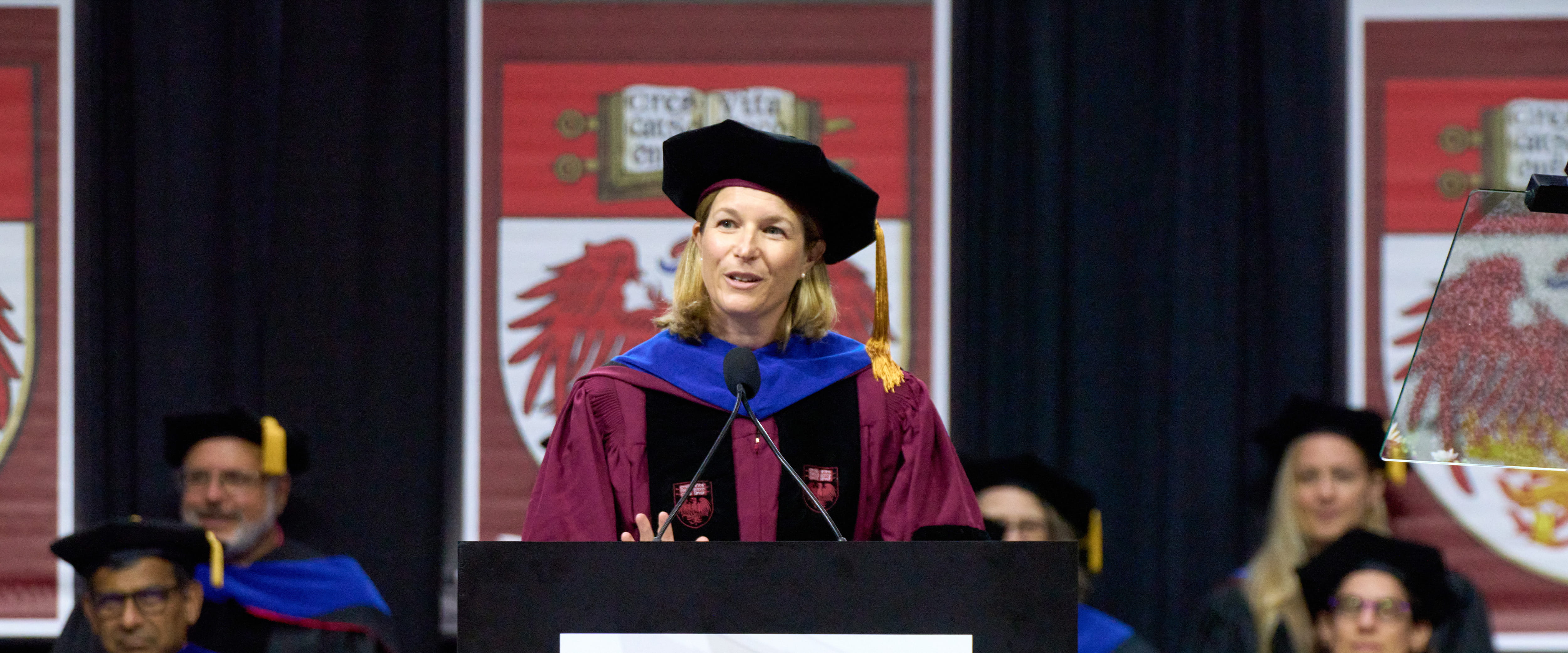
Returning to Booth to address the class of 2024, London spoke about asking questions and building teams whose members bring different strengths. She also described a bracelet given to her by a colleague. Its message was “Don’t let the hard days win.” Alongside the Post-it, it forms a small collection of reminders that can survive a calendar full of meetings.
There is a practical test for this philosophy. A question from the boss can open a discussion or close it, depending on whether an honest answer is welcome. London’s emphasis on curiosity asks something of the person with authority: leave enough space for someone else to explain what you have missed.
The idea also appears in Centene’s 2025 Code of Conduct, where her message encourages employees to ask questions and seek guidance when a decision is unclear. Meanwhile, the company’s Culture Ambassadors program brings leaders from across the organization together for training and relationships. These are stated expectations and programs; their value depends on what people do with them.
By 2026, London had reached her fifth year on Fortune’s Most Powerful Women list. The recognition records her place in corporate life. The Post-it records a demand she makes of herself. Between the two sits the daily assignment of leading a company while remaining open to information that might change her mind.
She has already changed industries, changed jobs, and revised her approach to the job. The reader who went to Hollywood has acquired a substantial set of responsibilities. The beginner’s question still has a place on her desk.