Jeff Strom’s route to the chief executive’s office passed through Milton, Florida. He joined Boise Cascade in 2006 in a sales position and later managed its branch there. In March 2026, he became CEO. The distance between those jobs is the subject of his career: a gradual widening of responsibility, from a local operation to a business that manufactures wood products and distributes building materials across a national network.
It is an ascent with remarkably little theatrical scenery. There is a management degree from Georgia Tech, a succession of operating assignments, and almost twenty years inside the same company before the board chose him. The interesting detail is where the apprenticeship began. Selling building materials puts a person close to the customer’s immediate problem. A promising corporate strategy is welcome; so is the order arriving when it is needed.
Strom now has responsibility for both. His appointment took effect on March 3, 2026, succeeding Nate Jorgensen after a planned transition. In April, he joined Boise Cascade’s board. By then, the former sales representative had worked his way through branch, regional, divisional and company-wide leadership. His résumé reads rather like a map whose scale keeps changing.
Seven years with a branch in the frame
The dates give the early part of that journey its weight. Strom became a branch manager in September 2008 and remained in that role until November 2015. Seven years is a substantial chapter in a career later compressed into a few lines of executive biography. It gives the local operation a different place in the story: a long assignment, with responsibility that preceded the larger titles.
In November 2015, he became a region manager. General manager of the Eastern Region followed in May 2019, then vice president and general manager of Eastern Operations in January 2020. The sequence matters more than the increasing length of the business cards. He was moving from one location’s performance to the coordination of several, then taking on broader leadership of the distribution business.
When Boise Cascade announced the 2020 promotion, chief executive Tom Corrick put internal leadership development near the center of his explanation. Strom was promoted alongside Rob Johnson and Chris Seymour, both from the Wood Products side. The three appointments placed experience accumulated within the company into larger jobs. Strom’s rise was part of an institutional habit of developing executives through operating work.
He had also changed his home base. He relocated to the company’s headquarters in Boise in 2017. His career therefore crossed geography as well as the organization chart. Milton remained part of his professional history; Boise became the place from which he helped run an increasingly wide territory.
- 2006Sales position at Boise Cascade
- 2008Branch manager
- 2015Region manager
- 2021Executive vice president, distribution
- 2025Chief operating officer
- 2026Chief executive officer
A succession before the succession
Strom’s first major handover came in March 2021. Nick Stokes was retiring after 42 years with Boise Cascade, and Strom was named executive vice president of Building Materials Distribution. At the time, the company described a network of 38 branches and nine millwork locations. The scale had changed again. Strom was taking responsibility for the division in which he had begun as a salesperson fifteen years earlier.
That appointment carried an explicit message about continuity. Jorgensen said the company had prepared for the succession. Stokes had spent decades developing the business; Strom would inherit relationships, locations and responsibilities already in motion. In a distribution business, a change at the top still has to leave the next customer’s order in capable hands. Retirement announcements do not suspend delivery schedules.
There was further preparation away from the daily operation. In 2022, Boise Cascade congratulated Strom on completing CEO Perspectives, a six-module program for senior executives who report to chief executives. It is a modest but useful detail. Years before his own appointment, he had taken part in a program concerned with strategic challenges and opportunities beyond a single operating assignment.
Florida returns, this time with doors
In December 2024, Florida reappeared in Strom’s public work. Boise Cascade purchased the assets of Parksite’s door shop in Lakeland. The deal covered that operation alone, rather than Parksite’s wider business. For Strom, then leading distribution, it was a concrete extension of the division’s millwork operations: more capacity to serve customers in another part of a familiar state.
Lakeland became Boise Cascade’s fifteenth millwork location. Together with its Milton facility, the addition would allow the company to offer Therma-Tru products throughout Florida. The new operation supplied entry and decorative glass doors; Boise Cascade planned to broaden its offerings. Doors make a useful corrective to abstract talk about market expansion. Here, expansion had a location, a product range and an existing team.
Strom framed the purchase around wider customer reach in the South and welcomed the incoming employees. There was a geographic rhyme in the announcement: Milton, where he had managed a branch, was now one part of the network being extended under his divisional leadership. His earlier workplace had become a reference point in a larger operating plan.
Two businesses, one operating brief
“Our integrated business model truly is our competitive edge.”
Jeff Strom · January 2025
On January 20, 2025, Strom became chief operating officer, overseeing Wood Products and Building Materials Distribution. His background had been concentrated in distribution; the new brief joined that experience to responsibility for manufacturing. Boise Cascade’s business includes making engineered wood products and plywood as well as moving building products to customers. The COO appointment put those two activities under one executive’s operational oversight.
That combination became central to his public explanation of the job. He described priorities around operations, market growth and service, and emphasized the advantage of connecting the two divisions. The reasoning is practical. Making a product and making it available to a customer involve different work. A company that does both needs the connection between them to function, especially when demand becomes less predictable.
Jorgensen called the appointment part of the company’s succession planning. By December, the board had unanimously selected Strom to succeed him as CEO. Boise Cascade said it would leave the COO position unfilled after the transition. The operating role had given Strom company-wide responsibilities before the final change of title. The handover followed a sequence the company had already made public.
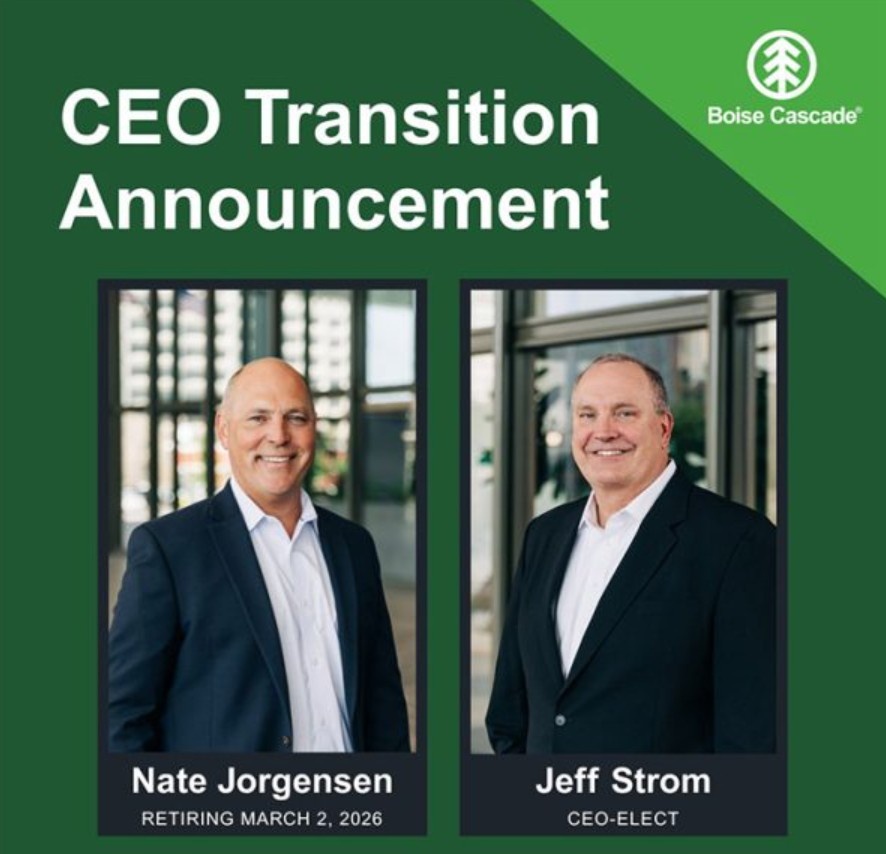
At the announcement, Strom said, “Our Company’s strength lies in our people.” It was a brief statement with a long list of people attached to it: customers, suppliers, investors, associates and the communities around the business. The language put relationships at the center of the assignment. His earlier jobs had given him several different positions from which to see those relationships at work.
A larger title meets a difficult market
The opening months of his tenure supplied an immediate test. In the first quarter of 2026, Boise Cascade recorded sales of about $1.5 billion and net income of $17.8 million, compared with $40.3 million a year earlier. Strom pointed to uncertain demand, mortgage-rate volatility, geopolitical events and severe weather. The conditions were a reminder of how much of a building-products executive’s world lies outside the executive’s control.
His response emphasized the work of employees and the connection between the company’s businesses. That theme continued in the second quarter, when sales reached about $1.8 billion and net income was $57.3 million. The prior-year quarter had produced $62.0 million, including $5.8 million in after-tax property-sale gains. Keeping that qualification in view makes the comparison more useful than an uncomplicated verdict of better or worse.
Strom linked the second-quarter performance to national scale and local support. It is a pairing that fits his own route through the business. National responsibility arrived after years of local and regional management. The two perspectives now appear together in his account of how the company serves customers. A large network still depends on what happens at its individual locations.
Quarter ended June 30. Prior-year net income: $62.0m, including $5.8m in after-tax property-sale gains.
The customer still wants the order
On August 3, 2026, Boise Cascade and James Hardie announced an expanded distribution agreement, effective July 31. Boise Cascade would become the sole nationwide distributor of Hardie’s full exterior-products portfolio, including Hardie siding and trim, AZEK trim and moulding, and TimberTech decking and railing. The arrangement also involved moving away from competing siding, trim and exterior moulding lines. A broader partnership required choices about what the network would carry.
Strom’s explanation returned to availability and dependable service. The agreement promised customers broader access and more consistent fulfillment. Those are intended benefits, with execution still required. For the CEO, the work includes fitting the new arrangement into a company whose branches already have products to move and customers to serve. A national agreement becomes useful through a succession of local transactions.
A home has more than one meaning
Strom’s work outside Boise Cascade connects to the same physical world. He serves on the board of trustees of Treasure Valley Habitat for Humanity, identified in earlier announcements as Boise Valley Habitat for Humanity. The connection places him alongside an organization concerned with homes and community, while his day job concerns the products and distribution systems used in building.
His public ambitions remain closely tied to that work: improving operations, growing markets, serving customers and creating value for the people connected to the company. As of October 2026, the next scheduled public checkpoint is Boise Cascade’s November 3 discussion of third-quarter earnings. The company announced the date on October 20. The first year of his tenure is still being written in operating results and customer relationships.
Twenty years after taking the sales job, Strom occupies an office with a much wider view. The useful detail is that his career still contains the branch. Milton, the regional assignments, the door-shop addition and the nationwide partnership describe different scales of the same recurring task: bringing products within reach of the people who will use them. A title can change on a specified date. Delivering on it takes considerably longer.