There is a moment, usually in late December, when a lot of people remember they meant to be generous. They dig up a receipt, fumble through a nonprofit's donation page, and give in a hurry - once. Jason Hausske built a company on the belief that this is the worst possible way to give, and that the fix is not a lecture about generosity but better plumbing. His answer is Cauze, a Boise-based app that hands anyone the kind of charitable account that used to belong to the wealthy, then dresses it up like a social feed.
The technical heart of Cauze is a donor-advised fund, or DAF - a giving vehicle that has existed for decades and, until recently, mostly served people with tax advisors. You put money in, take the deduction, and later recommend which charities receive grants. The catch was always the entry price. Traditional DAF sponsors often required a minimum of around $5,000 to open one. Cauze took that number and dropped it to a dollar.
"Not your grandparents' philanthropy." Cauze's own framing of the idea
That single change - a foundation with no wealth test and no paperwork - is the wedge. But it is not the part people remember after they use the app. What they remember is that Cauze looks and behaves like something they already know how to use. Hausske has described the product as roughly "Venmo meets Instagram for giving," a social network where the content happens to be generosity instead of vacations.
The company frames its thinking around three ideas it returns to again and again: remove the friction between a person and a charity, respect the behavioral science of why people actually give, and amplify the gift once it happens. Each maps to something visible in the product - the one-tap account, the monthly nudges, the pile-on mechanic. It is a rare case where the marketing language and the interface line up.
01 / What it actually doesThe foundation in your pocket
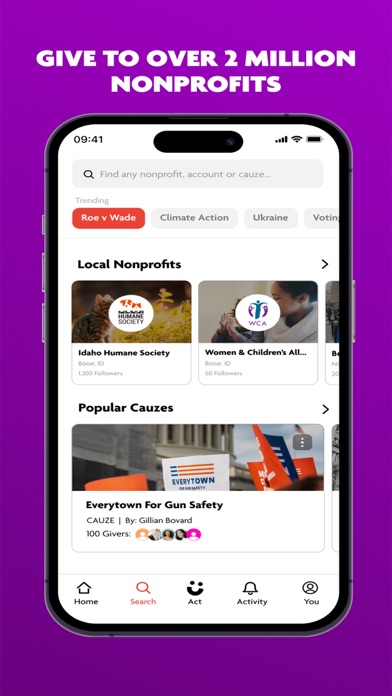
Open Cauze and you create a personal giving account in a few minutes. Fund it, then give to any registered U.S. nonprofit - the app carries more than two million 501(c)(3)s and refreshes the list weekly. You can give one dollar or ten thousand. You can set a Monthly Giving Goal and let the app nudge you toward it, the way a fitness tracker nags you to close a ring. Through a feature called RECUR, you can automate monthly donations to as many nonprofits as you want from a single dashboard, starting at a dollar a month.
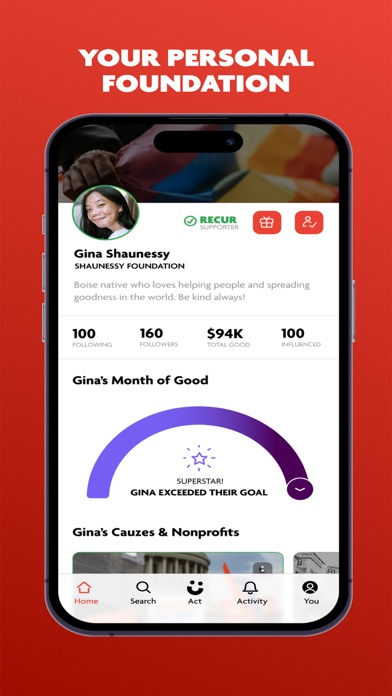
The social layer is where Cauze departs from a normal giving tool. Every user gets a profile - a "personal foundation" with a name, a mission line, and a running tally of the good they have done. You follow people. You build "Cauzes," which are curated, shareable collections of nonprofits grouped around a theme. And you can amplify: when one person gives to an organization, friends can pile their own contributions onto that gift, the way a post gathers likes. Generosity, in other words, is treated as contagious - because the founders think it is.
One design choice tells you almost everything about the company's worldview. Cauze shows that you gave. It does not show how much. Strip out the dollar figure and giving stops being a leaderboard, which is exactly the point - the app is built to spread the habit, not to rank the wallets.
02 / The mechanicsWhere a dollar actually goes
Because Cauze is a donor-advised fund, the money takes a specific route, and it is worth understanding. Your donation is tax-deductible the moment it lands, because it goes to the Cauze Charitable Fund, a registered 501(c)(3). You then advise the Fund on where to send grants. At the end of each month, the Fund consolidates every user's recommendations and issues grants to the receiving nonprofits - often bundling many donors' picks into single checks.
There is a filter on the plumbing, too. Cauze covers every public 501(c)(3), but it deliberately screens out organizations identified as hate groups on the Southern Poverty Law Center's list - hundreds of them. In a product built around giving publicly, that screen is less a footnote than a feature: it is what lets people put their name on a donation without worrying about where the rails might lead.
03 / Who uses itIndividuals first, employers next
Cauze's core audience is ordinary givers. Roughly ten thousand of them have collectively moved several million dollars through the app, a figure the company has cited as it grew out of Boise. But the more interesting distribution channel runs through employers. Companies fund their employees' Cauze accounts and run matching campaigns; participants have included the fraud-prevention firm Kount, the children's-products brand Lovevery, and the Leadership Boise program.
For a small company, workplace giving is usually a spreadsheet and a shrug. Cauze turns it into something employees can see and share, which is why a consumer app ends up with a business on the side. There is also Cauze Gifts - charitable gift cards and brand incentives where the recipient picks the cause, used for rewards, loyalty programs and service recovery.
04 / The marketCrowded field, unusual structure
Cauze is not alone in trying to modernize giving. On the consumer donor-advised-fund side, it shares a lane with names like Daffy and Charityvest, and with incumbents such as Fidelity Charitable. On the peer-to-peer side sit GoFundMe and JustGiving. On the corporate side, tools like Deed and Percent Pledge chase the same employee-giving budgets. What separates Cauze is less a feature than a posture: it describes itself as a tech-first nonprofit, and its parent is a 501(c)(3). The business model is the mission, not a wrapper around it.
"Imagine a million people giving a dollar in five minutes." Jason Hausske's stretch goal for the platform
That line is Hausske's north star, and it doubles as a product spec. A platform that can coordinate a million one-dollar gifts in five minutes needs rails built for speed and moments - a viral cause, a disaster, a celebrity match - rather than for the December receipt hunt. Cauze has flirted with exactly that, pointing to influencer and brand-driven matching moments as the kind of event the app is designed to catch.
05 / The companySmall team, long game
Cauze was founded in 2017 and launched its app to the public around 2019, raising roughly $3 million from individuals, private foundations and impact investors, and later adding about $1.27 million in debt financing. It runs lean - around seven employees in Boise - and ships steadily; the app reached version 2.34 in 2025 with support for the latest Apple platforms. For a company trying to rewire a decades-old giving vehicle, the pace is deliberate rather than explosive.
The founder's framing has stayed consistent since the early Boise press: giving should be easy, social, and monthly instead of hard, private, and annual. Three behavioral levers, one feed. Whether that reshapes how a generation gives is unproven. But the mechanics are real, the account is genuinely a dollar to open, and the bet underneath it is refreshingly legible - that generosity, like most habits, spreads faster when other people can see it.
It is also worth noting what Cauze is not trying to be. It is not a tip jar bolted onto a checkout, and it is not chasing the venture math where donations become a data business. The 501(c)(3) structure closes off the more aggressive monetization routes on purpose. That constrains how fast the company can move and how much it can spend, which is part of why the team has stayed at roughly seven people through several product cycles. The trade is deliberate: slower growth in exchange for the kind of trust a giving platform lives or dies on.
06 / What you can copyThe idea a builder can steal
Reduced to its useful core, Cauze is a lesson in taking an intimidating financial instrument and making it feel casual. The donor-advised fund did not need to be reinvented; it needed a different front door and a reason to come back more than once a year. The recurring habit loop, the removal of the status-signaling dollar amount, the employer as a distribution channel for a consumer app - each is a move that generalizes well beyond charity. The conditions where it might not work are just as clear: a habit app only compounds if people return, a social feed only amplifies if it reaches critical mass, and a lean nonprofit only survives if its costs stay lean. Cauze is a bet that all three hold. So far, in Boise, it is still on the table.