A donation begins in a soft, inconvenient place. A friend mentions a school. A photograph catches you between meetings. Someone you trust says this matters. Then the hard edges arrive: a new account, another password, a payment form, an address field, a receipt to save. By the time generosity meets administration, the feeling has often left the room.
Jason Hausske has spent much of his working life thinking about that disappearing moment. His observation is plain: people are inspired to give more often than they actually give. The space between impulse and action is where paperwork, uncertainty and tomorrow live. He has a brisk name for the condition: “latent good.”
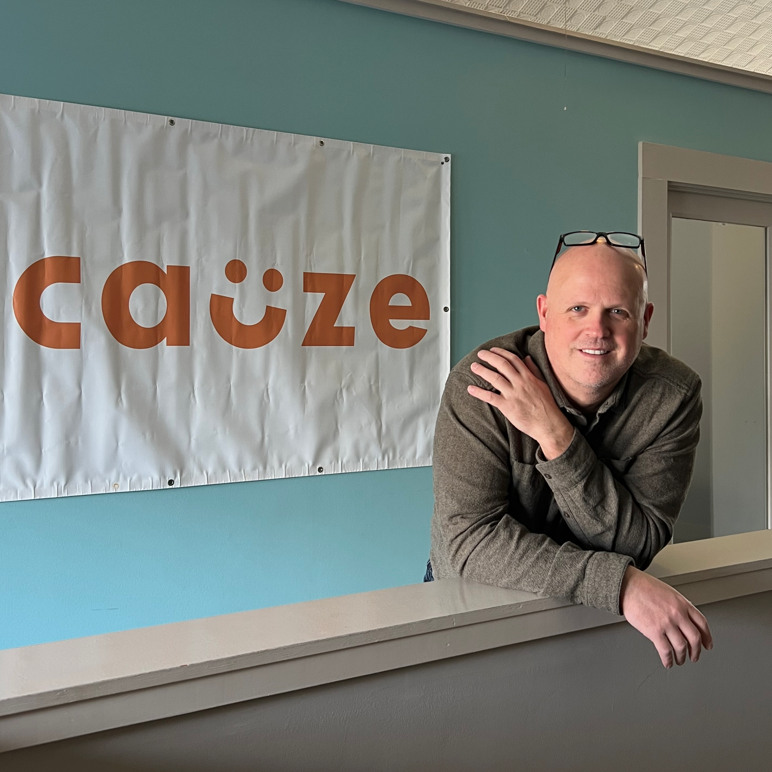
Cauze, the Boise company and charitable platform he founded, is his attempt to release it. The service gives a person a charitable account, lets that person find registered nonprofits, and makes each act of giving something friends can discover and join. The amount stays private. The gesture travels.
“We live in a world of latent good, with a gap between intent and action.”Jason Hausske
That distinction is the hinge of the whole project. Hausske wants generosity to be visible without becoming a contest. Cauze users can see that someone gave, but not how much. A five-dollar donor does not have to stand beside a five-thousand-dollar donor on a public scoreboard. Participation is the status signal. The check is nobody else's business.
The salesman meets the microgiver
Hausske arrived at philanthropy by way of a long education in persuasion. He studied economics at the University of Washington from 1986 to 1990, then built a career across technology sales, alliances and business development. His public work history runs through market-research service Profound, internet-infrastructure company Exodus Communications, broadband and voice provider Speakeasy, startup adviser Atlas Accelerator, supply-chain software company TEXbase and local-marketing platform Balihoo.
In 2004, Speakeasy appointed him vice president of sales. Three years later, he appeared at an MIT Venture Lab event in Seattle to teach early-stage companies how to get customers. The thread is adoption: how a stranger becomes a user, what prompts a first action, and what makes the action repeat.
Cauze carries that apprenticeship in its bones. It takes familiar consumer behaviors and changes their destination. A personal giving account can be funded monthly. A collection of nonprofits can be assembled around an interest and shared like a playlist. A friend can join with a dollar. An employer or brand can add matching money. A gift can give its recipient the pleasure of deciding where the funds land.
That last choice is more consequential than it first appears. A conventional charitable gift announces the giver's preference. A Cauze Gift hands the preference to the recipient. The money is already committed to charitable use, but the person opening the gift gets to explore, choose and explain what matters. It replaces the familiar problem of an unwanted gift card with a small exercise in agency. For companies, the same mechanism can become an employee benefit, a customer thank-you or a service-recovery gesture without prescribing a favored cause.
Hausske also treats matching as a social accelerant. A foundation, employer or public figure can promise to add money when others participate. The match makes timing visible and gives a solitary choice the feeling of a shared occasion. In Cauze's design, amplification can mean money, distribution or both: one person gives, another joins, and each new participant carries the invitation into a different circle. The mechanics resemble familiar growth loops, but the destination is a food bank, a school, an arts group or any other registered nonprofit a giver selects.
The vocabulary is deliberately ordinary: accounts, friends, gifts, collections. The old furniture of institutional philanthropy is kept mostly offstage. Hausske calls the small participant a “microgiver,” a word with none of the hushed carpeting of a wealth manager's office.
A social network with the volume turned down
When Hausske explains the product, he often reaches for families. Nieces, nephews and grandparents join one another. A young person commits ten dollars a month and a parent matches it. One person's choice becomes another person's discovery. These are modest scenes, which is precisely why they matter. The desired habit is not an annual gala. It is a family noticing what the family cares about.
In an interview about Cauze, Hausske drew a line between the depth of giving together and the thin pleasure of posting dinner. The joke has some bite. Social platforms trained billions of people to publish taste, travel and appetite. He is wagering that values can move through the same pipes, provided the experience feels natural and nobody is asked to make virtue into theater.
Curation matters here. Hausske does not think a platform should decide which cause is important to an individual. His thesis is that discovery will be social: people will find organizations through others they respect. It is a bet on trust as a search engine.
“The core thesis is that the curation will be social.”Jason Hausske
That belief also changes what a nonprofit gets. A place in someone's collection is warmer than a cold appeal and more personal than an ad. The donor is not simply transferring money. The donor is lending context, taste and a relationship.
The ambition is counted in people
Cauze has accumulated the conventional evidence of a technology venture. In 2019, it raised a $1.81 million seed round at a reported $5 million pre-money valuation. In 2022, another round brought in $1.27 million in convertible debt, with ImpactAssets among the investors. Hausske is also president of the Cauze Charitable Fund, the public charity that operates donor-advised accounts.
The product has grown as well. After two years on Google Play, Cauze had passed two million dollars in donations. Today, Cauze reports more than 165,000 donations and over twenty million dollars given to nonprofits. More than two million nonprofits are available on the platform.
Those numbers are useful, though they do not quite capture Hausske's chosen spectacle. His stated milestone is stranger and more memorable: one million people giving one dollar in five minutes. He has also imagined a Boise State football crowd lifting phones, giving five dollars apiece, and watching a sponsor match the whole thing.
The fantasy reveals his unit of account. Many founders would begin with the million dollars. Hausske begins with the million people. The point is coordinated agency, a crowd experiencing itself as generous in real time. His language for it is simple, social, fun and soul-filling. Three of those words belong in a product brief. The fourth is why the product exists.
A foundation without the mahogany
Cauze now describes its personal account as “the power of a foundation in your pocket.” It is a neat compression of Hausske's project. Foundations traditionally imply scale, advisers and ceremony. A pocket implies immediacy, privacy and one person's choices. The platform says there are no minimums and no wealth requirement. A giver can arrive with one dollar or ten thousand.
This is where Hausske's sales background becomes more interesting than a career footnote. Sales is often caricatured as the art of overcoming resistance. Cauze treats resistance as information. If someone wants to give but does not complete the act, perhaps the person does not need a stronger lecture. Perhaps the path is badly designed.
So the forms get shorter. Money waits in an account for the next moment of inspiration. Friends supply discovery. Recurring deposits create a gentle obligation to choose. Matching turns an individual act into a small event. None of this can manufacture concern, and Hausske does not pretend that it can. The software's job is to keep concern from evaporating before it reaches somebody useful.
His public persona fits the assignment. He calls himself an aspiring world changer, a believer in individuals and a company grower. Colleagues describe energy, ideas, experimentation and a bias toward customers. His recent public posts return to the same themes: forming a culture of compassion early, using workers and consumers as groups with influence, and reducing the friction around appreciated-stock gifts.
There is also a welcome incompleteness to the aspiration. “Aspiring” leaves room for work. Hausske's most telling answer about the company's future was not an oracle's prediction. He said he had ideas, did not know, and was focused on executing. For a person selling a more generous world, it is a pleasantly unvarnished ending.
The stubborn problem remains wonderfully small: a person feels something, then has to do something. Cauze is built for the distance between those verbs. Hausske has spent years trying to make it shorter, more companionable and easy enough to cross before the tab closes.