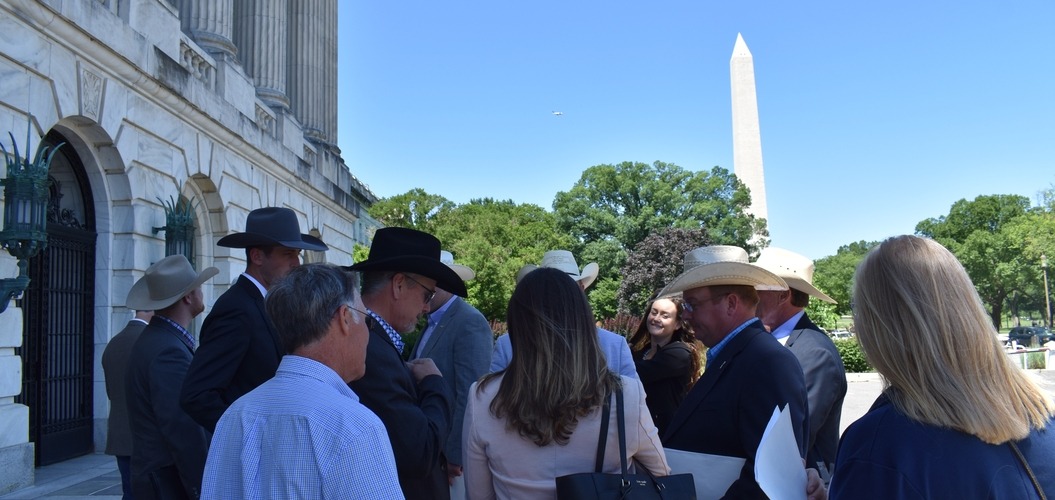
The useful thing about a cowboy hat in Washington is that nobody mistakes it for camouflage. In the public photograph from one of Western Skies Strategies' cattle-producer fly-ins, hats gather outside the Capitol while the Washington Monument pins down the horizon. The people under those hats have not arrived to perform “rural stakeholder.” They are the stakeholders. The distinction explains most of the company.
Western Skies Strategies, or WSS, is a small, privately held firm that works between Billings, Montana, and Washington, D.C. It lobbies. It advises. It organizes coalitions and prepares testimony. But it will also run an association's finances, renew its memberships, write its updates, manage its grants, negotiate its conference hotel and fix the registration record when somebody cancels on Tuesday. Its job description reads less like a consultancy than the contents of a crowded desk.
That is deliberate. WSS's central observation is that public influence and private operations are the same system. An association cannot credibly demand discipline from a federal agency while its own invoices live in a shoebox. A coalition cannot mobilize members it cannot locate. A conference is not an annual ritual if it loses money and exhausts every volunteer in sight.
The change of mind that started it
Jess Peterson founded WSS in 2007, at 26. He had grown up on a Montana ranch, studied at Gonzaga and worked as government-relations director for another rancher group. Then, as Washingtonian later reported, the group's vision changed. Peterson began looking elsewhere. Some members asked whether he would help create a new organization to represent them. Western Skies emerged from that invitation.
The origin matters because it was not the familiar consultant's decision to discover an attractive vertical. The clients pulled the firm into existence. Peterson also continued operating a cow-calf ranch near Billings. When he discussed labeling, trade, antitrust or meatpacker oversight, he did so as a lobbyist who would go home to the industry described by the paperwork.
The company’s cleverest product is not access. It is the absence of translation between the person living with a rule and the person writing it.
WSS says it has organized nearly two decades of producer fly-ins involving hundreds of cattlemen and women. Its case study says an agriculture organization, supported by the firm, testified at every Senate Agriculture Committee hearing from 2015 through 2022. The policy results it claims range from beef-labeling and animal-identification changes to meatpacking oversight and conservation support. The broader method is easier to verify than any single causal claim: find people with standing, prepare them carefully, and make their presence recurring rather than ceremonial.
What failed first was the plumbing
In 2013, two related professional organizations arrived with an unglamorous emergency. One worked with state regulatory agencies; the other represented private laboratories. The trouble was not a shortage of mission. It was too many missions resting on too little machinery: cash flow, websites, member engagement, online purchasing, annual meetings and board support.
WSS rebuilt budgets, digitized invoicing and payments, identified revenue sources, improved the websites and took on staffing. Meeting minutes from the seed-analysis organizations show the practical texture of the work years later: contract reviews, staff duties, online sales, meeting locations and board communication. The company's case study ends with its sharpest proof point, not a percentage but a relationship: “We're still with them today.”
This is where WSS differs from a conventional lobbying shop. The lobbyist rents influence for an issue. The association-management company rents an office. WSS tries to occupy the seam, offering executive directors, financial services, member operations, communications, policy work and events from one team. Its customers include agricultural and natural-resource associations, seed analysts, coalitions, nonprofits, local governments, rural-development interests and companies entering unfamiliar communities.
The room is part of the argument
Consider WSS's post-pandemic conference case. A professional organization needed to serve nearly 1,600 people in person, roughly 300 online and audiences in three languages. WSS handled registration, sessions, technical support, translation and follow-up. The gathering approached 2,000 participants and turned a profit.
That final fact changes the meaning of the others. Anyone can make a conference spectacular by spending without limit. The operating constraint is to produce belonging and still leave the association stronger. WSS treats meetings as a flywheel: good events create revenue, visibility and member attachment; those produce the capacity for better advocacy; advocacy gives members another reason to return.
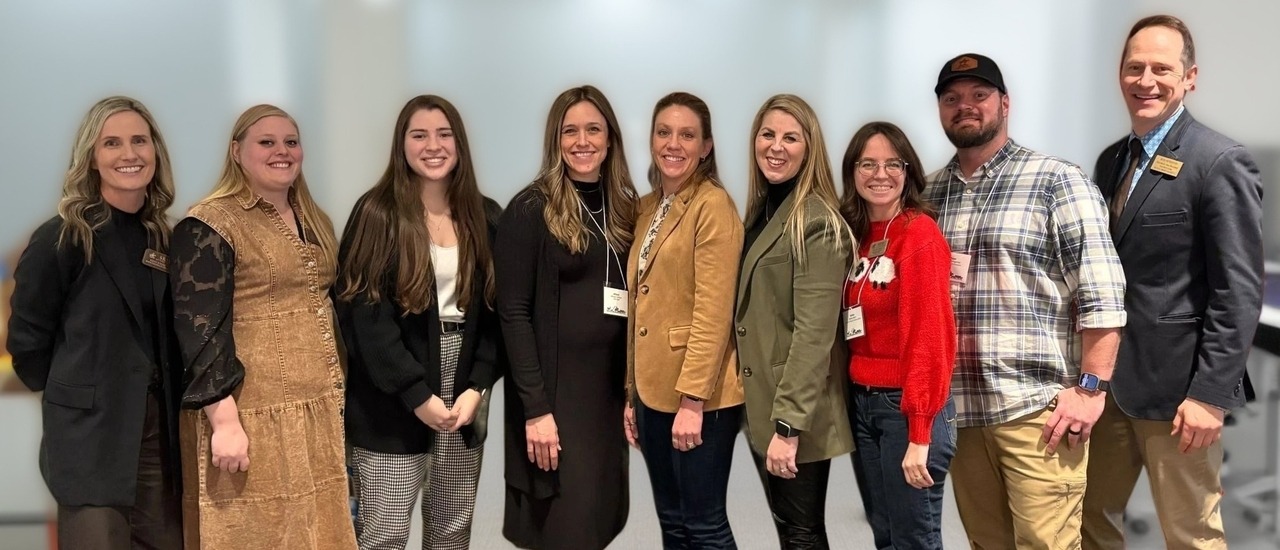
Eventually the firm turned its repeated frustration with generic membership software into SkyPoint HQ. The platform covers applications, renewals, communications, records, event sign-ups, payments, cancellations and attendee logistics. Yet WSS does not pitch it as software tossed over the fence. Its U.S.-based staff manages the system for each client. The product is the platform plus the humans who know why the database exists.
A price, and the limits of the model
WSS prices current work as customized engagements rather than publishing a menu. One historical disclosure offers a narrow benchmark: in the first quarter of 2013, the firm reported $10,000 in lobbying income from the United States Cattlemen's Association. That figure is not a modern rate card. It is a glimpse of one client, one service and one quarter before the firm had accumulated its present stack of operations, events and technology.
The model asks a client to buy breadth and trust. It makes sense when a member organization has important policy work but insufficient staff, when a board needs an operating partner rather than another recommendation, or when events and advocacy reinforce each other. It makes less sense for a company seeking a self-serve database, a single press release, or specialist counsel on an issue far from the team's agriculture, resources, rural-development and public-affairs experience. Integration is valuable only when the work actually needs integrating.
Strong fit
Member-led groups with thin staff, recurring events, a policy agenda and credible practitioners who can carry the message.
Weak fit
Teams wanting an off-the-shelf app, anonymous mass outreach or narrow advice with no operational handoff.
What another organization can copy
The replicable lesson is not “hire a lobbyist who owns cattle.” It is to shorten the distance between strategy and consequence. Western Skies does this with an operating loop that other small organizations can borrow without copying the company itself.
The Western Skies loop
- Start with the machinery. Map cash, member records, decision rights and event economics before promising a campaign.
- Put lived experience on the microphone. Let practitioners carry claims; let communications staff prepare the path.
- Make the gathering earn its keep. Design events to create revenue, relationships and the next round of action.
- Keep the feedback loop closed. Bring policy intelligence back to members and their experience back to policymakers.
The firm is still adding pieces. In 2026 it expanded state-policy capacity with Nathan Serlin, promoted economic-development work led by Allison Corbyn, recruited policy and communications interns, and helped the Montana Infrastructure Coalition stage its first summit. The direction is consistent: deeper execution, not a grander abstraction.
There is a tendency in public affairs to treat the hearing, announcement or handshake as the event. Western Skies treats it as the visible moment in a much longer chain. Somebody balanced the budget that bought the flight. Somebody kept the member list accurate. Somebody persuaded a rancher to leave work, prepared the testimony, reserved the room and followed up on the promise. Influence, in this telling, is simply operations with an audience.