There is a moment in every city construction project when the blueprint meets the bagel shop. On paper, a bridge rehabilitation is a sequence of steel repairs, concrete pours, utility work and paving. At street level, it is the morning when a delivery truck cannot reach the curb, a parent discovers the usual school route is fenced off, or a shopkeeper wonders why three parking spaces vanished. The engineering may be impeccable. The Tuesday can still be a mess.
Burtis Consulting Group has made a business out of that gap. The New York firm supplies the people and processes that sit between public agencies, construction managers and the communities living beside a project. Its community construction liaisons issue notices, attend community-board meetings, maintain contact lists, field complaints and push questions back toward the people who can answer them. Its permit specialists navigate municipal approvals. Its government-affairs and event teams coordinate the other moving pieces: public safety, traffic, agencies, vendors and schedules.
This is government relations stripped of its mahogany-desk stereotype. The essential tool is often not a policy paper but a phone number that someone answers.
A construction project has two maps
The first map belongs to the engineers. It shows catch basins, utilities, foundations, staging areas and phases. The second belongs to everyone else. It shows the restaurant that receives produce at 6 a.m., the bus stop an older resident depends on, the block where a child crosses, the loading zone, the community board, the elected official and the person who will call when the dust starts.
Burtis works on the second map without pretending the first one is optional. For the Sunset Park Infrastructure Project in Brooklyn, the firm worked with AECOM and New York City Economic Development Corporation on outreach around a five-phase program. The physical work included catch-basin replacement, removal of old cobblestones and inactive rail, new bike-lane and sidewalk construction, landscaping and street restoration. The liaison work meant newsletters, meetings, business outreach and a named point of contact.
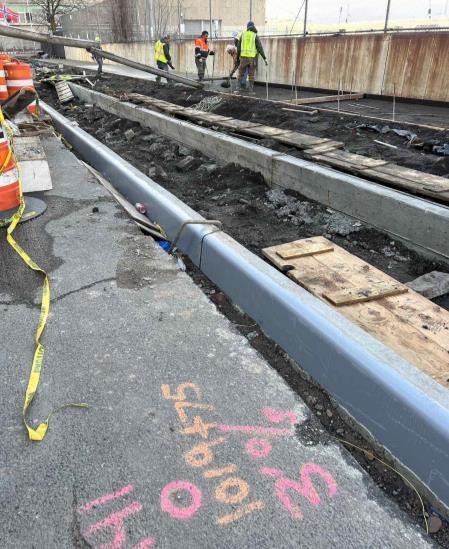
The loop matters because the information moves both ways. A construction team needs to tell a neighborhood what is coming. The neighborhood also spots consequences the schedule cannot see. In Sunset Park task-force minutes, residents asked about extreme weather, disabled pedestrians, cyclists and displaced bus service. The exchange exposed the honest boundary of engagement: the design was complete, so new elements could not simply be inserted as construction began. Outreach is most powerful early. Later, it can explain, mitigate and resolve, but it cannot perform time travel.
“The blueprint sees a work zone. The neighborhood sees its morning.”The practical premise behind community construction liaison work
The founder learned on nights when the whole city was watching
Cristin Burtis came to this work through New York City government, not through a conventional communications agency. She served under three mayoral administrations and led the Mayor's Office of Citywide Event Coordination and Management. Her résumé includes New Year's Eve in Times Square, Macy's Thanksgiving Day Parade, Fleet Week, Major League Baseball All-Star Games and Super Bowl XLVIII.
Events are temporary cities. They have street closures, credentials, crowds, police, fire safety, sanitation, transportation and a deadline that does not negotiate. That background helps explain the firm's peculiar range. Permit expediting, pedestrian managers, public meetings and event production look like separate businesses until you notice that each requires the same habit: identify every dependency before it becomes an emergency.
Superstorm Sandy made the lesson brutally literal. While Burtis was in the Mayor's Office, she and her team developed a citywide commodities-distribution plan, coordinated more than 100 tractor-trailers carrying emergency supplies and helped establish more than 30 temporary food shelters. The first things to fail in a crisis are often the assumptions between organizations: who owns the handoff, who has the current information, who can authorize the next move. Coordination is what remains when the org chart stops being useful.
Burtis Consulting Group applies that emergency-trained attention to slower disruptions. The company says its team later helped with logistics and operations for more than 500 temporary COVID-19 vaccination sites. On a bridge job, the same method becomes less dramatic but no less concrete: notify residents, coordinate with community boards, track concerns about parking or site cleanliness, and keep the route between complaint and remedy short.
A menu built around municipal friction
The customer is usually an organization whose project will touch public space: a government agency, construction manager, developer, property owner, utility or event producer. Public records and company materials place Burtis on work for NYCEDC, NYCDDC and NYCDOT, often alongside larger construction and engineering organizations. The firm lists relationships across the Port Authority, the Mayor's Office, emergency management, police, fire, utilities and community boards.
Its commercial position is the boutique subcontractor with institutional memory. A large engineering firm can manage the capital program. A lobbying shop can speak to government. A permit expediter can move paperwork. A public-relations agency can shape a message. Burtis combines portions of all four and adds field staff who have to hear what happened at the corner yesterday.
The copyable part
Make one person visibly accountable for the interface. Build the stakeholder list before construction. Publish a predictable update rhythm. Translate phases into street-level consequences. Log every question. Close the loop even when the answer is no. And invite feedback while a design can still move, not after the concrete order is placed.
The quiet product is trust with a paper trail
The company's certifications matter commercially. Burtis lists women-owned-business credentials from New York City, New York State, the School Construction Authority, the Dormitory Authority and the Port Authority, plus a small-business certification from DASNY. Those credentials can help prime contractors meet participation goals. But a certification gets a firm into the conversation; it does not keep a furious resident on the telephone.
That requires staff with mixed biographies. Burtis's public roster includes former political and government aides, permit experts, project coordinators, finance and compliance professionals, and liaisons who have worked in hospitality, healthcare, insurance and building operations. Those backgrounds make sense. Community work rewards the person who can read a room, remember a rule, document a promise and remain composed when everyone else has had enough.
The firm is not selling the fantasy that conflict disappears. Infrastructure produces disruption; permitting has constraints; people disagree about what a neighborhood needs. The useful promise is narrower: the disruption will have a name, a schedule, a contact and a route toward resolution. In a city famous for both ambition and aggravation, that is a product people understand.
In 2026, City & State New York named Cristin Burtis among its real-estate trailblazers, describing her central skill as getting government, communities and construction teams moving in the same direction. It is a neat summary, though “same direction” may be slightly too tidy. Cities rarely move in one direction. They cross, merge, stop unexpectedly and honk. Burtis Consulting Group is in the traffic-control business for institutions - standing in the intersection, waving the next complicated thing through.