In Washington, the obvious moment is usually the least important one. Cameras point at the hearing. Reporters wait for the vote. A senator lifts a hand, and policy seems to happen in public. But a food company, grower group, nutrition advocate, or biofuel producer has already spent months deciding what it can live with. Someone wrote the language. Someone found the objection hiding in paragraph six. Someone called the person who knows why the agency dislikes the verb shall. By the time the roll is called, the consequential work is old news.
That backstage interval is where The Russell Group has built its business. The Arlington, Virginia firm focuses on federal food, agriculture, and energy policy. Its customers are companies, trade associations, producer groups, nonprofits, and coalitions with an expensive problem: government can alter their economics, yet no single organization can reliably track every committee, rule, appropriation, and political fault line.
The firm's answer is compact. It offers strategic relationship building, policy development, coalition management, and issue analysis. Those labels sound dry enough to file. In practice, they mean knowing who decides, turning a commercial objective into language government can use, assembling enough allies to make the ask credible, and watching the process closely enough that the client is not surprised.
Listen
Define the policy objective and the non-negotiables.
Translate
Draft language, one-pagers, and a plausible route.
Assemble
Recruit voices that make the position harder to dismiss.
Watch
Track Congress, agencies, budgets, and rulemaking.
A niche wide enough to contain a grocery store
The firm is narrow by Washington standards and enormous by lunch standards. Its published expertise covers child nutrition, trade, appropriations, climate and sustainability, food safety, agricultural research, animal health, biotechnology, labor and immigration, biofuels, and tax. Walk down a supermarket aisle and nearly every policy question behind the products lands somewhere on that list.
That focus separates The Russell Group from full-menu public-affairs shops. A generalist can staff a banking fight on Monday and a defense contract on Tuesday. Russell's pitch is accumulated context. Team biographies include former congressional staff, USDA officials, White House personnel, association executives, and corporate sustainability leaders. Former Agriculture Secretary Dan Glickman serves as a strategic adviser. The useful asset is not merely a contact list. It is the memory of why a program was designed a certain way and which compromise made it possible.
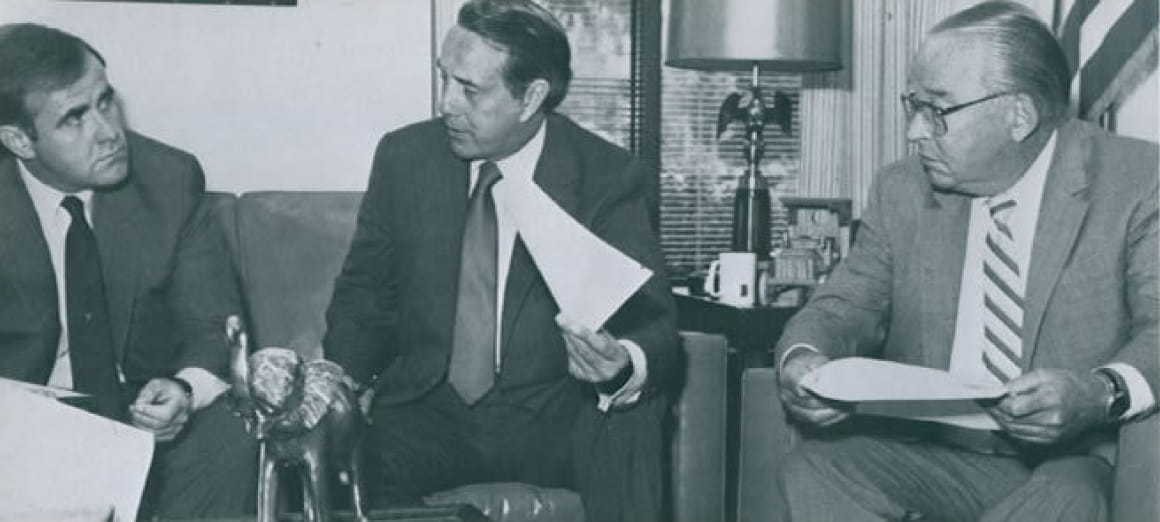
The origin fits the model. In 1985, former public servants Richard Lyng and William Lesher formed Lyng & Lesher as a food-and-agriculture consultancy. Randy Russell joined in February 1986. Soon afterward, President Ronald Reagan named Lyng secretary of agriculture. Lesher and Russell carried the practice forward; today Russell is president and CEO. The firm did not wander into agriculture after spotting a market category. It started inside the category and stayed there.
“When you hire us, you get all of us.”The firm's operating promise
That sentence is more than collegial branding. Many lobbying boutiques are constellations of individual rainmakers, each with a personal book of clients. The Russell Group presents a pooled model: one relationship should unlock shared policy knowledge across the team. That only works when the niche is tight enough for context to travel. An appropriations expert and a climate specialist can help the same agriculture client because the client's problem often crosses both desks.
The first thing that failed was unity
The cleanest example is climate policy. Randy Russell offered a blunt diagnosis of earlier efforts: agriculture, forestry, and food communities had not been unified. The correction was not a cleverer slogan. It was a larger table.
The Food and Agriculture Climate Alliance began in 2020 as a dialogue among organizations that did not usually arrive at climate debates with the same incentives. Farm groups, forest owners, food businesses, state officials, and environmental advocates developed shared principles. Policies should be voluntary, market- and incentive-based, science-based, bipartisan, and useful to rural resilience. The alliance produced more than 40 recommendations and later hired The Russell Group for federal advocacy. It has since grown beyond 90 members.
What changed their minds was not sudden harmony. Members still disagreed. The breakthrough was agreeing on the rules of disagreement and the conditions under which each side could say yes. That is coalition management at its most practical: reduce the number of surprises, preserve room for difference, and carry one legible position into the room.
What does the work cost?
The Russell Group does not publish a rate card. Federal lobbying disclosures do, however, reveal pieces of the commercial model. Examples from the fourth quarter of 2024 show several clients reporting $50,000 in income to the firm, another at $60,000, and the Food and Agriculture Climate Alliance at $90,000. These are disclosed quarterly lobbying amounts, not universal prices and not the firm's full revenue.
What buys that kind of fee? Labor, certainly, but also compression. A client is paying to shorten the distance between a sprawling concern and a usable government action. The deliverable might be draft legislation, an appropriations request, a regulatory comment, a coalition call, or a warning that the chosen route will not survive contact with the committee. Good counsel sometimes produces a document. Sometimes it prevents one.
The customer list visible in public filings makes the range concrete: food manufacturers, animal-health companies, grain and dairy groups, potato growers, electric cooperatives, and climate coalitions. The market is not “everyone who needs government relations.” It is organizations whose federal problem touches the food system and matters enough to justify sustained representation.
The part worth copying
Most readers will never draft a farm bill. The operating habits travel well anyway.
Choose a narrow arena. Expertise compounds when the next assignment reuses the last assignment's context.
Translate goals into artifacts. A one-pager, draft clause, or decision map gives allies something specific to improve and carry.
Build the constituency early. A persuasive idea without a group behind it is still only a memo.
Share the account. Clients get continuity when knowledge belongs to a team instead of one charismatic gatekeeper.
There are boundaries. The model loses force when an issue sits outside the firm's food-agriculture-energy map, when a client wants a quick theatrical confrontation instead of a long negotiation, or when the interested parties have no overlap to bargain around. Bipartisan relationships are useful when policy must outlast elections. They are less useful when the goal is simply to make noise for one news cycle.
The firm has also made a small but telling investment in its own pipeline. It supports two agriculture scholarships at North Carolina A&T and has offered a paid summer internship since 2021. Through MANRRS, it recruits students into hands-on government-affairs work. That effort will not remake Washington by itself. It does recognize the same lesson as the client work: a field changes when you widen who is in the room before decisions are made.
Forty years of useful boring
In 2025, The Russell Group marked its 40th anniversary. Around the same period it formalized a new management structure: Tyson Redpath over advocacy and business strategy, Jessica Schulken over advocacy and external affairs, and Allyson Alvaré Kranz over operations. The move is not cinematic. It is what a relationship business does when it wants institutional memory to survive growth.
That may be the company's most honest achievement. It has made a durable business from the unphotogenic parts of influence: reading, drafting, calling, convening, revising, and returning the next morning. The vote is still the scene everyone watches. The Russell Group keeps working on the scene that comes before it.