Imagine arriving at a shop for something its website says is in stock. The door is open. The product is gone. A map solved your first problem and quietly handed you another. That gap between finding a business and completing a purchase is where Weedmaps has spent much of its life. Cannabis makes the gap especially interesting: the customer needs useful information, and the retailer needs a way to be found.
- Consumers search menus, reviews and deals, then request pickup or delivery.
- Businesses pay for visibility and software. Retailers fulfill the orders.
- Weedmaps’ fortunes depend on what those businesses can afford to spend.
01 The customer wants a door that opens
Weedmaps dates its launch to July 30, 2008. The original proposition was wonderfully literal: put cannabis businesses on a map. A product category with plenty of curiosity and uneven access had an information problem. A directory could make a fragmented market easier to navigate without growing a plant or leasing a storefront.
Justin Hartfield is central to that origin. Current corporate biographies also identify Doug Francis as a co-founder; early reporting names Keith Hoerling, the technical co-founder. The company grew around a practical consumer routine: find somewhere nearby, inspect its menu, read what other people thought, and decide whether to make the trip.
02 The menu is the machinery
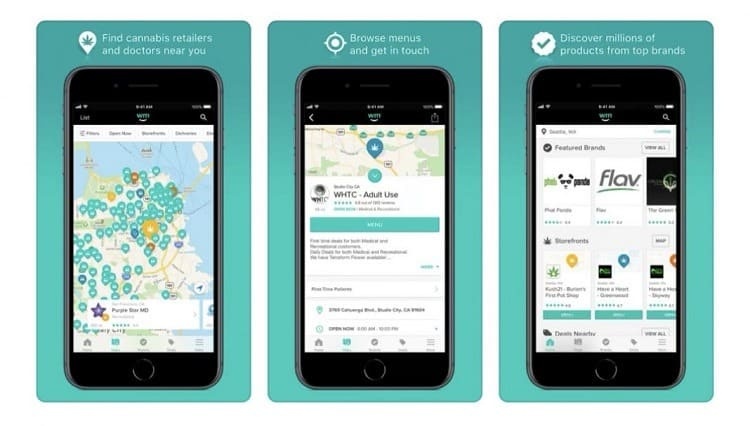
Today, the consumer platform combines dispensary discovery, product information, reviews, deals and order requests. Adults and medical patients can browse participating businesses and arrange pickup or delivery where available. The retailer completes the transaction. Weedmaps supplies the connection; availability and local rules determine what that connection can do.
The less visible work happens behind the screen. Live Menu integrations synchronize descriptions, pictures, prices and availability with a retailer’s point-of-sale system. Order integrations pass reservation requests into its workflow. A menu that updates with the shop is more useful than one that remembers what the shop had yesterday.
catalog
POS
menu
request
In June 2024, BLAZE connected to Weedmaps’ catalog of more than 340,000 unique products. The integration pre-populates inventory information, including images and descriptions. Staff can still edit fields. This is a refreshingly mundane competitive advantage: less typing, fewer inconsistent records, and fewer opportunities for the same product to acquire three different identities.
The software also extends beyond the marketplace page. WM Store carries menus and order requests onto retailers’ own websites. WM Insights reports listing engagement and, for brands, product and market information. The connective tissue is the point: a business can use Weedmaps to attract demand while keeping a customer-facing website of its own.
03 The bill goes to the business
The shopper gets free discovery. Retailers, delivery operators and brands buy access to that shopper. Weedmaps for Business supplies listings and commerce tools; paid placements put businesses and promotions in front of consumers already considering a purchase. The distinction matters. Weedmaps earns money from the businesses pursuing the sale.
Its alternatives occupy overlapping territory. Leafly offers discovery, reviews and cannabis information. Dutchie sells retail commerce software. Jane provides commerce tools and can also sync menus to Weedmaps. Software companies can compete for a retailer’s budget while connecting to one another inside the same store.
In the second quarter of 2026, average monthly revenue per paying client was $2,807. That is a reported average, not an advertised subscription price. It makes the commercial question concrete: can a shop turn the attention it buys into enough profitable orders to justify another month?
04 What the big number bought
The 2021 Silver Spike combination brought Weedmaps to Nasdaq with $579 million in gross transaction proceeds: $254 million from the SPAC’s trust and $325 million from a private investment in public equity. The headline number sounds like an enormous operating budget. The allocation tells a different, more useful story.
The announcement earmarked roughly $125 million as primary capital, including transaction expenses, and roughly $455 million for existing holders. Those announced amounts were rounded. Shareholder liquidity and money available to build a company serve different purposes; anyone copying the financing story should keep separate columns for them.
A directory can deliver the customer.
It cannot supply the retailer’s margin.That is the business tension.
05 The cost of looking bigger
One clear warning arrived in the third quarter of 2022. Adjusted EBITDA was negative $9.6 million, and CEO Chris Beals stepped down. Francis took the interim lead. The sequence puts the later product cuts in context: the business was already confronting the expense of its ambitions before it reduced the range.
The expansion phase encountered trouble. In December 2023, Weedmaps retired WM AdSuite, WM CRM and WM Screens, concentrating on products supporting its marketplace and commerce experience. The change made the portfolio narrower. Maintaining a broad suite had stopped being the organizing idea.
Audience measurement brought a separate reckoning. In 2024, WM Technology settled an SEC matter concerning its monthly-active-user reporting and paid a $1.5 million civil penalty, without admitting or denying the findings. The lesson for marketplace operators is straightforward: define engagement carefully before selling a growth story around it.
Revenue fell to $174.7 million in 2025, from $184.5 million in 2024. Management pointed to pricing pressure on cannabis operators and constrained marketing budgets. Doug Francis described “cautious spending across much of the ecosystem.” A marketplace selling visibility feels the squeeze when its customers start protecting cash.
06 A smaller promise, kept
In April 2026, the board announced voluntary Nasdaq delisting, citing operating constraints, weak trading liquidity and reporting burdens. Subsequent reporting identifies MAPS on OTCQX. For the June quarter, Weedmaps reported $42.4 million in revenue and $2.9 million in net income. Leaving an exchange did not remove the everyday job of serving shops and shoppers.
The company’s stated mission is to “power a transparent and inclusive global cannabis economy.” Its advocacy work includes education and support for social equity entrepreneurs. That ambition sits alongside a small, testable promise: help someone discover a product and reach a business that can supply it.
For another founder, the useful move to copy is solving a specific search problem, then improving the handoff. For a retailer, judge paid discovery by fulfilled orders and contribution margin. This approach needs accurate inventory, enough local demand and workable unit economics. Where shops cannot legally operate, or cannot earn enough on an order, another pin on the map will accomplish very little.