The cleverest thing about Weed Man is what it leaves in the garage. The company does not lead with mowers, flower beds or elaborate landscape construction. It treats lawns. Fertilizer goes down. Weeds, insects and disease get managed. Compacted soil gets aerated. Thin turf gets seed. Then the truck returns because a lawn is not a one-visit problem. It is a living subscription with crabgrass.
That narrow job has carried a family business from a single pickup truck in Mississauga, Ontario, to a network that says it now covers nearly 1,000 territories in the United States and Canada. Weed Man reports more than 700,000 lawns serviced each year, 54,000-plus five-star reviews and over $350 million in system sales. The last figure is network sales, not the franchisor's revenue, but it describes the size of the machine.
Homeowners buy the visible result: thicker turf, fewer weeds and one less Saturday spent decoding bags in the garden aisle. Franchisees buy the machinery behind it: protected geography, a recognized name, agronomic methods, training, software, purchasing leverage, marketing and a coach on the phone. Weed Man sits where consumer services, environmental management and franchising meet. The customer sees grass. The operator sees routes, renewals and density.
One truck, one nickname, one useful constraint
Desmond Rice arrived in Canada from Ireland with an appetite for a steady living. In 1970, he and his wife, Brenda, began serving local demand for professional weed control and pest management. Children in the neighborhood supplied the brand name. The fellow arriving in a pickup to deal with broadleaf weeds was, naturally, the Weed Man.
The business started with weed control, but its philosophy moved upstream. Strong turf is harder for weeds and pests to invade, so the program put fertilization first and treated mowing and watering as jobs shared with the homeowner. That sounds like agronomy. It is also product design: improve the underlying system instead of selling an endless whack-a-mole attack on symptoms.
By 1976, the Rices were franchising across Canada. Each territory could adapt to local soils, seasons and regulations while using a common brand and operating method. This is Weed Man's durable compromise. Lawn science must be local, but billing, marketing, training and service standards do not have to be reinvented in every town.
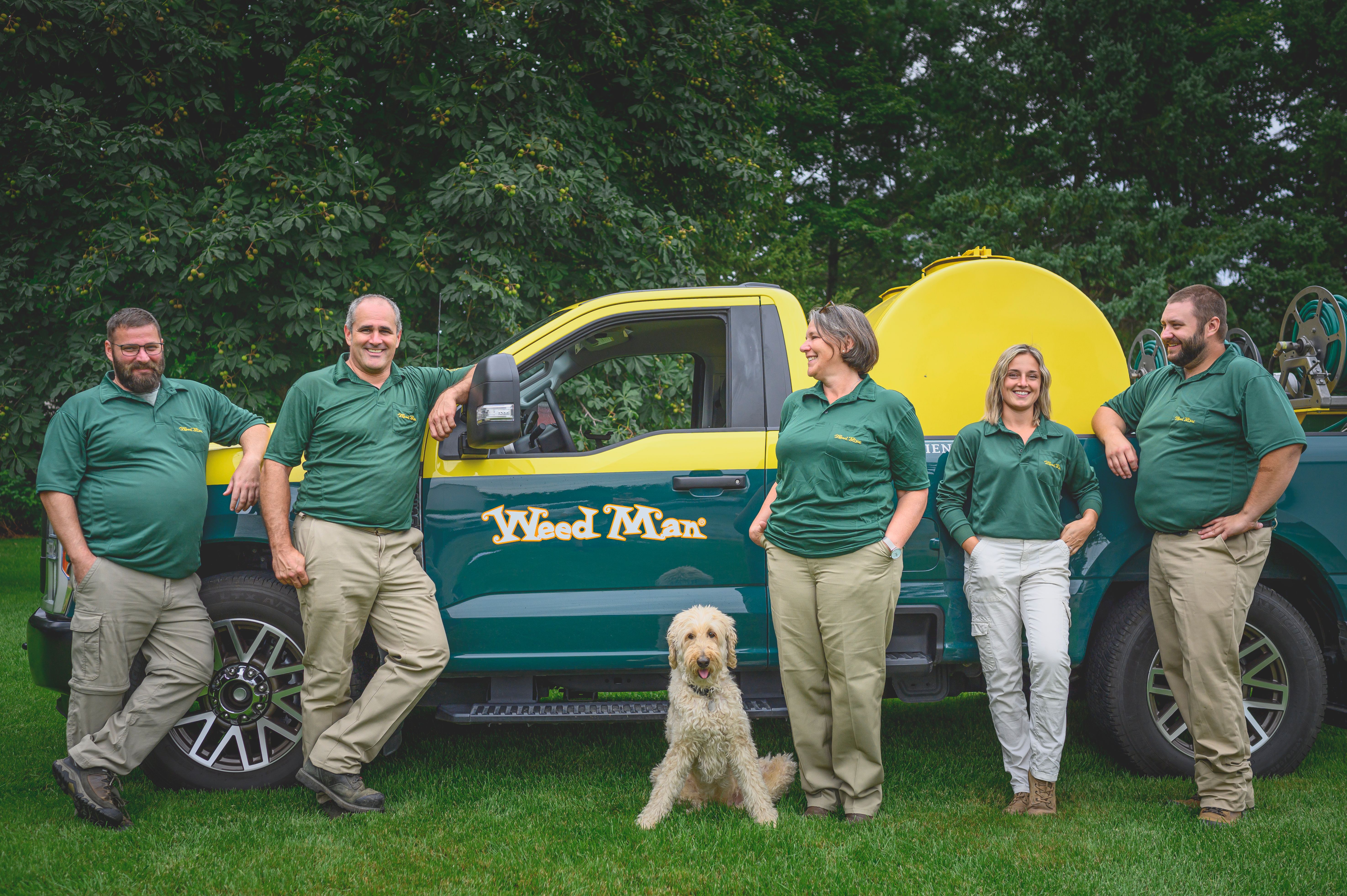
The first thing that failed was year one
The most revealing Weed Man story begins in somebody else's basement. In the mid-1980s, chemical engineer Roger Mongeon visited a neighbor who ran a two-truck Weed Man franchise from home. Mongeon had spent a decade at Union Carbide and wanted less travel, more family time and a business of his own. The neighbor showed him the numbers. Mongeon studied the industry for months, sold his house and bought a territory in Hull, Quebec, in 1987.
It did not instantly work. The first operation grossed about $123,000 and lost roughly $8,000 in year one. Mongeon later recalled watching his line of credit sink to $5,000. That was the first failure: not the concept, but the assumption that training makes a new operation feel familiar. A manual can shorten a learning curve. It cannot delete it.
What changed his mind about the risk was evidence. In year two, sales doubled and the location produced about $50,000 in profit. By year three, he was ready to expand. His original ambition was a $700,000 lawn company and a quiet life. Instead, he became a major Canadian operator, acquired the U.S. franchising rights from Des Rice in 1996 and helped design the brand's American expansion.
You'll spend a lot of money buying a franchise and getting equipped. When you start, you'll find that even though you've been trained, everything is new and you have a lot of doubts.Roger Mongeon, former Weed Man USA CEO
Mongeon's reported operating habit was almost comically unromantic: detailed 10-year plans and “maniacal” measurement. Calls, routes, sales and service did not float around as folklore. They became numbers. For the U.S., his team added another layer by recruiting experienced lawn-care operators as subfranchisors. Those regional partners could sell and support franchises, and share in royalties. Local knowledge was not a loose exception to the system. It was made part of the system.
The repeatable loop
What the customer buys - and what the owner pays
For homeowners, the core menu is fertilization, targeted weed control, core aeration and overseeding. Depending on the local franchise, the list may extend to topdressing, disease control, grub and insect treatments, vegetation control, mosquito service and perimeter pest management. The proprietary slow-release granular fertilizer is the flagship input. The service guarantee and local office are the trust layer.
The difference from a do-it-yourself bag is diagnosis and continuity. The difference from a neighborhood generalist is a narrow specialty backed by national purchasing, marketing and training. The difference from TruGreen, Lawn Doctor and other national alternatives is the pitch that an owner in the community can deliver local accountability without giving up a larger system's tools.
That bargain has a price. Weed Man's 2025 U.S. franchise disclosure document estimated $81,150 to $109,400 to begin operation. The range included a $30,000 to $50,000 initial franchise fee, $4,600 for training, $7,700 in equipment and fixtures, $6,250 in computer hardware and software, and $25,000 to $30,000 in additional funds for the first three months. A truck and spray package was listed at $1,000 to $1,500 a month. Royalties were 6.5 percent of annual net sales up to $1 million and 5.5 percent above that, alongside a 1.2 percent advertising-fund contribution.
Where the opening money goes
Selected high-end estimates from the 2025 U.S. FDD. Real estate improvements vary.
The disclosure does not promise profit. The owner still has to hire technicians, navigate pesticide rules, manage seasonal cash flow, win renewals and pack enough nearby customers onto each route. Protected territory prevents another Weed Man franchise from selling next door. It does not prevent a competitor, a drought or a homeowner with a spreader.
The second-generation company
Family succession shaped the network as much as fertilizer. Jennifer Lemcke, Mongeon's daughter, first encountered Weed Man as a teenager when her father bought his franchise. She later became an owner, worked across the business and rose to chief executive. In late 2018, the U.S. group formed TH Canada Inc. and purchased the Canadian rights as co-founder Brenda Rice prepared to retire. The transaction reunited related control of the Canadian and U.S. systems, then covering more than 680 territories.
The culture it advertises is built around service, integrity, passion and innovation. In practice, the more distinctive traits are operator intimacy and internal mobility. Local offices recruit technicians, train managers and promote from the field. Annual meetings spread methods across the network. Community drives and veteran programs give local owners a reason to be seen beyond the treatment sign left on a lawn.
By 2025, the company said it had awarded 18 expansions, four transfers and one new franchise in Enid, Oklahoma. In 2026, large franchise groups Epic3 and LND announced a merger, while the network highlighted openings or expansion in Boston, Detroit and Downriver, Mansfield and Lubbock. The stated destination is $1 billion in system sales. Bigger operating groups suggest that Weed Man's next chapter may be consolidation as much as fresh franchise recruitment.
The copyable part is not the logo
A founder cannot copy 56 years of recognition. The useful pieces are smaller and available now. Choose a recurring problem whose progress can be observed. Keep the core service narrow enough to train. Turn local variation into a diagnostic step, not an excuse for chaos. Give each operator clear geography. Make follow-up part of the product. Measure the unglamorous middle, where calls become customers and customers become dense routes.
Five things an operator can steal
- Sell an outcome over a season, not an isolated visit.
- Fix the underlying condition before chasing visible symptoms.
- Standardize training and software while keeping diagnosis local.
- Design territories for route density and owner accountability.
- Treat retention as the business model, not the victory lap.
There is a consumer lesson too. Weed Man can help when the homeowner wants a managed program, understands that turf improves over multiple applications and will still mow and water correctly. It is not a magic green paint. A technician can feed soil and control weeds; nobody can negotiate with a heat wave.
Where it fits
Dense suburban routes, customers who value turf, repeat treatment needs, workable water access and local operators who can retain trained crews.
Where it strains
Sparse territories, very short seasons, severe water restrictions, hostile regulation, weak renewal rates or customers expecting one visit to reverse years of neglect.
The limitation is part of the appeal. Weed Man is not pretending every outdoor problem belongs to it. Its expertise is the treated lawn, its market is the homeowner who prefers guidance to guesswork, and its economic unit is a route that returns. One pickup truck became a system because the company kept asking the same practical question: what must happen next for this lawn, this customer and this operator to come back healthier?