How Three Salesmen Turned Door Knocks Into a $25 Million Bug Business
Three former door-to-door sales managers built RIDD by treating bug spray like a subscription - and automating the busywork away. In four years they went from 6,000 customers to 30,000.
In the summer of 2020, three men who had spent years knocking on strangers' doors decided to knock for themselves. Carson Bird, CJ Edgington and Jason Wilde had all sold pest control the hard way - clipboard in hand, one porch at a time - and two of them had managed sales teams at another company. When they launched RIDD Pest Control out of Lehi, Utah, they brought something more valuable than a logo: they brought the reps. Distribution first, everything else second.
Four years later, RIDD is one of the fastest-growing pest control companies in America. Revenue climbed from $8.9 million in 2022 to roughly $25 million in 2024. The customer base went from about 6,000 to 30,000 in a single year. And on the industry's closely watched PCT Top 100 list, RIDD jumped 27 spots to No. 60. None of that came from a technological breakthrough. It came from selling a boring service extraordinarily well.
01 / The ProductWhat RIDD actually sells
On paper, RIDD does what every exterminator does. Its licensed technicians treat homes for ants, spiders, wasps, earwigs and cockroaches, then add specialty work on top: mosquito and tick fogging, rodent control, termite prevention, German roach programs, snake prevention, moles and carpenter bees. What it deliberately does not do is telling. RIDD skips bed bugs and wildlife removal - the one-off, unpredictable jobs - and stays focused on the recurring plans it can schedule, route and renew.
The real product is closer to peace of mind than pesticide. Customers sign up for an ongoing plan, usually treated on a quarterly or bi-monthly cadence, with free re-treatments between visits if bugs come back. The pitch is convenience and a guarantee, wrapped in family- and pet-safe treatments and a technician who shows up on time and texts before arriving. RIDD's own framing is a tagline you can read on a truck: "Don't Get Stressed. Get RIDD."
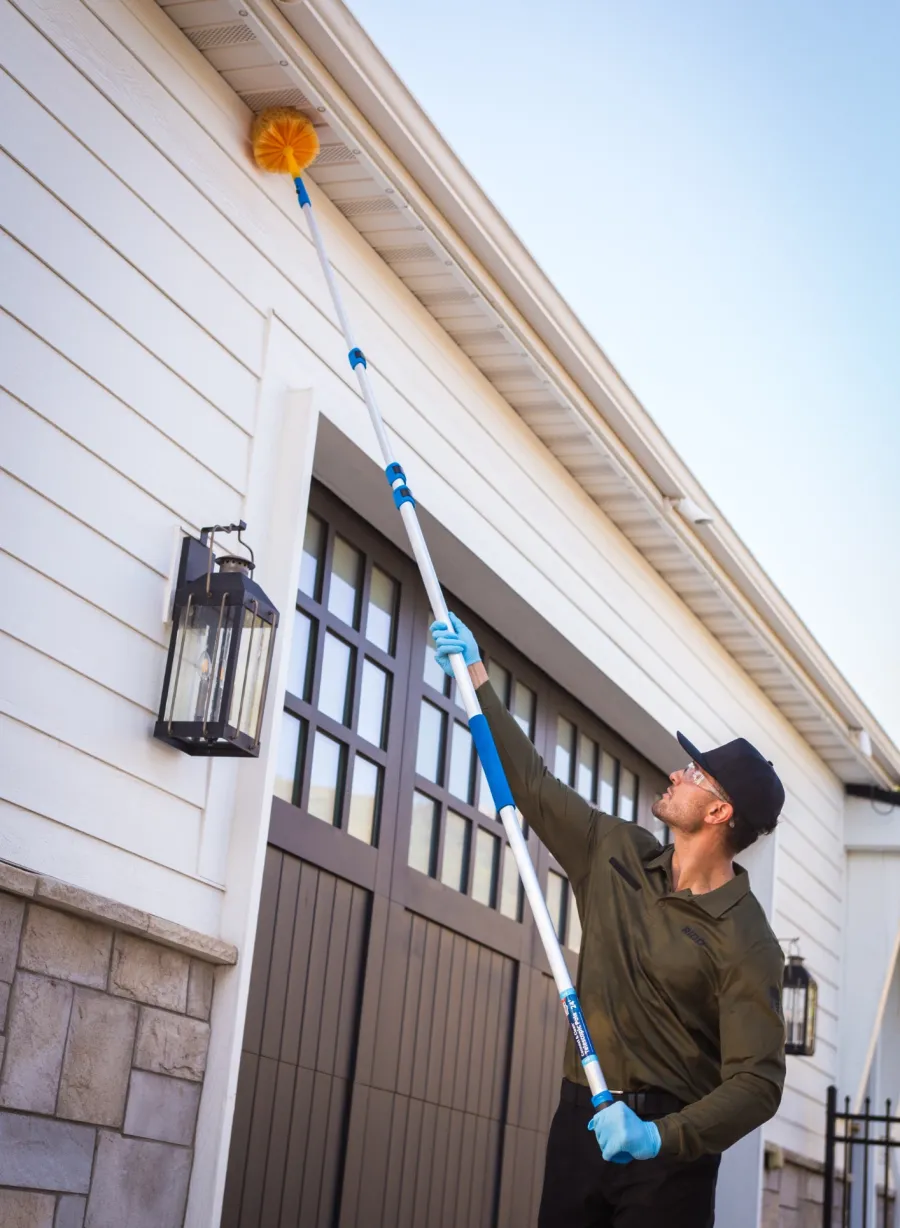
RIDD's bet is simple: pest control is not a product you buy, it's a service you forget about. Sell the forgetting.
02 / The ModelBug spray as a subscription
The move that separates RIDD from the corner exterminator is the business model, not the chemistry. By turning treatments into recurring plans, RIDD converts a low-trust, one-time transaction into predictable revenue and a customer relationship that compounds. Every new plan is a small annuity; every mosquito or rodent add-on lifts the value of an account that already exists. That is why the customer number matters as much as the revenue number - retention is the whole game.
Selling those plans is a seasonal, brute-force operation. RIDD staffs roughly 200 sales representatives who fan out across neighborhoods in the warm months, backed by a core of about 40 technicians and 30 office staff. It is the Utah door-to-door machine that also produced rivals like Moxie and Edge - a corridor of companies that learned to sell home services one porch at a time and then industrialize the follow-through.
03 / The MachineThe $100,000 automation
Doubling a customer base in a year usually breaks a company's operations. Invoices pile up, renewals slip, collections calls go unmade. RIDD's answer was to automate the paperwork before it drowned them. Running on the field-service platform FieldRoutes, the company built "Trigger Rules" to handle batch charges, payment reminders, renewal notices, past-due messaging, collection notices and appointment confirmations without a human touching them.
The savings were concrete enough to name a dollar figure. RIDD's Chief Administrative Officer, Dan Farah, estimated the automation did the work of about three full-time back-office employees. Smarter routing did the same for the field, lifting technicians from 10 stops a day to 14 while cutting drive time. In a labor-tight, low-margin business, the software is not a nice-to-have - it is the strategy that let a sales machine scale without collapsing.
If we pay someone $35,000 a year and you have three of those people, that's easily a hundred grand a year that the automation saves.Dan Farah, Chief Administrative Officer, RIDD

04 / The ProofTen thousand reviews and a motto
RIDD's internal shorthand is "Service Above All," and the company points to more than 10,000 customer reviews averaging around 4.8 stars as evidence it isn't just a slogan. In 2024 it was named a "Most Trusted Company" by Snoball. The reviews are not uniformly glowing - as with any high-volume door-to-door operation, some customers report friction over pricing and cancellation - but the weight of them tilts strongly positive, which is the harder thing to fake at 30,000 accounts.
That reputation is the moat. In a fragmented industry where most competitors are indistinguishable to a homeowner, the company that answers the phone, shows up on time and stands behind a guarantee wins the renewal. RIDD's growth is less a story about bugs than about turning ordinary reliability into a repeatable, rankable advantage.
05 / The Exit-in-PartSelling a slice, keeping the machine
In May 2024, Massey Services - a family-owned pest management company founded in Orlando in 1985 - acquired RIDD Pest Control of Miami, the company's South Florida operation. Terms were not disclosed. "We are pleased to welcome the Ridd Pest Control of Miami team members and customers to the Massey Services organization," said Tony Massey, the acquirer's president and CEO. The deal expanded Massey's South Florida footprint while RIDD's Utah-based core kept compounding.
It is a quietly instructive outcome for anyone building in home services: you can sell a regional branch for cash and consolidation without giving up the growth engine. RIDD trimmed a market that made more sense inside a larger operator, banked the transaction, and kept knocking everywhere else.
06 / The MapWhere RIDD fits in the market
Pest control in the United States is a large, deeply fragmented industry. At the top sit national giants like Terminix and Orkin and regional heavyweights like Massey; underneath them are thousands of local operators, most doing a few hundred accounts and competing on little more than a phone number and a truck. That fragmentation is the opportunity RIDD is exploiting. A young company with real routing software, a recurring-revenue model and a trained sales force can roll up neighborhoods faster than the mom-and-pops can respond and more cheaply than the nationals bother to.
RIDD's closest lookalikes are the other Utah door-to-door graduates - Aptive, Moxie, Edge - companies that turned summer sales culture into national home-services brands. Against the incumbents, RIDD competes on service and freshness; against its Utah peers, it competes on retention and operational discipline. Its six-state footprint across Florida, Georgia, the Carolinas, Virginia and Utah is deliberately Sun Belt and Mountain West, where warm weather keeps the pest calendar - and the billing cycle - running most of the year.
The expertise that holds it together is unglamorous: licensed, locally trained technicians who understand regional pests, paired with a back office that treats scheduling and renewals as a data problem. That combination - field craft plus software - is what lets a four-year-old company behave like a much older one.

07 / The TakeawayWhat you can copy - and where it breaks
The RIDD playbook is unglamorous and portable. Start with distribution you already control. Convert one-time jobs into recurring plans so the revenue and the relationship both compound. Automate the back office before growth overwhelms it. Compete on reliability in a category where reliability is rare. None of it requires a patent - it requires discipline and a tolerance for a business most founders would find boring.
Where it wouldn't travel: the model leans on a seasonal army of commission sales reps and a warm-weather pest calendar, so it fits the Sun Belt and Mountain West better than a market with a short bug season or a distaste for door knocking. Aggressive door-to-door selling also generates the pricing and cancellation complaints that show up in RIDD's own reviews - a tax on the growth that has to be actively managed. Copy the subscription-and-automation core; be honest about the sales culture that powers it.