The most revealing thing about Authority Brands is that most homeowners will never know they hired it. They call Benjamin Franklin Plumbing when the sink backs up, Mister Sparky when a breaker spits sparks, or Woofie's when the dog has become more shag rug than schnauzer. The corporate parent stays off the van. Its work happens behind the windshield: software, purchasing, training, financing, marketing and the routines that turn an urgent phone call into a scheduled visit.
From headquarters in Columbia, Maryland, the privately held company supports 15 franchise systems. More than 1,000 owners operate across over 2,700 territories in the United States and Canada. Together, those locations produce more than $2 billion in annual system sales. That last phrase is important. It measures sales across the network, not revenue booked by the parent company. Still, it gives the shape of the enterprise: a large business intentionally presented to the public as many smaller ones.
A portfolio built around the panic drawer
Authority Brands sits in an unusually durable corner of the consumer economy. A homeowner can postpone a new sofa. A flooded basement, dead air conditioner or aging parent does not negotiate so politely. The portfolio spans plumbing, HVAC, electrical work, restoration, house cleaning, pools, lawns, mosquitoes, trees, screens and junk. It also reaches beyond the building through in-home caregiving and pet services.
This is less a neat category than a map of household anxiety. Some jobs are emergencies. Others recur every week or season. A few are discretionary but inconvenient enough that customers gladly outsource them. All require local labor, and many depend on trust inside or around the home. Those qualities make the market difficult to centralize at the point of service and attractive to centralize everywhere else.
Company figures reported in 2026. System sales represent sales across franchise locations, not consolidated corporate revenue.
The group began in 2017 around The Cleaning Authority. Homewatch CareGivers arrived first, followed quickly by America's Swimming Pool Company and Mosquito Squad. The decisive expansion came in 2019, when the Clockwork acquisition added three trade names with long histories: One Hour Heating & Air Conditioning, Benjamin Franklin Plumbing and Mister Sparky Electric. Monster Tree Service and STOP Restoration followed in 2020. DoodyCalls joined in 2021. By 2023, after additions including Woofie's, DRYmedic, The Junkluggers and Screenmobile, plus the launch of Lawn Squad from an acquired lawn-care system, the current 15-brand outline had emerged.
The brand on the invoice is only the front door. The scalable product is everything the customer never sees.
The customer behind the customer
Authority Brands has two audiences, and confusing them obscures the business. Homeowners and families buy the actual services. Franchise owners buy the system that helps deliver them. For an aspiring operator, the alternative is starting alone: choosing software, building a website, finding vendors, learning how to price jobs, recruiting technicians and discovering through expensive mistakes which marketing channels produce a ringing phone.
The franchisor packages that learning. Authority Brands describes three enterprise platforms in particular. BuyMax pools procurement and offers rebates or discounts. BuyFin helps owners present consumer financing and collect payments, useful when a furnace fails before a household has budgeted for one. Success Academy provides hands-on training across the operating life of a business. Those sit beside brand marketing, technology, call-center support, coaching and shared operational expertise.
The arrangement is a trade. Owners surrender some freedom and pay brand-specific franchise fees and royalties in exchange for a playbook, a name and institutional support. The parent gains recurring economics without staffing every truck. Exact terms differ by brand and are disclosed to prospective franchisees rather than in consolidated public accounts. The local operator still carries the daily burden: hiring, service quality, scheduling and reputation in a territory where one bad visit can travel quickly through neighborhood group chats.
Why not put one name on every van?
A single household-services brand sounds efficient until it meets reality. Homeowners search for specialists. A name associated with plumbing does not automatically feel credible in dementia care; a cheerful pet-care identity may be the wrong costume for disaster restoration. Authority Brands preserves category-specific names and operating knowledge while placing common capabilities beneath them.
That distinguishes it from a simple lead marketplace, which matches customers and contractors but usually does not provide an end-to-end operating model. It also distinguishes the group from a single-brand franchisor, where every growth bet remains tied to one trade. The closest alternatives are other multi-brand systems such as Neighborly, Home Franchise Concepts, Empower Brands, Premium Service Brands and BELFOR Franchise Group. Each offers a different mix, but all are chasing some version of the same advantage: fragmented local demand served through repeatable national infrastructure.
Authority Brands states its acquisition filter plainly. It looks for market leaders or brands capable of becoming one, services with low disruption risk and systems with strong unit economics. The first criterion buys recognition. The second favors work that still needs trained people in local markets. The third matters because no amount of corporate software can rescue a territory whose basic labor, pricing and customer-acquisition math does not work.
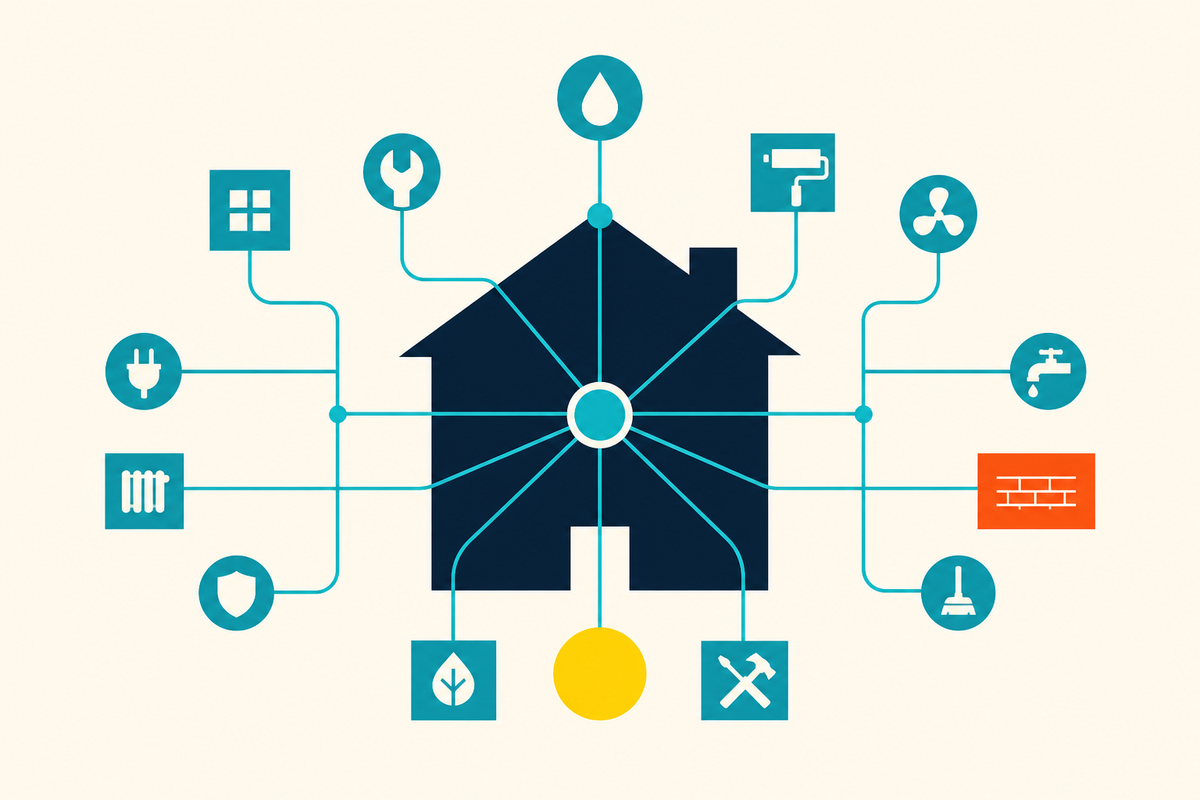
Editorial illustration, not reported financial data. The portfolio mixes emergency, project-based and recurring services.
Scale, with fingerprints left on it
Private equity is central to the story. Funds advised by Apax Partners bought Authority Brands from PNC Riverarch Capital in 2018, when the platform had two principal concepts and more than 300 franchise locations. Apax spoke at the time about acquisitions and digitization. British Columbia Investment Management Corporation made a significant minority investment alongside Apax funds in 2022. Purchase prices and valuation have not been publicly disclosed.
The acquisition strategy does have a human wrinkle. Authority Brands says many businesses were purchased directly from founders, some of whom remained involved. ASP founder Stewart Vernon became an executive vice president after his pool-services company joined the platform. That continuity is practical. A founder often knows why an odd-looking rule exists, which seasonal metric matters and where franchisees will push back. A spreadsheet can inventory processes; it cannot easily capture scar tissue.
Culture at this scale is less about office perks than whether owners believe the center understands the field. The company stages training, brand workshops and franchisee summits, and it publicly emphasizes shared learning. In 2024, six owners received International Franchise Association Franchisee of the Year recognition. Its Success Academy also won Gold and Bronze in the 2023 Brandon Hall Group technology awards. Awards do not prove unit economics, but they show where management wants the network to look: owner performance, instruction and repeatability.
The next operating center
The company is now making its backstage operation more physical. In June 2026, Georgia officials announced that Authority Brands would establish a new headquarters, called the Franchisee Success Center, at 200 Galleria Parkway in Cobb County. The planned 48,000-square-foot site represents a $13 million investment and is expected to create 390 jobs over several years, concentrated in operations, IT, finance and marketing. Columbia remains the current public corporate address while the transition takes shape.
The leadership bench has changed with that move. Former IHG executive Jay Caiafa is chief executive. Josh Greear became chief financial officer in September 2025. Steve Clemente joined as president and chief operating officer of the trades group that December. In February 2026, Ryan Bowes became chief growth and transformation officer, overseeing franchise development, call-center operations, BuyMax and acquisition integration. It is a roster built for the less glamorous phase after buying brands: making them work together.
Capital is following the same theme. In May 2026, Authority Brands completed its third whole-business securitization, a $461 million issuance comprising $286 million of term notes and up to $175 million of revolving commitments. Revenue-generating assets from 12 U.S. brands secure the notes. The structure turns the expected durability of franchise cash flows into working and growth capital. It also raises the stakes on consistent execution across the system.
A roll-up gets headlines when it buys. A platform earns its keep on the ordinary Tuesday after the deal closes.
Where the model can bend
A broad portfolio reduces dependence on any one trade, but it introduces its own friction. HVAC and home care share back-office needs, not labor pools or regulatory rhythms. Central tools must be common enough to create savings and flexible enough not to flatten useful differences. Franchisees are owners, not branch managers; a support program only works when they adopt it. Customers, meanwhile, judge the local visit, not the elegance of the capital structure.
The opportunity is cross-pollination without forced sameness. A better call center can help several brands. Procurement can lower input costs. Financing can rescue a sale when an essential repair collides with a household budget. Training data from hundreds of territories can expose patterns that a lone operator might miss. None of those advantages requires repainting every truck.
That is Authority Brands' place in the market: not quite a consumer superbrand, not merely a holding company and not a gig-economy marketplace. It is an infrastructure company for local service entrepreneurs, wrapped around a collection of specialist names. Its promise is that the independent owner can remain close enough to know the neighborhood while borrowing the reach of a national system.
The test will stay stubbornly concrete. Did the technician arrive? Was the caregiver dependable? Did the pool clear up? Did the dog return looking recognizably like a dog? For all the technology and finance behind Authority Brands, the enterprise ultimately lives or dies at somebody else's front door.