Before Wealthfront could automate investing, it had to abandon an appealing idea about investors: that what they wanted was someone especially good at picking stocks. Its predecessor, kaChing, combined virtual portfolios with the prospect of following talented money managers. There was a game, there were experts, and there was a rather inconvenient shortage of demand.
- Wealthfront turned portfolio maintenance into a software service.
- The standard managed portfolio costs 0.25% annually, plus fund expenses.
- Cash management now supplies most of the company’s revenue.
Andy Rachleff, a Benchmark co-founder and Stanford lecturer, and Dan Carroll were working on a problem with an obvious constituency. Ordinary people could not easily buy the investment management available to institutions. But access to experts and demand for experts turned out to be different things. Stanford’s case study describes the company shutting its game, recruiting professional advisers, then confronting another repositioning when customers failed to follow.
The expert was the wrong product
The eventual answer arrived in December 2011: automated investment management. Customers could delegate the construction and upkeep of a diversified portfolio. Software would do the repetitive work. The company had moved from helping people choose a manager to helping them avoid a long sequence of investing decisions.
That distinction explains the appeal better than the familiar label “robo-advisor.” A robot in a suit sounds faintly ridiculous. A service that takes an annoying recurring task off your list sounds useful. Wealthfront’s subject is money, but its product is also the time and attention money demands.
“Software is our superpower.”
Wealthfront’s recruiting page
Its careers materials emphasize automation, data and human-centered design. The engineering is part of the service itself: turning a risk assessment into a portfolio, keeping allocations in line, and handling trades across many accounts. Consistency matters when the task recurs long after the enthusiasm of opening an account has worn off.

The audience helps explain those choices. Wealthfront describes its clients as digital natives, often higher earners who prioritize saving. Someone paid partly in company shares may already have plenty of financial complexity without wanting a second job managing investments. Path, its planning software, aggregates accounts and models goals such as retirement. The useful question becomes whether today’s saving supports tomorrow’s plans. A forecast gives the customer a way to examine trade-offs; it cannot make an uncertain future predictable.
A quarter of a percent, in actual dollars
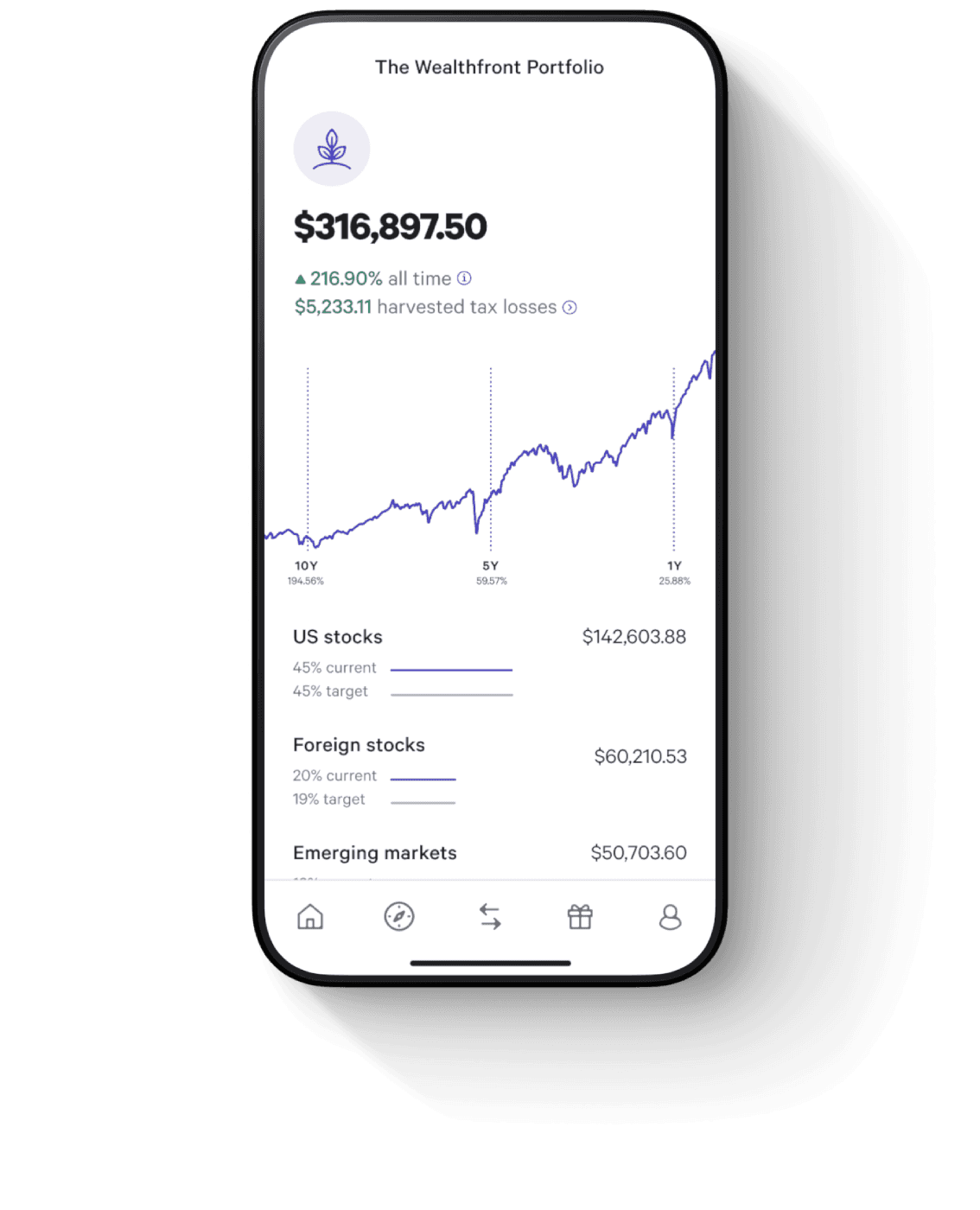
The standard managed portfolio starts at $500 and charges a 0.25% annual advisory fee. At a constant $100,000 balance, that is $250 a year, before underlying fund expenses. Calling the fee small is less useful than asking what it buys: diversification, rebalancing, reinvestment and, in eligible taxable accounts, tax-loss harvesting.
Different investment scopes. Illustration excludes fund expenses and changes in account value.
Buying a low-cost ETF yourself remains a plausible alternative. Wealthfront must earn its fee through the maintenance around the investment. Its position sits between a brokerage that leaves the decisions with you and an adviser offering a continuing personal relationship. How attractive that middle ground looks depends on which chores you want to keep.
Tax-loss harvesting sells a holding that has declined and buys a suitable replacement, preserving similar market exposure while realizing a loss. Depending on the investor’s circumstances, that loss can offset taxable gains. Much of the benefit can be tax deferral: money kept invested today may face tax later.
Direct indexing takes the machinery inside the index. Instead of holding one fund, the account owns individual stocks. An index can rise while some constituents fall; those individual declines can create harvesting opportunities. Wealthfront’s standalone S&P 500 Direct charges 0.09% annually and requires $5,000. Its Nasdaq-100 version charges 0.12%.
 Allocation.
Maintenance.
Repeat.
The cash account stole the show
Then consider the product that asks customers to take less market risk. Wealthfront introduced its Cash Account in February 2019, giving short-term savings a place alongside long-term investments. An emergency fund and a retirement portfolio solve different problems. Offering both lets the company participate before a saver feels ready to buy stocks.
The distinction has become commercially substantial. In fiscal 2026, ended January 31, Wealthfront reported $365 million in revenue. Cash management contributed $271.7 million, roughly three-quarters. Investment advisory contributed $91.9 million. The company commonly described as a robo-advisor has built a revenue engine around cash.
Fiscal year ended January 31, 2026. Percentages rounded.
Wealthfront is not a bank. Its brokerage sweeps cash to program banks, which pay interest; Wealthfront earns revenue through those relationships. Deposits become eligible for FDIC insurance at the banks, subject to limits and conditions. The account has a $1 opening minimum and no account fees. Its yield varies. That variability also helps explain why cash economics deserve attention alongside investment fees.

The awkward details still count
Automation does not remove responsibility for explaining what the software does. In 2018, Wealthfront agreed to a $250,000 SEC penalty in a settlement covering false wash-sale monitoring disclosures and other compliance failures. The SEC found that its earlier descriptions overstated how accounts were monitored. That history belongs beside the convenience story.
Current disclosures explain the remaining boundaries. Trading in an outside account, including a spouse’s account, can create wash sales that undermine a claimed tax loss. Harvesting is irrelevant inside an IRA. Someone who needs intricate estate planning or regular personal coaching may want human advice. A comfortable do-it-yourself investor can also buy inexpensive funds without paying for automated maintenance. Betterment and the large brokerages offer other routes.
Grow with the saver
In 2022, a proposed $1.4 billion UBS acquisition was mutually terminated; UBS instead announced a $69.7 million convertible-note investment. Wealthfront subsequently priced its December 2025 IPO at $14 a share. By September 30, 2026, it reported $100.5 billion in platform assets and 1.54 million funded clients. Platform assets include cash, so the total should not be mistaken for investment assets alone.
Custodial accounts arrived in June 2026. Home Lending expanded into California that August, joining Colorado and Texas. These products follow customers into raising children and buying homes. The lesson readers can copy is modest: distinguish the cash you need soon from money invested for later, understand the fees, and make saving repeatable. Wealthfront’s early mistake was assuming people wanted a better stock picker. Its enduring proposition asks how much investing work they would gladly hand over.