Warren Hogarth had done the respectable things. He had studied, saved and paid his bills. After moving from Australia to the United States, he avoided getting a credit card because spending his own money seemed sensible. Then he tried to borrow money for a car. The missing credit history became a problem. His careful financial habits had left him difficult for a lender to read.
There is a particular comedy in an MBA encountering a form that declines to be impressed. Hogarth eventually secured the loan after considerable back-and-forth, helped by his Harvard Business School diploma. The episode stayed with him. A person with his advantages had stumbled over the rules. He began thinking about everyone who would arrive at the same desk without a diploma to wave.
Today he is co-founder and CEO of Tilt, the company previously called Empower. Its central proposition is to look more closely at the money moving through a person's life. Income and spending can tell a lender something a credit score misses. That question of what counts as evidence runs through Hogarth's own career: a Queensland childhood, chemical engineering, venture capital and, finally, a business of his own.
A fence, a fuel cell, a different future
His early years were divided between Brisbane and his grandparents' cattle ranch in western Queensland. There were horses to ride, calves to muster, fences to mend and machinery to repair. He remembers the work as an education in resourcefulness. A broken piece of equipment offers a fairly direct assessment of your ingenuity. It has little interest in your presentation skills.
The University of Queensland records an engineering honours degree in 2002, a commerce degree in 2004 and a doctorate in chemical engineering in 2006. Even before finance became his profession, his education straddled the thing being built and the economics around it. The university later gave him its Distinguished Young Alumni Award in 2014.
He had initially imagined an industrial career. A refinery internship fitted that route. A lecture about emerging science and technology helped change his view of doctoral study, and he went on to become a Fulbright Scholar at Princeton. Fuel cells offered an early possibility for a startup. Harvard Business School followed; he graduated in 2008. His route into finance was considerably less direct than a business-school biography might suggest.
The detours matter because he was already interested in making something, rather than simply finding a comfortable professional destination. Research, an attempted energy venture and business school each supplied a different kind of preparation. None came with a promise that the next transition would be tidy. His eventual company would require another change of occupation, with all the awkward beginner's work that implies.
The investor who wanted teammates
Hogarth joined Sequoia Capital in 2008. The timing supplied a brisk introduction to uncertainty. Over his years there, he worked with founders and businesses including Sunrun, FutureAdvisor and Carbon. He could see how a young company assembled its people, made decisions and responded when the original plan met the outside world.
The founders remember practical help. Sunrun co-founder Lynn Jurich describes him as an adviser during the company's early growth and credits the perspective he brought during five years on its board. Carbon co-founder Joseph DeSimone recalls introductions to engineering and product leaders who joined the core team, along with help thinking through the software and data aspects of the business.
Those are useful details in a profession that can become rather fond of announcing its own importance. Recruiting someone who can build the product is tangible. So is helping a founder think through a business model. They describe an investor doing work around the table, before the eventual outcome can make everyone look unusually prescient.
Yet Hogarth wanted a different working life. He has compared venture investing to a swim team: people belong to the same group and encourage one another, while much of the actual performance remains individual. Running a startup offered the daily dependence of a shared undertaking. He wanted colleagues whose work, successes and setbacks were bound together.
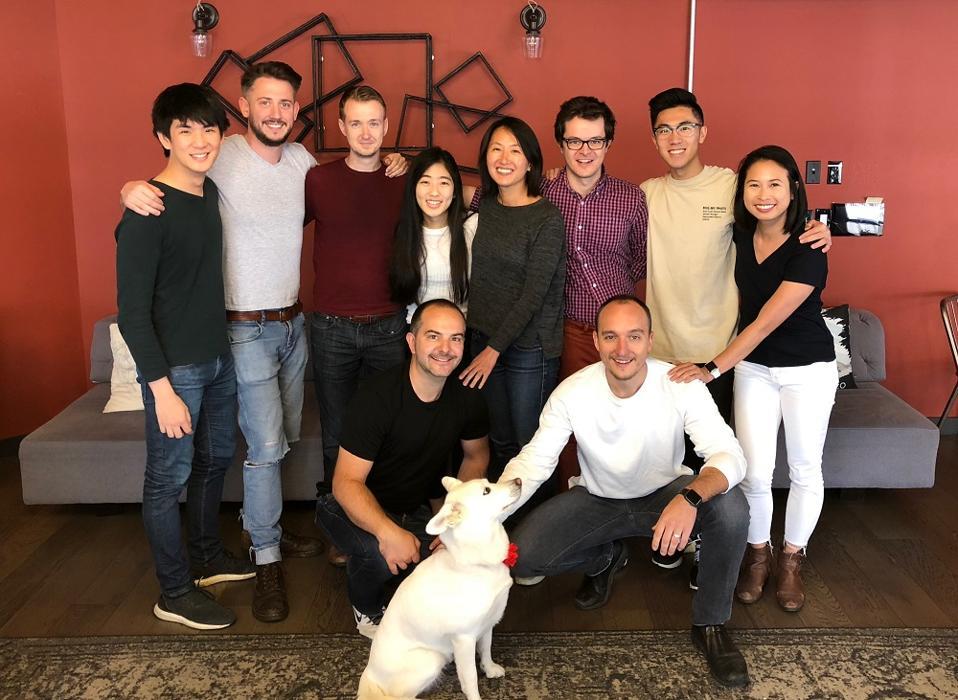
A visit to relatives in Arkansas also helped sharpen his interest in everyday financial problems. He saw familiar difficulties beyond the coastal circles around him. The audience for a useful financial tool was wider than the people he happened to meet in Silicon Valley. In 2016, he and technical co-founder Justin Ammerlaan started Empower.
Customers get a vote
The first idea was a personal financial assistant on a phone. It could help people follow balances, bills and subscriptions, and spot small opportunities to improve their finances. A reminder delivered at the right moment might prove more useful than a neat account of money already spent. The ambition was to make advice useful during the day it was needed.
Hogarth describes a deliberately staged introduction: prototypes went to a few hundred people, feedback arrived over several months, and a beta reached a few thousand more. Each round supplied an opportunity to discover that the founders' assumptions needed work. A public launch did not end the listening. It simply increased the number of people with an opinion.
His explanation of startup failure is disarmingly practical. Sometimes customers simply do not want the product. Money raised and intelligence assembled cannot settle that question on their behalf. He talks about mistakes as a route to becoming more efficient and more receptive, provided the people involved are prepared to learn. The condition does a good deal of work.
Empower eventually shifted from budgeting toward access to credit. By September 2022 it had reached one million subscribers and announced $150 million in equity and debt financing. Hogarth and Ammerlaan had gone without salaries for their first year and a half. The operation had grown to that subscriber count with fewer than 60 people. His experience allocating capital had acquired a rather personal application.
“My team sees something that traditional lenders overlook - many people are good for it.”
Warren Hogarth, August 2025
Looking at the money in motion
The company became Tilt in August 2025, alongside the introduction of three unsecured credit cards issued by WebBank. At that point it reported more than three million active US subscribers and said it had been profitable since 2022. Its underwriting used over 250 nontraditional indicators, supported by six years of performance data.
The distinction is straightforward enough to explain without a diagram of a neural network. A credit history records past borrowing. Cash flow offers evidence about current income and expenditure. Tilt uses that additional information to assess people whose conventional record may be limited or imperfect. The business depends on finding useful signals in lives that a narrower assessment might pass over.
250+
Nontraditional indicators · August 2025
Conceptual illustration of Tilt's approach. No approval outcome is implied.
The new name made that intention visible. Branding agency Ragged Edge developed an identity around tilting the odds toward customers. An italic wordmark suggested movement; illustrations by Pearl Chuaynarong brought ordinary human effort into the visual language. For a company dealing in assessments and probabilities, the choice to show imperfect people doing things was apt.
Hogarth's company has also acquired a record beyond its own announcements. It appeared on the Inc. 5000 in four consecutive years, from 2022 through 2025. Its ranks were 55, 56, 65 and 258. Those figures describe places on an annual company list, rather than a measure of any customer's experience. The individual encounter with the product remains the more intimate test.
The question travels
On July 1, 2026, Tilt announced its completed acquisition of Brazil's Blipay, a salary-advance lender with more than six million registered users. Brazil became its fourth market outside the United States, following Mexico, the Philippines and India. The acquisition carried Hogarth's original question about financial visibility into another national system.
Blipay's use of open banking data and Pix payments gave the deal a practical logic. Tilt described it as a way to extend its approach through a local business already serving customers. Hogarth argued that its underwriting experience could become more useful as the company entered additional countries. That is an aspiration with an operational burden attached: new markets bring new circumstances to understand.
There is a considerable distance between struggling to finance one car and overseeing lending businesses across five countries. The connection is the evidence each applicant gets to present. Hogarth's experience gave him a personal reason to ask the question. Building a company requires that the answer work repeatedly for people whose lives look little like his.
Leaving room to be surprised
He has also made room for an embarrassing product memory: a “crypto leaderboard.” It is a wonderfully compact reminder that an experienced investor can still chase an idea customers do not need. Hogarth treats it as a lesson in staying close to their problems. The team can laugh about it, which is a useful fate for a feature that should not have survived.
His wider ambition includes personal finance education beginning in elementary school. He has spoken about protecting family time, too. These interests give some shape to the person behind the underwriting vocabulary: someone concerned with how people learn, and with what work can crowd out if it is allowed to occupy every available hour.
The car-loan episode survives because it contains an awkward little reversal. Doing what seemed responsible made Hogarth harder to assess. Years later, he is still working on that gap between a person's circumstances and a system's view of them. The diploma helped him get through the door. Tilt's continuing assignment is to make more of the person visible before the door closes.
Keep the conversation going
Interviews, public profiles & further reading