Wade Eyerly was showing off an airline when he had to remind people how to use its stairs. One person at a time, please. It was June 2013 in Burbank, California, and Surf Air was preparing to sell a rather expansive promise through a rather small airplane door: pay a monthly fee and fly as often as you like. The aircraft was a turboprop. The ambition required considerably more room.
For $1,650 a month, early subscribers could trade the repeated business of buying tickets for membership. Eyerly, the co-founder and original chief executive, was selling relief from a familiar sequence of irritations. The drive. The terminal. The waiting. Then, after the meeting, the whole performance in reverse. A frequent commuter could reasonably wonder whether the airport had become a second employer, albeit one that charged for the privilege.
The attraction was easy to understand. Delivering it meant dealing with airplanes, regulators, capital and a finite number of seats. That gap between a pleasant promise and its expensive machinery runs through Eyerly’s career. His businesses have asked customers to trust a different arrangement. His experience has also supplied reasons to read the arrangement carefully.
Christmas cards in July
Born in Kansas City, Missouri, in 1979, Eyerly grew up as the oldest of eight children. His father was an entrepreneur, and family finances moved between comfortable periods and lean ones. As a boy, Wade sold Christmas cards door to door in July. Seasonal demand, apparently, was open to negotiation.
His route into business took a long detour through public service. He earned a bachelor’s degree in international economic policy and cross-cultural relations at the University of Central Missouri, then a master’s in public policy at Brigham Young University. Two years as a church missionary in Russia had given him Russian fluency. He also spent time working in Manila, an early connection to a country that would become important to his investing career.
He worked on the Bush-Cheney campaign, on Vice President Dick Cheney’s staff, and later at the Pentagon and the Defense Intelligence Agency. An Iraq deployment followed in 2009. These were jobs inside large institutions, where authority, procedure and consequences were part of the working environment. The future airline founder had plenty of exposure to systems that required permission before movement.
A membership with wings
The airline idea grew out of conversations with his brother David, a pilot. Wade knew the passenger’s frustrations; David understood the difficult prospects facing someone entering aviation. By 2012, the brothers and their fellow founders were developing Surf Air through the MuckerLab accelerator in Southern California. Interest arrived well before permission to carry passengers.
There was money, too. In August 2012, the young business had raised $4 million, with investors and prospective members drawn from technology and entertainment. Actor Jared Leto was among them. But the start date slipped while federal approval remained outstanding. Enthusiasm could fill a waiting list. It could not issue an operating certificate.
On June 12, 2013, Surf Air began flying between Burbank and San Carlos. Santa Barbara joined the network the next month. Smaller airports and private terminals were central to the proposition: less time passing through the apparatus of travel, more time doing whatever had made the journey necessary.
The unlimited offer had a practical boundary. A member could hold four boarding passes at once. Eyerly used the old Netflix DVD arrangement to explain it: unlimited use over time, with a limit on what any customer could reserve simultaneously. Otherwise, one exceptionally enthusiastic traveler might accidentally become the airline’s entire scheduling department.
The distinction matters. Surf Air still had fuel bills, crews and aircraft to pay for. A subscription changed when customers paid and how they thought about the next trip. It did not make another seat appear. The company was attempting to match recurring revenue to repeated journeys, starting with people whose calendars already contained the demand.
The second airline had a shorter flight
Eyerly’s time running Surf Air ended in 2014, when former Frontier Airlines chief executive Jeff Potter took over. It is an essential date in his biography. The business continued under different leadership; its later history should not be folded into his tenure as though he remained at the controls.
He returned to the model with Beacon. Announced in February 2015, it brought together Eyerly, Cory Cozzens, Reed Farnsworth and Ryan Morley to serve the Northeast. The advertised starting price was $2,000 a month. Licensed operating partners would handle flights while Beacon concentrated on membership and service.
“The idea is worth almost nothing - the execution is where all the value resides.”
Wade Eyerly, 2016
The appeal was personal as well as logistical. A small, recurring group of travelers could become acquainted in a way that passengers on a large commercial flight rarely did. A plane full of familiar faces was another possible benefit of joining. The business nevertheless closed in 2016. Eyerly subsequently joined Wheels Up to work on new ventures.
That outcome belongs beside the successful launch of Surf Air. A useful biography leaves room for both. Getting customers interested, assembling an operating model and sustaining a company are separate accomplishments. In later interviews, Eyerly discussed the embarrassment of losing a role and the responsibilities involved in closing a business. The cheerful subscription pitch had acquired some expensive footnotes.
A diploma with something behind it
By 2017, Eyerly was building Degree Insurance. Working with co-founder Dennis Murashko, he turned toward a purchase whose consequences could outlast any airline membership: a college education. Students commit money and years before knowing what their earnings will look like. The expected return is often discussed confidently. The uncertainty tends to arrive after the bill.
“Getting a college degree could be the largest uninsured investment you’ll make in your life,” Eyerly said in 2021. His proposed answer was American Dream Insurance, designed to cover an earnings shortfall after graduation. Colleges would buy coverage for students. The degree completed would help determine the guarantee.
The design described at the time looked across five years of earnings. Graduates would supply tax documents; if their total fell below the covered amount, the insurer would pay the difference. That is a consequential distinction from promising a job on graduation day. The product concerned income over a defined period, with conditions attached to eligibility.
There was a concrete early test. In July 2021, Augustana College offered the coverage to 20 incoming transfer students at no cost to them. A proposal about the economics of education had reached an actual enrollment decision. For those students, the experiment attached a financial commitment to a promise that higher education usually expresses more generally.
Eyerly also carried the idea into policy discussions. In March 2022, he spoke during a U.S. Department of Education negotiated-rulemaking session about guaranteeing graduate earnings. The founder who had once needed aviation approval was again explaining a new product inside an established regulatory setting. Different paperwork, familiar surroundings.
- College buys coverageExpected earnings set by institution and major.
- Graduate earns over five yearsIncome documented through tax records.
- Insurer covers a shortfallPayment depends on policy terms and eligibility.
From buying aircraft to backing founders
His next chapter put him on the other side of the funding conversation. At Double River Impact, Eyerly led investments in Philippine businesses including Peddlr, Shoppable, Humble Sustainability and Prosperna. Those relationships connected him with Buko Ventures, an early-stage investor founded by operators working in the Philippines.
In June 2024, Buko announced that Eyerly would lead its next phase. The plan included a fundraise targeting more than $35 million and expansion into six additional countries: Vietnam, Indonesia, Ghana, Uganda, Nigeria and Kenya. Those were ambitions stated at the announcement, rather than a reason to treat the target as money already raised.
The investment idea centered on economies becoming more connected through internet access and mobile phones. For Eyerly, Manila was already a place he had worked, rather than simply a label on an investment map. The earlier chapter in his life now had a business sequel.
Buko’s website currently lists him as managing partner. Eyerly Electrics also identifies him as founder and CEO, alongside co-founder Trevor Lee, in a business planning U.S. transformer manufacturing. Its stated emphasis on realistic schedules and disciplined execution gives the newer venture a noticeably practical vocabulary. An operating plan, however, remains a plan until the equipment and production follow.
The appointment that would not move
The public roles can make Eyerly sound permanently in transit. His early account of family life offers a smaller scene. During Surf Air’s startup years, he described an evening “immovable appointment”: walking home from the office for dinner and his young son’s bedtime, then returning to work. The calendar had at least one customer with priority boarding.
There were games, too. Eyerly has collected and designed strategy board games, and in an early interview he described playing quarterback for his flag football team. He hired for character and follow-through alongside technical ability. These details make the airline founder easier to picture: someone interested in rules, choices and the people expected to carry them out.
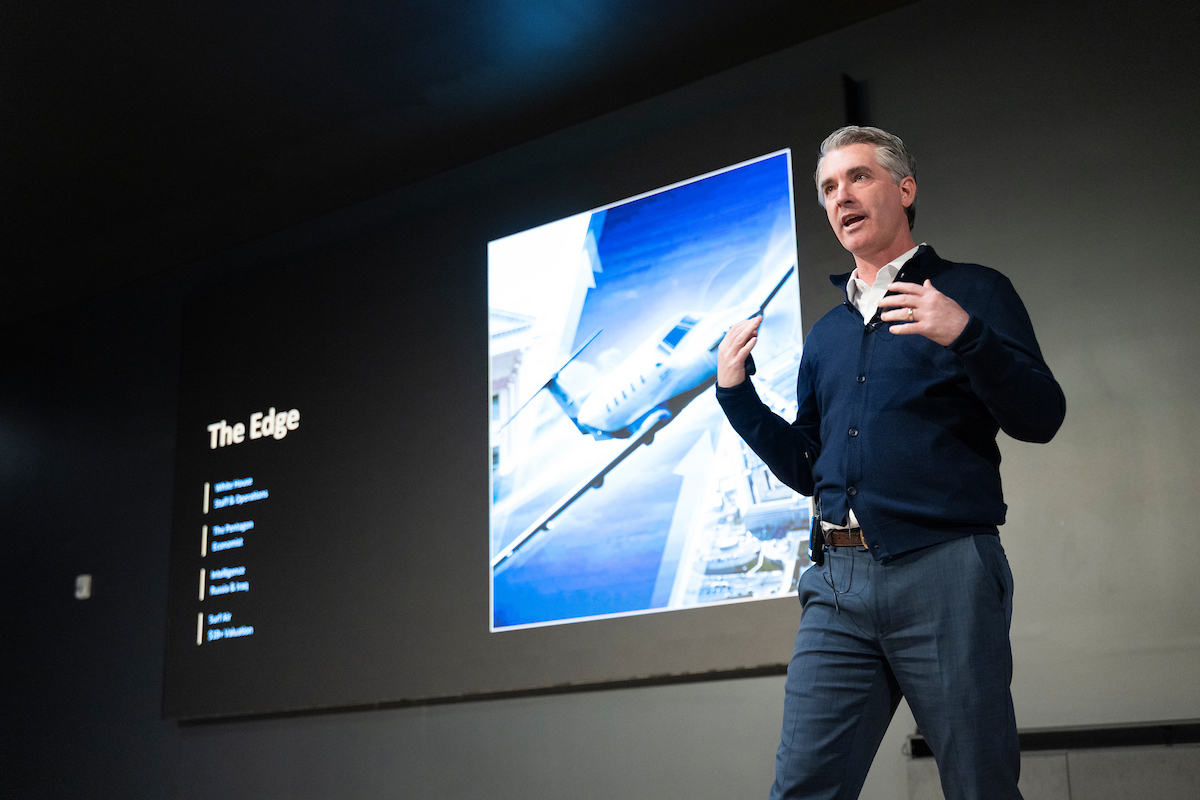
In February 2026, he brought his experience to students at Utah Valley University. His lecture covered identity, the signals people send to employers and investors, and the value of understanding one’s own ambitions. He encouraged students to work backward from their goals and make their strengths legible to others.
That advice feels at home in a career spent explaining unfamiliar offers. An airline membership needed passengers to understand its limits. An earnings guarantee needed colleges to understand its obligations. An investor needs founders to explain what they intend to build. Eyerly has occupied every side of that conversation, including the uncomfortable ones.
Back in Burbank, the stairs still admitted one person at a time. There is something useful about keeping that image beside the big promises. A new business can change the terms of a transaction. It must still get people through the door, deliver what they bought and have enough left to do it again tomorrow.