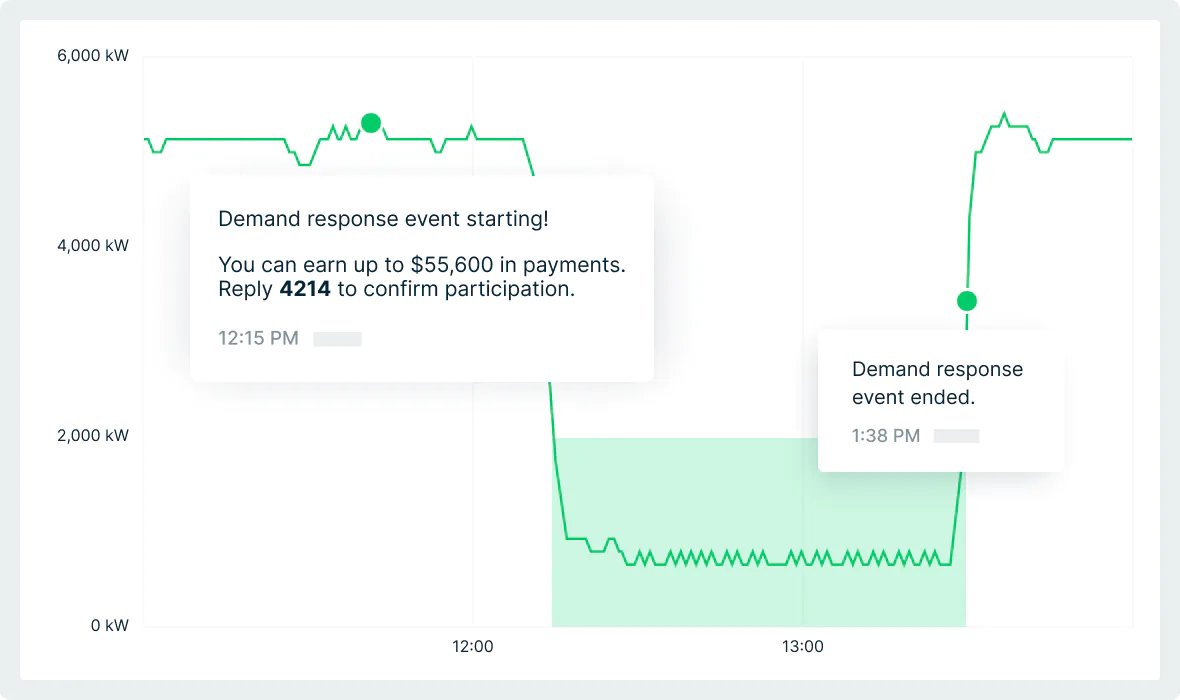
Imagine a factory manager looking at two schedules. On one, a power-hungry process runs this afternoon. On the other, it waits. The output might be the same. The electricity system, however, could value the difference enormously. During a tight hour, a dependable reduction in demand gives the grid breathing room. Voltus has built a business around finding that room, putting a meter on it, and arranging for somebody to pay.
- Sell flexibility. Reduce, shift, or supply electricity when a program calls.
- Share the proceeds. Voltus keeps part of the earnings it generates.
- Check the promise. A useful resource must be eligible, measurable, and ready.
This is demand response, part of the broader business of virtual power plants. The plant is a coordinated collection of assets: batteries, cooling systems, industrial equipment, and other resources distributed among customers. Its address is a portfolio. Its product is an agreed response at the time the electricity system needs it.
The electricity you can postpone
Electricity customers usually think about how much they use. Grid operators also care about when. Voltus connects those perspectives. It identifies eligible resources, handles enrollment and market participation, coordinates dispatches, measures performance, and manages payments. An operations team supplies the practical knowledge: which equipment can change, for how long, and under what conditions.
Voltus’s demand response FAQ advertises zero out-of-pocket participation costs. The company retains a portion of customer earnings. That arrangement removes an obvious sales obstacle, but the manager still has arithmetic to do. A production delay, uncomfortable building, or depleted backup battery can have a cost even when joining the program carries no upfront bill.
The customers span factories, property owners, institutions, and distributed-resource providers. Voltus displays Walmart, Graniterock, Vornado, and Pace University among its customers. Households generally enter through device or energy partners. A single thermostat is a small proposition; an aggregation gives a market operator something it can schedule.
Nine markets, many rulebooks
Founded in 2016, Voltus brought together energy-market and technology experience. Co-founders include Gregg Dixon, Matthew Plante, Dana Guernsey, and Neil Lakin. Guernsey previously managed energy markets at EnerNOC and helped develop Voltus’s platform before becoming CEO. Plante’s experience includes EnerNOC and connected-home company EcoFactor. Their expertise concerns both the equipment and the rules governing its value.
The company reports operating across all nine wholesale electricity markets in the United States and Canada. That breadth is part of its pitch. CPower, Enel’s demand response business, and direct utility programs offer alternatives. A customer’s choice turns on local eligibility, operating constraints, payment terms, and confidence in the provider’s execution.
Inside the company, the operating vocabulary is equally specific. Voltus calls its employees Voltans and describes its values as Bright, Gritty, and Good. It is an all-remote business. A 2021 account of its culture described a weekly meeting called Veritas, where leaders shared board material and discussed employee feedback. That is a useful historical glimpse of how it tried to keep a distributed team informed.
VoltApp makes the relationship visible: earnings forecasts, payment status, energy data, and dispatch performance. Market APIs let partners connect their resources. Software, however, earns its place by completing the transaction. A line on a dashboard matters when it becomes a verified response and a payment.
Google buys breathing room
On October 22, 2026, Google and Voltus announced an expanded agreement for a gigawatt-scale virtual power plant in PJM. An initial June agreement covered 100 megawatts. The October release describes an additional 1,070 megawatts, assembled from new capacity at local homes and businesses. These are announced commitments, not a claim that every resource is already operating.
The arrangement is called Bring Your Own Capacity. Google funds distributed flexibility on the grid serving its operations. Participating customers can receive payments and bill savings. The interesting shift is the buyer: a large electricity user is paying to make other customers’ flexibility available to the regional system.
“Electricity is now the constraint behind almost every major ambition we have, but it doesn’t have to be.”
Dana Guernsey · October 2026 funding announcement
Voltus raised $225 million in October 2026, led by Generation Investment Management with co-leads Activate Capital and Vitol. It says the funding will advance BYOC and connected batteries, with a target of 20 gigawatts by 2030. That is an ambition; the funding announcement does not turn it into delivered capacity.
Other deals explain the direction. A September Siemens integration connects building controls with demand response revenue. An August Sunrun agreement brings residential solar-plus-storage capacity into hyperscaler offerings. June’s acquisition of Brightfield AI adds battery project assessment and development capabilities. Voltus is broadening the equipment it can reach and the routes through which it reaches it.
The expensive part of a promise
The company’s history contains two consequential setbacks. Its proposed Broadscale SPAC merger ended in August 2022 after Voltus said it could not complete the required actions by the deadline. The public listing never happened. The proposed transaction’s valuation belongs to that abandoned deal.
In January 2025, FERC approved a settlement requiring Voltus to pay $18 million in penalties and disgorgement. The investigation concerned allegations that, during 2016-2020, resources were registered without knowledge or consent and capacity was cleared that would not have performed. Dixon agreed to a separate $1 million penalty and restrictions on future involvement. Voltus and Dixon stipulated to facts while neither admitting nor denying the alleged violations.
Those details go to the product itself. A virtual power plant requires permission and dependable performance. Counting a resource and being able to call on it are different operational achievements.
Start with what can safely wait
A business considering Voltus can copy the first step without buying anything: inventory its flexibility. Identify equipment that can pause, shift schedules, or draw on storage. Establish boundaries for production, safety, comfort, and backup reserves. Then ask which local programs fit and what measured performance would earn. That assessment needs the people who run the equipment, alongside whoever manages the electricity contract.
Then read the participation agreement. Ask who authorizes dispatches, how the reduction is measured, what happens after a missed event, and which other programs the site can join. A promising estimate becomes useful only when it reflects the equipment and commitments the customer actually has.
If the operation cannot change safely, the market is inaccessible, or disruption costs exceed payments, the proposition weakens. Where the conditions fit, the appeal is straightforward. The factory manager’s second schedule has acquired a customer.