At Rhode Island Hospital, the trouble began with two diesel generators. The machines could still produce electricity. But an eligibility change meant they could no longer earn demand response revenue. For an engineer managing a hospital’s energy budget, that distinction was expensive. The equipment worked; its place in the market had stopped working.
- CPower pools the energy flexibility of businesses and institutions into virtual power plants.
- Customers can earn grid-program revenue and reduce some electricity charges.
- The opportunity depends on what a site can safely change, its equipment and its local market.
That is a useful place to meet CPower Energy. The company operates between the physical world of buildings and machinery and the rule-bound world of electricity markets. Its job is to discover what a customer can contribute, organize that contribution and get the customer paid.
01 / A power plant made of possibilities
Electricity systems need supply and demand to stay balanced. A conventional plant helps by generating power. Demand response helps by reducing the amount customers draw when the system needs relief. Batteries and eligible on-site generators offer other ways to change that draw.
CPower assembles those capabilities into a virtual power plant. The resources remain at customer sites; the coordination makes them useful together. A grid operator gets an organized resource instead of thousands of separate conversations with facility managers.
The customers are businesses with meaningful energy use: manufacturers, property owners, schools, healthcare organizations and data centers. Developers and operators of distributed energy projects also use CPower. Its expertise combines market participation, asset integration, dispatch and the unglamorous business of measuring what actually happened.
↳ Program proceeds are shared with customers.
02 / The schedule is part of the product
The obvious question is how much a battery or flexible load can earn. The better question is what else that asset must do. A battery may need to preserve backup capacity. A factory has production commitments. A school has occupied classrooms. Flexibility begins with those boundaries.
EnerWise Site Optimization, launched in December 2021, models energy use and market opportunities to build site-specific hourly schedules. Its task is to allocate assets across available programs and bill-saving opportunities within equipment, permitting and incentive constraints. Automation makes a complicated timetable manageable.
CPower Connect gives customers visibility and control across grid-connected assets and programs. Behind the interface sits a service operation: enrollment, dispatch, performance tracking and payments. The software matters because the market is complicated; the service matters because a real building must deliver the response.
Revenue sharing is central to the business. CPower facilitates participation and shares program proceeds with customers. Metering can bring a separate subscription, deducted from demand response payments. Peak demand management also has fee arrangements. A customer should compare net proceeds after services, upgrades and operational costs, rather than treating a gross incentive as profit.
03 / The generator was only half the problem
Back at Rhode Island Hospital, CPower recommended emissions-control upgrades and a contractor to handle the work. Its 2018 case study described a projected six-month payback. That calculation helped the hospital approve the spending. The lesson is practical: fixing eligibility can matter as much as installing capacity. The forecast was a proposal’s economics, not a completed-results report.
“Capacity charges are right now about 25% of our budget.”
Marc Leduc · Rhode Island Hospital · 2018
A customer considering participation can copy the sequence: inventory equipment, identify what operations can tolerate, check eligibility, then model the return. A site with no controllable demand, usable storage or eligible generation has little to sell. Incompatible controls and program obligations can also make an attractive headline payment a poor fit.
04 / Open the cabinet. There’s the grid.
At Fort Detrick in Maryland, the idea has a substantial physical form. Ameresco developed solar and battery infrastructure for the Army installation. CPower’s case study describes its role in modeling battery sizing and revenue potential, then integrating market participation with the project.
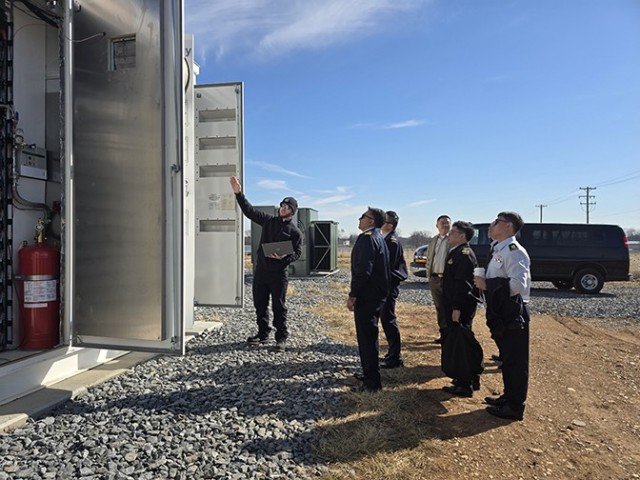
The installation pairs an 18.6 MW solar facility with a 6 MW / 6 MWh battery system. Those battery numbers describe different things: output and stored energy. How long storage can respond matters alongside how much power it can deliver. A useful market schedule respects both.
The competitive field includes other demand response providers, including Enel and Constellation. CPower’s proposition combines aggregation, optimization and operational support. For a buyer, meaningful differences sit in accessible programs, contract terms, integration work and how closely a provider understands the facility.
05 / Now the computer gets a turn
In February 2026, CPower, Bentaus and Supermicro announced a demonstration in which GPU infrastructure responded to wholesale-market signals. They reported a full dispatch signal cycle under 20 milliseconds. It was a test of responsiveness, rather than proof that every AI workload can interrupt production economically.
Hardware partnerships widen the approach. In April, Generac paired its equipment and dealer network with CPower’s PJM market services. Vertiv announced an integration involving battery storage and other on-site assets, following work monetizing a 1 MW microgrid at its Ohio customer experience center.
Paid to customers since 2015, according to CPower’s current company page.
CUMULATIVE CUSTOMER PAYOUTS · NOT COMPANY REVENUEOwnership has changed, too. The current business emerged from Comverge and Constellation’s commercial and industrial demand response operations in 2014. LS Power bought it in 2018. NRG completed its acquisition in January 2026, alongside a portfolio of gas plants. The roughly $13 billion seller-reported transaction value covered the combined portfolio.
For a facility manager, the starting point remains refreshingly specific. What can this building change? For how long? What must remain protected? CPower makes a business out of finding buyers for those answers. Somewhere behind the electricity bill, a perfectly ordinary piece of equipment may have another useful job.