A savings group has a problem that faster internet cannot settle: who gets to touch the money? In Vodacom Lesotho’s Mokhatlo account, the answer is written into the product. Members can see transactions. Designated approvers must authorise withdrawals. A phone sends the news by SMS. The interesting innovation is the arrangement between people.
- The connection: mobile, fixed broadband and enterprise services across Lesotho.
- The money: M-Pesa payments, shared savings, credit and investing.
- The design choice: keep useful services accessible through a phone menu.
That arrangement offers a useful way into Vodacom Lesotho. We tend to describe a telecommunications company by its towers, coverage and download speeds. Here, the more revealing question is what happens after the signal arrives. Can a shopkeeper accept payment? Can a group keep its savings visible? Can someone invest a small balance without first becoming a conventional investment client?
A signal acquires a second job
Vodacom Lesotho began operating in 1996, with the government participating through Lesotho Telecommunications Corporation. Privatisation brought in Sekha-Metsi, a consortium of local investors, in 2000. Today, Vodacom Group holds 80% and Sekha-Metsi 20%. The company’s roots combine an international operator’s resources with a local shareholder.
Its everyday business remains recognisably telecoms: prepaid and contract voice, messaging, data and fixed connections. Vodacom Business serves small offices, larger companies and public institutions with broadband, networking and enterprise IT. Econet Telecom Lesotho is the principal domestic mobile alternative. Customers choose between networks; businesses also weigh fixed and satellite connections against their particular locations and workloads.
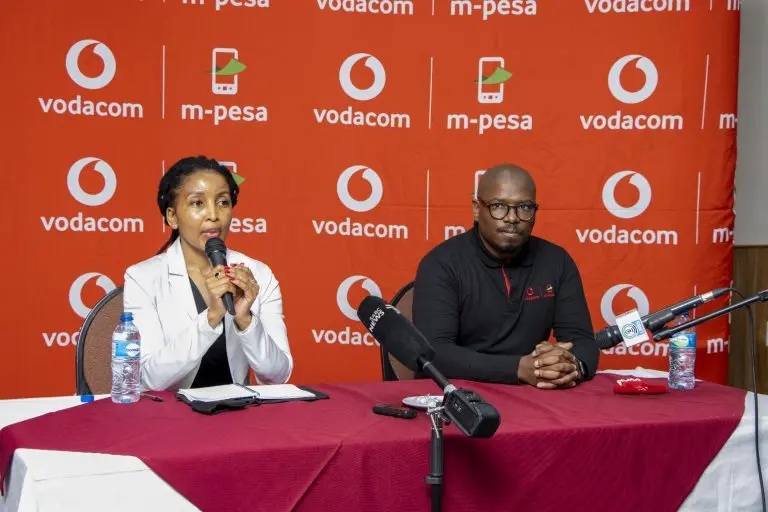
Then came M-Pesa, introduced in 2013. A phone could hold a wallet, receive money, pay bills and buy airtime. A conventional bank account or modern handset was no longer a prerequisite for those functions. VCL Financial Services operates the money business. The network had acquired a second job.
The cash behind the screen
A wallet balance is useful only when someone will accept it. M-Pesa’s agents supply cash or electronic money to customers, connecting the digital ledger to the physical economy. Merchants supply another reason to keep money inside the system. Distribution is part of the product, even when it happens across a counter.
The older menu had a specific nuisance: enter one digit incorrectly and you could have to start again. At the 2021 app launch, management identified that friction as a reason for the new interface. The app added convenience without retiring the older menu. Its launch announcement described zero-rated transactions, allowing customers to use it without a data balance when mobile data was enabled. USSD remained another route. That is a practical response to unequal devices and budgets: improve the interface while keeping an accessible entrance.
By its FY2026 ESG release, Vodacom reported 953,156 M-Pesa customers. That scale helps explain why access rules matter. In March 2025, Vodacom announced a further opening: M-Pesa became available to mobile users on other networks. The change removed the requirement to become a Vodacom subscriber. Strategically, it widened the potential market for financial services beyond the operator’s own SIM cards. Access still requires registration; the subscription barrier changed.
Give the savings group a set of keys
Mokhatlo makes the logic unusually visible. It is a shared account for people saving towards a common goal. Members can inspect balances and transactions. Groups with five or more members need at least two leaders, two approvers and a regular member. Cash withdrawals require the assigned approvals.
Mokhatlo’s published product page lists no account fees. The design gives an existing social practice a clearer record and a division of authority. It also creates obligations: members need eligible M-Pesa accounts, and designated people must participate when approvals are required. A beautifully simple menu cannot make an unavailable approver answer. Product builders can copy the principle: preserve the familiar group, then make its rules easier to enforce.
Separate services, connected through the mobile-money relationship.
The M50 door into investing
In July 2026, VCL Financial Services and STANLIB Lesotho introduced Tsetela, a mobile-based investment service. Individuals can begin with M50; Mokhatlo groups with M300. Access runs through the M-Pesa menu. STANLIB supplies the investment expertise, while VCL Financial Services supplies the route from the wallet.
“Financial inclusion goes beyond access to services”Mohale Ralebitso, CEO, at the Tsetela launch
The fine print matters as much as the opening amount. Interest is calculated daily and paid monthly. Withdrawals take up to 72 hours. Investing and withdrawing carry no direct transfer fee, but the detailed terms specify a 3% deduction from earned interest attributable to VCL Financial Services, alongside withholding tax. Capital and returns are not guaranteed. Someone needing cash immediately should notice that withdrawal window before moving money.
These distinctions explain the business model. Connectivity earns money through bundles, contracts and enterprise services. Financial services add transaction charges and partner economics. Tsetela’s terms allocate a share of interest to VCL Financial Services. A wider menu creates more occasions to use the relationship, with different costs attached to different actions.
The licence became the bottleneck
The company’s setbacks have included a threat far more immediate than slow broadband. In 2020, the communications regulator imposed a disputed M134 million penalty over auditor independence and subsequently moved to revoke the operating licence. Vodacom challenged the decisions; the High Court blocked enforcement while the case proceeded.
Local reporting in November 2022 described a M4 million settlement and the disputed decisions being set aside. The regulator’s lawyer said the payment was a settlement, not necessarily a fine or admission of guilt. It is a useful corrective to any technology-only account of the company: regulatory relationships can become an infrastructure dependency too.
The mountain keeps its vote
Geography remains another constraint. In August 2026, Vodacom Lesotho launched managed enterprise broadband powered by Starlink, offering primary or backup connectivity alongside terrestrial options. The attraction is concrete for organisations where fibre, microwave links or towers are difficult to deploy. Local installation and service support sit around someone else’s satellite technology. At launch, the Lesotho News Agency reported an entry package of 100GB at M805 monthly on a 36-month contract. That commitment makes the fit a question of budget as well as terrain.
The lesson travels beyond Lesotho. Build around a task people already recognise. Keep an accessible route in. Find partners for capabilities you do not own. Then attend to the unglamorous dependencies: cash at agents, group approvals, withdrawal timing, licences and a working connection. Every new service has to survive that last mile between an attractive menu and an ordinary day.