A coverage map is a remarkably polite document. It offers a patch of color where a person might instead encounter a stalled video, a page that refuses to load, or a connection that exists chiefly in the imagination of the map. Vivek Adarsh spent part of his research career investigating that discrepancy. There was a signal. There was also a wait. The interesting work lay between them.
Today, Adarsh is the co-founder and CEO of Mithrl, a San Francisco company making AI tools for scientific research. The setting has changed from mobile networks to laboratories, but a similar question runs through the work: what happens after information becomes available? A dataset can be present, a tool can be powerful, and a useful answer can still remain inconveniently far away.
That connection is one way to read his career. It passes through university research, industrial computing, an airline-software venture, and a company whose name gives a small clue about its founder’s reading habits. The route deserves a closer look.
A map, a phone, and an awkward disagreement
In 2019, Adarsh joined fellow doctoral researchers on a measurement trip to New Mexico, working in and around tribal lands near Santa Fe. The question was practical: how well did mobile broadband actually work there? A published coverage boundary could establish that an operator claimed to serve a place. It could say much less about the experience of someone trying to use that service.
The resulting research compared tribal and rural networks with urban ones, including networks under heavy demand. Adarsh and his collaborators collected more than 30 million LTE packets across 16 datasets, studying four major American operators. Their analysis found that, in the locations examined, rural and tribal connections could perform worse than congested urban connections. Identical subscription plans did not deliver identical experiences.
The distinction mattered because a connection is lived through tasks. People want a video to start, a website to respond, a download to finish. Those ordinary requests can expose weaknesses that a colored map smooths away. The research measured those differences rather than treating the presence of coverage as the end of the inquiry.
A related project took measurements into the air. Adarsh co-authored work testing inexpensive radio equipment carried by an unmanned aircraft, comparing its readings with devices on the ground. The aim was to assess larger areas with less labor. Even here, the team checked the attractive shortcut against the experience it was supposed to represent. A useful aerial view still needed to answer to the ground.
The machinery behind a spinning wheel
At the University of California, Santa Barbara, Adarsh worked with computer scientist Elizabeth Belding in the MOMENT Lab. His research combined wireless networking, performance analysis, and reinforcement learning. The subject can sound remote until a video starts buffering. Then the difference between theoretical capacity and usable service becomes a rather intimate problem.
His publications approached that problem from several directions. One studied how to estimate overload inside LTE networks using passive observations. Another examined video-stream quality across rural and urban settings. A further collaboration investigated whether social-media posts could help detect power and communication outages. The work repeatedly asked what could be learned from signals already available, rather than assuming complete access to the system underneath.
There is a useful restraint in that approach. A cellular network does not hand an outside researcher a neat explanation of every delay. Researchers have to work with what they can observe, design comparisons, and establish how much those observations can support. The challenge includes knowing where an appealing explanation outruns the measurements.
Adarsh completed his computer science doctorate in July 2022, becoming the lab’s twentieth PhD graduate. His dissertation brought together predictive and autonomous approaches to resilient networks. Before that came a computer science master’s degree at Santa Barbara in 2018 and an electrical engineering bachelor’s degree from the University of Pune in 2016. The progression crossed disciplines while staying close to systems people depend on.
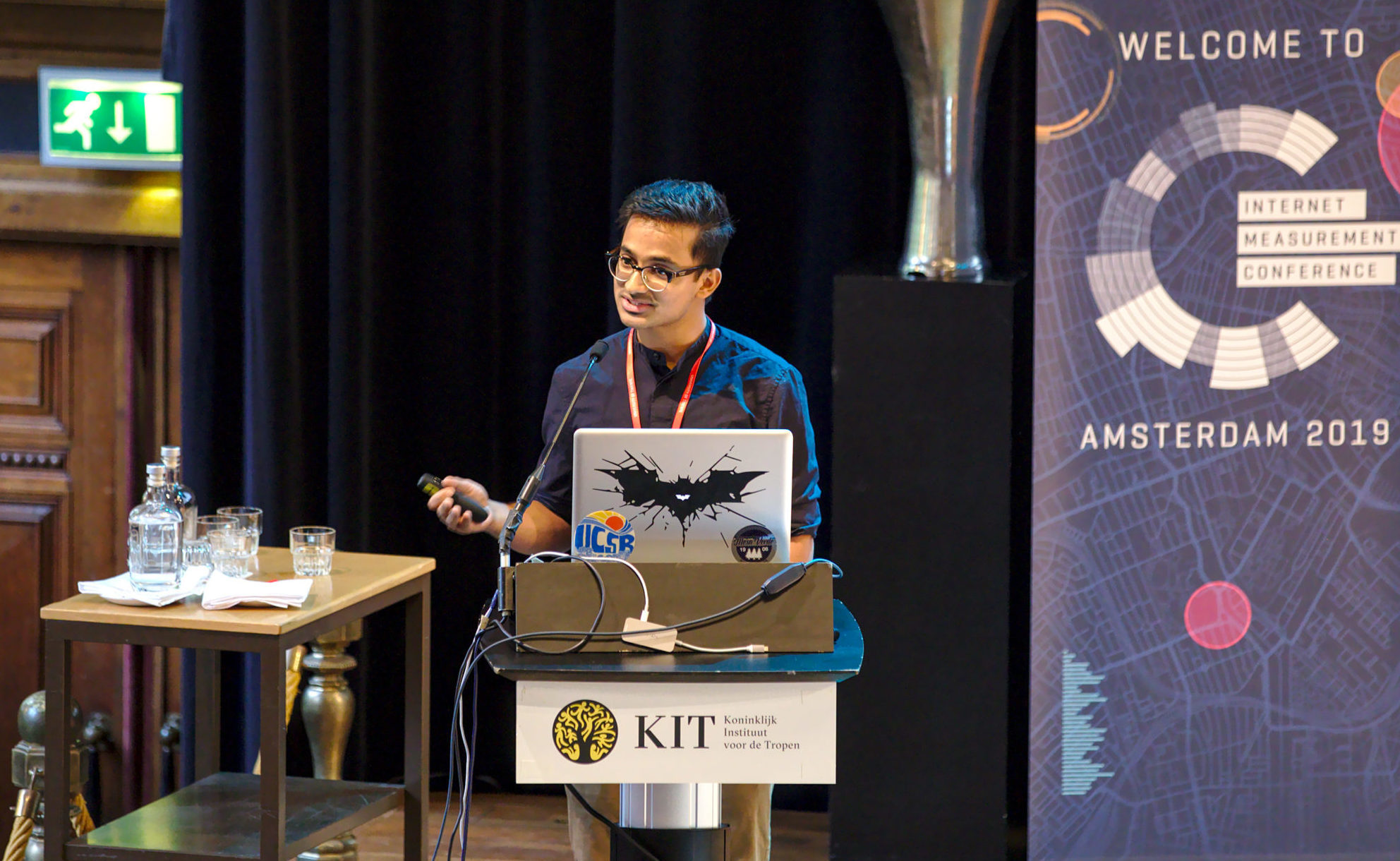
An intern project with somewhere to go
The industrial side of his education included NVIDIA and Hewlett Packard Labs. His 2022 CV records a research internship at NVIDIA in Singapore in 2015, working on parallel computing to turn unstructured video metadata into structured information. It is an early instance of a recurring task in his work: making material easier for a computer, and eventually a person, to act upon.
At Hewlett Packard Labs in the summer of 2020, he worked on SARAS, a project using smart network interface cards to accelerate computing at the edge. These cards can take on processing work alongside a host computer. The engineering problem involved finding a useful balance among speed, energy use, and cost.
His project won Best in Class at HPE’s virtual intern fair, where more than 400 interns presented their work. Adarsh described wanting “to make a tangible impact” on the way edge computing operated. The modest wording suits the task. A faster system earns its keep through what it allows somebody else to do.
That research also has a paper trail beyond an award. Adarsh is a named co-inventor, with Diman Zad Tootaghaj, Anu Mercian, and Puneet Sharma, on a US patent granted in September 2022. It concerns directing queries across computing resources distributed between a host and a hardware accelerator. The title is long enough to test a reader’s endurance. The underlying concern is familiar: put the work where it can be handled effectively.
The airline chapter
After his doctorate, Adarsh became CEO of AviAI in August 2022. The venture applied AI and machine learning to airline operations. His responsibilities included developing the product, selling it, and raising money, according to his CV. Research had supplied one kind of test. Running a business added customers, budgets, and the need to persuade people to change how they worked.
Aviation was a personal interest as well as a commercial setting. A public biography from that period describes him as an aviation enthusiast. It is an apt industry for someone interested in connected systems: an airline’s decisions depend on many moving parts, and information becomes valuable when it helps someone choose what to do next.
The airline venture belongs in his story because it puts an operating role between the doctorate and Mithrl. The transition involved more than selecting a new research topic. Adarsh was taking responsibility for the whole proposition, including whether a product solved a problem that someone would pay to have solved.
- 01NetworksIs the connection usable?
- 02Airline operationsCan the information support a decision?
- 03Scientific softwareWhat should the researcher do next?
A scientist should be able to ask a question
Adarsh and Shara Balakrishnan founded Mithrl in 2023. He became CEO; Balakrishnan became CTO. Their company set out to make scientific data analysis accessible through a conversational interface, allowing researchers to ask questions without having to assemble every computational step themselves.
The division of labor is central to the proposition. A researcher may know which question is worth asking while lacking the time or specialist programming skills to turn a large dataset into an answer. Mithrl’s tools are intended to take on analytical work and connect results with relevant scientific literature. The scientist keeps the task of deciding what deserves investigation.
By November 2024, Mithrl had announced a $4 million financing led by Bonfire Ventures. In September 2026, the company announced a $20 million Series A led by Obvious Ventures, with Headline and AGI House among the participants. Those are company financing milestones. They mark the resources available to build the business, rather than a verdict on every result its software produces.
Mithrl’s newer product, Mithrl-1, is designed to work inside a customer’s own environment, incorporating that organization’s data and workflows. Its stated emphasis includes traceability, reproducibility, and keeping evidence attached to an answer. Those details become consequential when a research team has to decide which result to trust and which experiment to run.
For Adarsh, this puts a commercial product around a demanding question: can software shorten the journey to a decision while preserving the reasons behind it? The network researcher’s old problem returns in another form. Access is useful. The experience after access determines how useful.
Mithrl’s announced Series A, led by Obvious Ventures.
Making room for the unexpected
Adarsh has also talked about the possibility that faster analysis might change scientific serendipity. If tools make research more directed, what happens to the productive accident? His answer is to give researchers more opportunities to encounter one. His answer rests on creating more opportunities for an unexpected finding.
It is a measured aspiration for a technology often introduced with grand predictions. He is describing conditions: more questions explored, more results examined, more chances to notice something that was not on the original list. Discovery still requires a person to recognize the significance of an unexpected result.
His account of working at NVIDIA also emphasizes talent, commitment, and empathy toward customers. That last quality has practical consequences for a founder. A researcher waiting for an analysis experiences a problem that a software team can easily underestimate. Understanding the wait is part of understanding the job.
In September 2026, Adarsh co-signed a company essay with Balakrishnan and scientific AI lead Aqib Hasnain about the next phase of Mithrl. It described preserving the context of scientific findings and working alongside customers to build the workflows they need. The ambition was broader than producing an answer quickly: help a team understand what it can reasonably do with that answer.
“You can’t control luck, but you can create the conditions for it to appear more often.”
Vivek Adarsh
A camera, a fantasy novel, and the next experiment
Away from research and company building, Adarsh makes photographs. His personal portfolio includes landscapes, travel, and portraits, with pictures from trips across several continents. A camera offers another way to attend to detail, although a landscape has the considerable advantage of not requesting a product roadmap.
He is also a Lord of the Rings fan. Even the name Mithrl sits comfortably beside that interest. The personal detail is welcome in a career otherwise crowded with network protocols, edge hardware, and computational analysis. People who build serious tools are allowed a little fictional metallurgy.
The work continues through specific connections. On October 13, 2026, Lexogen and Mithrl announced a partnership linking Lexogen’s Kangooroo analysis platform with Mithrl-1. The arrangement connects sequencing data with tools for interpreting it, and includes four weeks of access with a Lexogen purchase. It is a concrete attempt to reduce the handoff between generating information and working out what it means.
Adarsh’s career has crossed enough settings to resist a tidy industry label. The more durable thread is a concern with the delays inside useful work: a network concealing congestion, a computing system allocating resources, an organization waiting for analysis. He has spent years learning how those waits arise. At Mithrl, he is building a business around what researchers might do when more of that waiting is removed.
Follow the work
Explore Adarsh’s projects, photographs, and conversations.