Kasey Zhang has spent a surprising amount of his life inside feedback loops. There was the piano bench, where the wrong note arrives without tact. There was competitive League of Legends, where five people discover in public whether a plan survived contact with another five. There was the venture-capital meeting, where a company is reduced to a few sharp questions about what works, what does not and what might compound. Now there is the AI agent: eager, articulate and liable to repeat yesterday's error with perfect confidence.
Zhang's current company, Osmosis, is built around that last irritation. He co-founded it in San Francisco in 2024 with Baiqing, known as Andy, Lyu. The two met in middle school and stayed friends for more than a decade before starting a company together. Zhang runs the business as CEO. Lyu, a former TikTok data-infrastructure tech lead, runs technology as CTO. Their shared proposition is compact: an AI agent should be able to learn from experience.
That sounds obvious until one watches an agent fail. A prompt gets patched. Context gets rearranged. Another model is called. The system may improve, but it has not necessarily learned from the consequence of its own work. Osmosis gives developers a post-training system for reinforcement learning: define a task, collect attempts, score the outcomes, adjust the model and send it back to work. The platform handles machinery such as compute orchestration, reward modeling and training-run observability. Zhang's business is the practice room.
a real task
the result
the model
with feedback
A reward is useful when it measures the work a customer actually cares about.
The competitor becomes the coach
Long before model weights, Zhang dealt in other kinds of repetition. He competed in classical piano competitions and performed at Carnegie Hall. He also played League of Legends competitively. These biographical details can look like colorful ornaments on a founder profile, but together they reveal a working preference. Piano and esports are unforgiving schools of iteration. Both turn a large ambition into smaller attempts, then deliver evidence.
In college at Northeastern University, Zhang helped build an institution for that process. Challengers Uprising created amateur League of Legends competitions and a route toward higher-level play. The platform worked with Riot Games so its tournaments fed into the LCS Proving Grounds qualification system. Unified acquired the business in June 2021. Zhang wrote at the time that combining the teams would let them support future esports talent with bigger events.
He was building a second community at Northeastern. As a co-director of the Husky Startup Challenge, he helped run a 2021 cohort of 78 student founders and 28 ventures. Looking back on his first semester with the program, Zhang described the sense of belonging he found in the entrepreneurship club. The detail matters. His projects tend to create an arena, invite ambitious people into it and make improvement visible.
A view from both sides of the table
After the acquisition, Zhang moved from operating into early-stage venture capital. His public career history includes Rough Draft Ventures, Glasswing Ventures and Audacious Ventures, where his work focused on AI and data investments. In a 2023 podcast conversation about the job, he offered a crisp description: venture capital is fundamentally a sales business, heavily shaped by relationships and access. The investor must evaluate people as carefully as markets.
That period gave him a view of AI companies when prototypes meet production. The demo can be fluent while the workflow remains brittle. A general model may know a great deal and still choose the wrong tool, fail halfway through a multi-step task or produce the correct answer too slowly and expensively to be useful. Each edge case becomes another manual repair. Zhang eventually returned to building around the pattern he had been studying.
“At Osmosis, our belief is that RL is the missing piece for AI agents that truly learn and work.”Kasey Zhang, after RL IRL
Osmosis entered Y Combinator's Winter 2025 batch with an earlier version of its product focused on agents learning from prior interactions. It stored previous attempts, found similar situations, recommended a plan and measured the result. The company later sharpened its public position around reinforcement fine-tuning and post-training infrastructure. The language changed; the obsession did not. Stop making the system rediscover the same lesson.
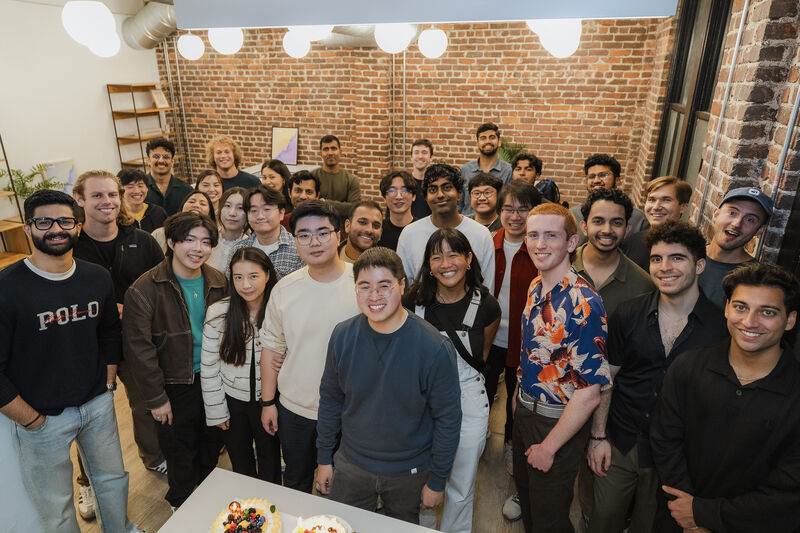
The friendship with Lyu is part of the operating system. Zhang has written that he always knew he wanted to start a company with him. Their experiences are complementary: one spent years on startups, communities and investments; the other worked on real-time recommendation and model-serving infrastructure at TikTok. Trust accumulated before cap tables and customer calls entered the relationship. Osmosis started in an apartment. Nearly a year later, the team celebrated its first dedicated office along with Zhang's birthday.
Smaller, narrower, measurable
The clearest demonstrations of the Osmosis thesis are not universal assistants. They are small models with particular jobs. In May 2025, the team released a 4-billion-parameter model trained to use tools through Model Context Protocol. Another 0.6-billion-parameter model turned unstructured material into a requested schema. In July, a 1.7-billion-parameter model tackled code merging, the mundane work of applying one code change without trampling another.
For the code-merging model, Osmosis used a slice of a public commit dataset and a simple reward. A perfect merge earned one point. A correct merge with stray new lines earned a fraction. Failure earned none. The company then evaluated the model on 10,000 examples. Its published result put the small specialist ahead of several much larger foundation models on that defined score, with lower latency.
One narrow job, one legible score
Company-published reward score on 10,000 code-merging validation examples, July 2025. The benchmark measures this defined task, not general model ability.The clever part is the refusal to make the reward clever. A narrow task and an honest score can be more useful than an ornate proxy. This is what founders can steal from Zhang's approach: begin with the behavior that matters in production. Make success observable. Let the model practice against that definition. A smaller model does not need to win at everything if it can become dependable at the work on the invoice.
Building the room around the loop
In October 2025, Osmosis announced a $6.3 million seed round co-led by CRV and Audacious Ventures, joined by investors including Paul Graham, Guillermo Rauch, Misha Laskin and Erik Bernhardsson. In the same period, Zhang and the team convened RL IRL at Y Combinator. More than 800 people registered; more than 200 founders, researchers and engineers attended. Sessions covered product design for reinforcement learning, reranker models, training environments, multimodal data and enterprise workflows.
Zhang said the purpose was applied reinforcement learning: how companies, not only large labs, could use it to make agents better and faster. That focus fits the arc. Challengers Uprising created a competition structure for people outside the professional tier. The Husky Startup Challenge gave student builders a cohort and a deadline. RL IRL made room for practitioners who wanted training loops rather than slogans. His instinct is to pull a specialized practice into public view.
By 2026, Osmosis was publishing deeper infrastructure work, including methods for training many LoRA adapters concurrently and reducing memory use during long-context reinforcement learning. Zhang also appeared as a co-author on research about how supervised fine-tuning data overlaps with reinforcement-learning data, and on early signals of failure in coding-agent trajectories. The company that began by remembering an agent's past attempts had moved closer to the machinery of how models are trained, watched and corrected.
The founder who once helped build a path to pro for amateur gamers is now building a path to competence for AI agents.
There is a gentle comedy in asking a former competitive gamer and pianist to make machines less repetitive. Human mastery is repetition, conducted with attention. Machines can repeat at absurd speed, yet repetition without a meaningful reward is merely expensive motion. Zhang's bet is that the useful agent will not be the one with the polished voice. It will be the one that notices the score, adjusts and performs the task better next time.
His X biography offers two small clues to temperament: “aspiring hedgehog” and “chopping wood and carrying water.” The hedgehog is the creature of one substantial idea. The second phrase favors ordinary, repeated work. Both suit a founder committed to a single proposition across many forms: practice only compounds when feedback reaches the performer.
Osmosis is still an early company, which makes its central question more interesting than any finished answer. Can a production agent improve from the work it does without turning every correction into another engineering project? Zhang has arranged his career around arenas where the score is visible. Now he is trying to give the machines one they can use.