A cell-therapy researcher can have a beautiful single-cell dataset and still be stuck. The sequencer has finished its work; the biology has not. Someone must clean the data, choose a pipeline, check the assumptions, compare the result with other experiments and ask whether the apparent signal deserves another assay. In one case published by Mithrl, that trip took eight to ten weeks. The same analysis through its software, the company says, took under a week and produced findings that agreed with the human bioinformaticians’ work. There is a large amount of drug discovery hiding in the time between those two clocks.
- Mithrl gives biopharma teams a natural-language route from experimental data to traceable analysis.
- Its customer-reported single-cell comparison cut an eight-to-ten-week process to under one week.
- The company’s unexpected discovery was that faster analysis could change which questions scientists asked - and sometimes lead to patent filings.
Mithrl, founded in San Francisco in 2023 by Vivek Adarsh and Shara Balakrishnan, calls its product a Scientific Decision Engine. The phrase sounds grand until one sees the modest irritation beneath it. Biology laboratories have become astonishingly good at making data. The people paid to understand it can spend much of their time tending the machinery of analysis. A wet-lab scientist with a question waits for a computational colleague to build or adjust a workflow. Then both wait for an answer they can defend.
The queue after the sequencer
Mithrl’s opening move was to automate the analysis of sequencing and other omics data. Its Eos platform accepts questions in natural language, orchestrates workflows, quality checks and statistical methods, and lets researchers examine the resulting evidence. The company says the software can handle RNA sequencing, proteomics and metabolomics, as well as connect results with literature and structured biological knowledge. This is a product for research organizations, sold through enterprise agreements rather than a consumer app. Its terms specify fees in customer order forms; it publishes no price list.
The division of labor matters. A bench scientist can request an analysis without writing code. The computational biologist can examine how it was done. Program leaders can revisit the same result rather than receive a detached slide. Mithrl says its average analysis iteration is 32 times faster than the prior workflow, a company-reported figure across its customers. That statistic measures analysis speed, not the time to approve a medicine. Its stated ambition of taking teams from idea to an investigational new drug application 50% faster remains an ambition.
In that case, the customer had single-cell RNA-sequencing data for target discovery, biomarkers and intellectual property work. The analysis queue depended on specialized bioinformatics skills. Mithrl says its system combined the single-cell results with bulk data and outside scientific knowledge. The unnamed company’s CEO reported that Mithrl and human specialists reached concordant insights from identical datasets. That is a useful comparison, though it is one customer’s account, published by the vendor. The honest lesson is narrower than “AI solved drug discovery”: a team with a recurring, well-defined analysis burden found a faster path through it.
The surprise in the patent drawer
Speed was the first sale. It did not remain the whole story. As customers used the platform, Mithrl says they found biological connections missed by their usual workflows. At least six customer-owned patent filings followed within an eleven-month period, according to the company. Mithrl’s founders say a patent engine was never on the roadmap. That is a revealing admission. A tool built to hurry a familiar chore had begun to alter the range of discoveries customers could consider.
“A rise in a gene’s expression is not the same as an increase in the activity of the protein it encodes.”Mithrl founders, September 2026
That sentence is a useful test for any AI system claiming to reason about biology. A plausible story is cheap; the distinction between what was measured and what was inferred is expensive. Mithrl now stresses provenance, reproducibility and context. Its software is intended to retain the assay, biological setting, perturbation and chain of evidence behind a finding. Those details decide whether a result can support a program meeting, a follow-up experiment or a patent claim. They are also where a fluent model can mislead an impatient researcher.
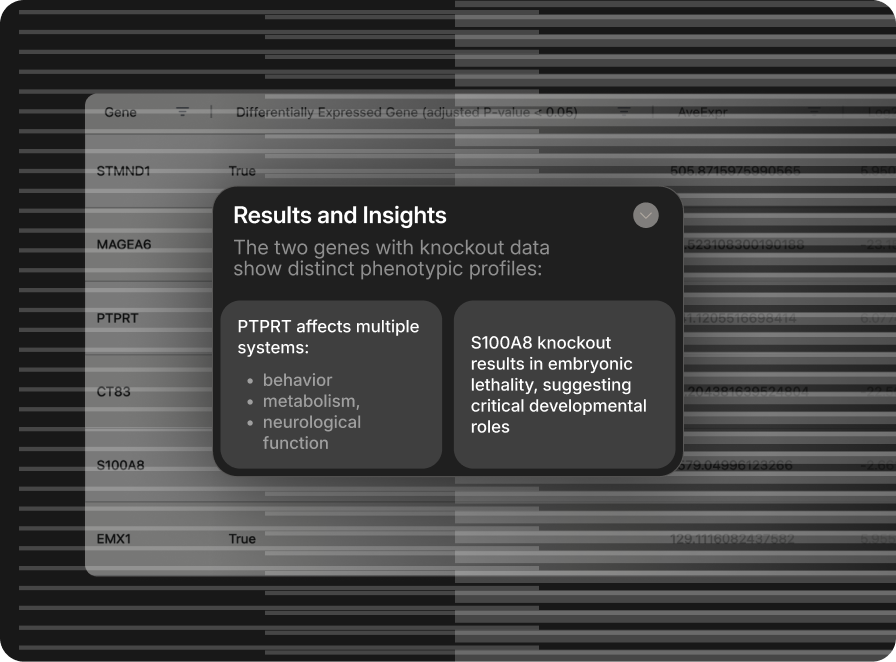
The strategic shift arrived in public in April 2026, when Mithrl began describing itself as an engine for decisions rather than an accelerator for analysis alone. The difference is visible in the questions it now proposes: Which target is biologically grounded? Which biomarker survives scrutiny? What mechanism links an observed expression change to a pathway? Which experiment should come next? The point is not that a model should make those calls on a scientist’s behalf. It is that the scientist should be able to make them while the supporting work is still in view.
Sequencing and other omics
Workflows, QC, statistics
Pathways and literature
A testable next question
Custom biology, shared memory
Mithrl’s current market position sits between generic AI assistants and the bespoke pipelines maintained inside pharmaceutical companies. It promises natural-language access, but also works directly with partner scientists and engineers to build workflows fitted to their assays and standards of proof. The company says it deploys inside partners’ environments under their governance. That adds service work to a software sale. It also acknowledges an awkward truth: one disease program’s convincing evidence may be another program’s irrelevant noise.
A public collaboration with Elephas Biosciences makes the role concrete. Elephas profiles live tumor fragments and measures real-time immune responses; Mithrl supplies analysis that can connect those functional signals with broader genomic data. The partners have discussed the approach in an immunotherapy webinar, including work across 131 human tumor specimens. This is translational research, where a biomarker hypothesis must eventually meet a real patient and a real treatment choice. The software can help organize the evidence. It cannot replace the clinical experiment that decides whether the hypothesis holds.
In September 2026, Mithrl announced a $20 million Series A led by Obvious Ventures, with Headline, AGI House and pharma executives participating. Alongside the raise it previewed Mithrl-1, a biomedical world model meant to connect experimental findings with structured knowledge and stay with a program as its questions change. The founders described the launch as forthcoming. The business case is clear enough: if research teams can keep what each experiment taught them, the next team need not begin with a blank whiteboard.
The experiment worth copying
There is a practical idea here for any research organization, including one that never buys Mithrl. Pick a repeat analysis with a known dataset. Run the existing workflow and the proposed automated one side by side. Compare agreement, elapsed time, inspectability and the quality of the next question - not just the number of charts produced. Give the bench scientist access to the result and the computational scientist access to the method. Retain the record of what was observed, what was inferred and what remains to be tested.
That approach has conditions. It depends on usable data, clearly defined assays and experts willing to challenge an attractive output. Where evidence is sparse or biological context is wrong, a faster answer can simply be a faster mistake. Mithrl’s distinctive claim is that it can make the analysis quicker while leaving the scientific argument open to inspection. Its customers will decide whether that claim survives the next experiment. For now, the company has identified a queue that deserves to be shorter - and a reason to keep every receipt.