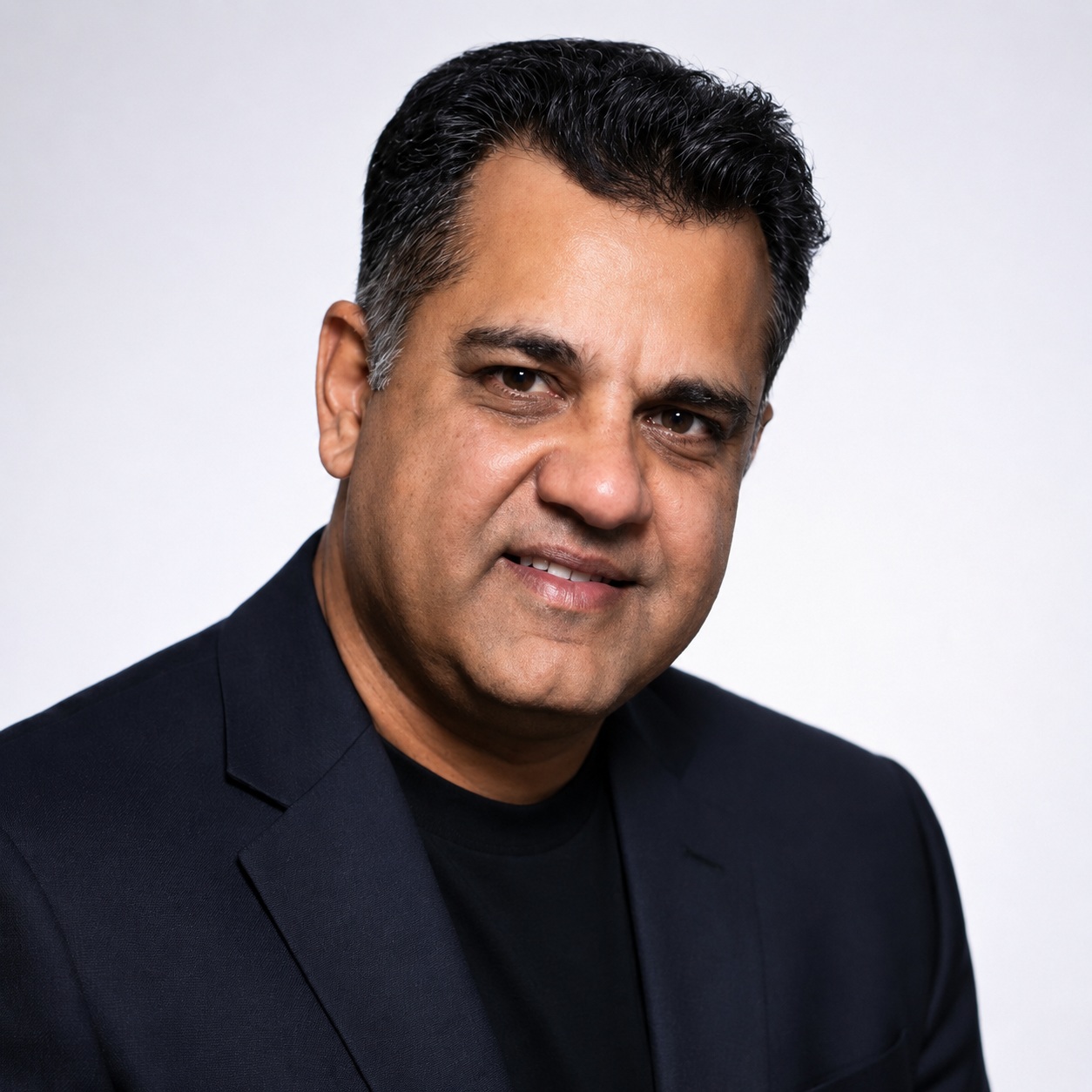
From the Lab to the C-Suite
Vishal Gauri runs Seclore. That sentence doesn't do justice to the strange arc that got him there.
In July 2025, Seclore - a Santa Clara-based data-centric security company with $45 million in funding and $59.5 million in annual revenue - handed its CEO title to a man who spent the early years of his career studying plasma reactors and ceramic processing. Gauri holds 18 patents in domains that have nothing to do with cybersecurity. His first job was as a material scientist at General Electric. His PhD is in engineering from Ohio State. His undergraduate degree is from IIT Delhi, one of the most competitive technical institutions on earth.
And yet, here he is, leading one of the more quietly consequential companies in enterprise security - a company that answers a question most organizations don't even know they're asking: once your data leaves your network, how do you still control it?
"Unless you protect the data itself, you are not truly protected."
- Vishal Gauri, CEO, SecloreGauri didn't fall into cybersecurity. He arrived at it after two decades of building and scaling enterprise technology companies - from GE's labs to Novellus Systems (now Lam Research), from the President's office at Nagarro (where he grew Americas revenue 20x before a successful acquisition) to co-founding IvyCap Ventures, a VC fund that channels IIT alumni networks into early-stage investing. He joined Seclore in 2021, led North America sales and global customer success, rose to Chief Customer Officer, and then to CEO.
That path is not accidental. It reflects a deliberate instinct: move toward complexity, stay curious, and keep building.
The Scientist Who Wouldn't Stay in the Lab
Most tech executives grew up in tech. Gauri grew up in materials science. After earning his B.Tech from IIT Delhi - where admission rates hover around 2% - he went on to complete a PhD at The Ohio State University, working at the intersection of engineering, chemistry, and applied physics.
Between 1999 and 2004, he held roles at General Electric and Novellus Systems (a semiconductor equipment company later acquired by Lam Research). During that time, he filed patent after patent - on composite materials, ceramic processing, UV technology, plasma reactors. The 18 patents he holds are a testament to a mind that doesn't solve problems so much as dissect them down to first principles and rebuild the answer from scratch.
But labs have ceilings. By 2004, Gauri was at Nagarro - a global technology solutions firm - running their Americas operation. Over the next decade-plus, he took that business to 20x its original revenue, navigating its acquisition by Allgeier SE and its subsequent public listing. That is not a small achievement. That is someone who can build, not just invent.
"He has a relentless passion for learning new technologies and remains constantly curious about technological developments."
- Cybersecurity Summit speaker bioAn Unusual Trajectory
Between Nagarro and Seclore, Gauri co-founded IvyCap Ventures, a venture capital fund with a distinctive thesis: leverage alumni ecosystems - particularly IIT networks - to source and support early-stage startups. The fund reflects a founder who thinks structurally about how innovation happens, not just at the company level but across entire knowledge communities.
He also served as President and Chief Strategy Officer at Incedo, an AI/ML data analytics firm, where he led a strategic pivot that revived growth and expanded margins. Moving from pure services to productized AI solutions is exactly the kind of needle-threading that enterprise companies routinely botch. Gauri threaded it.
Protecting Data in the AI Era
When Gauri joined Seclore in 2021, the company was already building something unusual: security that travels with the data. Not perimeter security. Not just encryption at rest. Persistent, policy-enforced protection that follows a file wherever it goes - across organizations, across borders, across cloud environments.
The problem it solves is older than AI, but AI has made it urgent. When enterprise data now flows through large language models, RAG pipelines, and agentic workflows, the old question - "who can access this file?" - is no longer the right question. The new question is: "who can access this data, through what system, under what conditions, and can I revoke that access if something changes?"
"AI has fundamentally changed the nature of enterprise data risk. Data now flows through AI in the same way it flows through people, but without the same level of visibility or accountability."
- Vishal Gauri, CEO, SecloreAs CEO, Gauri has moved the company in a specific direction: toward intelligence. Seclore used to be known primarily for its enterprise digital rights management capabilities. Under Gauri, the company repositioned as a Data Security Intelligence platform - one that doesn't just protect data but generates insights about how data is being used, misused, or at risk.
In February 2026, Seclore officially repositioned as a "Data Security Intelligence" company - a signal that the category Gauri is building toward isn't just security, but security that thinks. The company now generates $59.5 million in annual revenue, with 480 employees and a total of $45 million in funding, including a $27 million Series C closed in May 2022.
"If organisations want to scale AI responsibly, they must be able to trust and control how their data is used across every interaction."
- Vishal Gauri, CEO, SecloreBoard member Rohit Razdan put it plainly when announcing Gauri's appointment: his unique combination of enterprise security expertise, go-to-market strategy, and innovation leadership positions him ideally to address emerging challenges from both GenAI and quantum computing threats. That's the kind of mandate that sounds obvious in retrospect - when you hear Gauri's career arc, the appointment makes sense in a way that rarely happens.
Key Milestones
The GenAI Warning Nobody Wants to Hear
Gauri speaks at cybersecurity conferences with the cadence of someone who has thought through the problem more carefully than the audience has. At the Cybersecurity Summit - he's spoken at the Atlanta and Salt Lake City editions - he tends to arrive at provocations from unexpected angles.
His current fixation is what happens when enterprises adopt generative AI without solving for data security. The numbers he cites are striking: GenAI tools now reportedly generate 90% of documents in enterprises that have adopted the technology. That means 90% of enterprise content is being created by systems that, in most cases, have no persistent protection built in. The data flows. The protection doesn't follow.
"GenAI tools are now generating reportedly ninety percent of documents in enterprises that adopted AI. Without real protection, the adoption of GenAI will be fraught with risks."
- Vishal Gauri, CEO, SecloreHe also talks about the CHIPS Act and manufacturing digital security - a domain where Seclore has particular traction, given the sensitivity of CAD files, design documents, and supply chain data in regulated industries like semiconductors, defense, and financial services.
What distinguishes Gauri's framing is the insistence on data-centricity as a principle, not just a product category. Most security vendors talk about protecting networks, endpoints, or applications. Gauri argues the network is the wrong unit of analysis. The data is the right unit. And once you accept that, the entire security architecture has to change.
"Data is moving across boundaries, across countries, and across organisations. Unless you protect the data itself, you are not truly protected."
- Vishal Gauri, at GITEX 2025The Record
- 18 patents across composite materials, ceramic processing, UV technology, and plasma reactors - filed during his early engineering career
- Grew Nagarro's Americas revenue 20x over 11 years, culminating in acquisition by Allgeier SE and public listing
- Co-founded IvyCap Ventures, a venture capital fund focused on alumni-driven innovation ecosystems
- Appointed CEO of Seclore in July 2025, succeeding founder Vishal Gupta
- Launched Seclore ARMOR - an AI-era Data Security Intelligence platform - in December 2025
- Led Seclore's strategic repositioning as a Data Security Intelligence company in 2026
- Manages a company with $59.5M annual revenue, 480 employees, and $45M total funding
- Regular speaker at Cybersecurity Summit, GITEX, and major enterprise security events