The most revealing sentence in Virtana’s history is not about artificial intelligence. It comes from 2015, when the company was still called Virtual Instruments and the money it expected did not arrive. “We had to make hard decisions,” executive John Gentry said at the time. The business cut its workforce from just under 300 people to a little over 100. A search for a buyer had come up empty. Fibre Channel, the storage-network technology at the center of its original product, looked like a narrowing world.
That could have been the obituary. Instead, it became the awkward middle chapter. Virtual Instruments kept its support and engineering functions intact, found additional financing, merged with one company, bought two more, changed its name and widened the question its software could answer. It had started with: What is happening inside this storage fabric? Virtana now asks: What is happening anywhere between an application, a cloud bill and the GPU waiting for data?
First, make the invisible measurable
Virtual Instruments began in 2008 as a private-equity spinout from optical-networking company Finisar. Founding CEO Mark Urdahl had spent years around Fibre Channel, the protocol connecting servers to storage arrays in large data centers. Those storage-area networks could involve thousands of ports, switches and devices. When an application slowed, every team had a plausible suspect and no shared view of the crime scene.
The company’s instrumentation captured the traffic moving through that fabric and paired it with analytics. This was unglamorous, expensive-to-ignore work. A bank, hospital or government agency may tolerate a clunky dashboard. It will not tolerate a payment system or medical-record application stalling while server, network and storage teams point at one another. Virtana’s lasting product idea is that high-fidelity operational data can turn an argument into a diagnosis.
“We used to have frequent long conference calls that would include many people sitting on the call and throwing things at the wall.”Healthcare architect, in a commissioned economic study
The same customer said those calls dropped to almost nothing after VirtualWisdom was installed. That is the product in plain English: fewer expensive people guessing together. Current Infrastructure Observability still reaches deep into storage, compute, hypervisors and networks. It measures latency and congestion down to conversations between hosts and storage, then correlates those signals with capacity, health and application impact.
What failed first was the financing plan
The 2015 reset matters because it stripped away a flattering explanation. The original technology had real customers, including large companies. But a capital-hungry organization built around a maturing niche was vulnerable when promised funding vanished. Management’s first response was survival: shrink, preserve service, preserve engineering and gain control over cash. The company also said it was pursuing cloud subscriptions even as it kept perpetual licenses.
What changed its mind about the size of the market was not one epiphany. Customers’ infrastructure was changing underneath it. Applications were moving outside conventional data centers; VMware estates, public clouds and cloud bills introduced new blind spots. A Fibre Channel lens could remain valuable, but it could no longer be the whole picture.
The rename was unusually honest. “Virtual Instruments” described where the company had been. Virtana needed a name broad enough for CloudWisdom, WorkloadWisdom and VirtualWisdom to become one platform. In 2020, HighBar Partners and Benhamou Global Ventures invested $15 million. In January 2022, Atalaya Capital Management, Elm Park Capital Management, HighBar and Benhamou supplied another $73 million for product development, sales and marketing.
A control room for systems that refuse to stay in one room
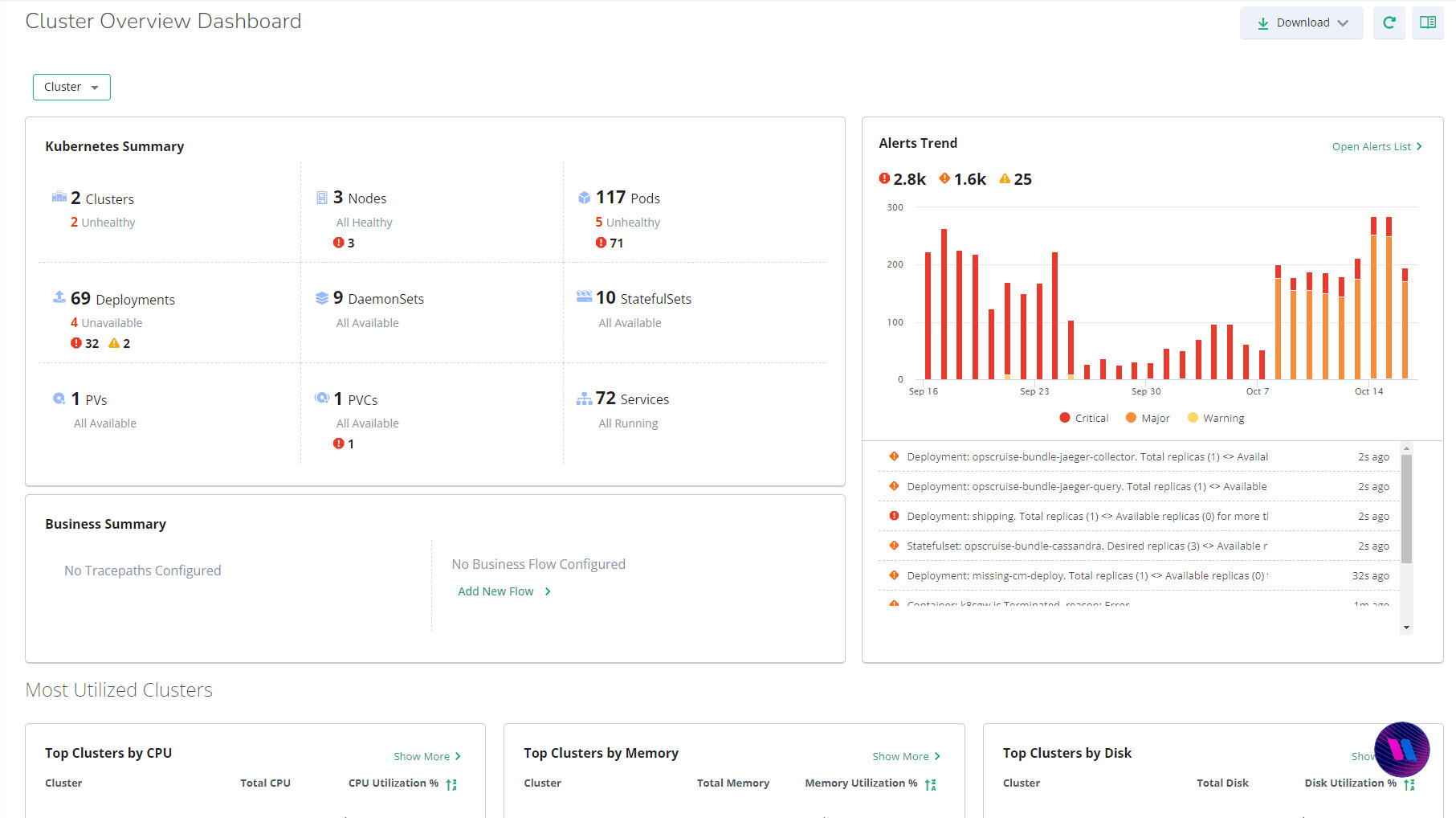
Virtana Platform now brings several jobs into one console. Global View is the command layer. Infrastructure Observability watches physical, virtual and cloud equipment. Application Observability joins traces, metrics, logs and transactions to what is happening in Kubernetes, storage and networks. Service Observability maps the dependencies behind a business service. Container Observability covers clusters, nodes, pods and deployments. Cloud Cost Management reads bills and utilization to flag idle resources and rightsizing opportunities.
Workload Placement addresses a decision that cloud enthusiasm often skips: should this workload move at all? It inventories applications, maps dependencies, groups systems that must travel together and compares performance and cost. In one project, Presidio and AWS had produced a migration case for a media customer using broad industry averages. Finance and IT wanted evidence from their own efficient environment. Virtana supplied the deeper baseline - including the option to discover that “do nothing” was more sensible.
AI Factory Observability is the newest extension. Training and inference failures do not respect product categories. A GPU can appear busy while starving for data because storage or the network cannot feed it. Virtana connects GPUs, CPUs, data pipelines, storage, networking, models, large language models and agent workflows. In 2026 it announced coverage across Dell and HPE AI factories, Nutanix environments and AWS Bedrock Guardrails, alongside a system-aware application product and outcome-based service-level management.
What it costs - and when the math travels
Virtana does not publish a menu price. Modules use enterprise subscriptions, with professional and enterprise tiers, while Infrastructure Observability can also involve appliance-level licenses. Deployment can be SaaS, on premises or air-gapped. That flexibility is useful to regulated customers and a warning that this is not a five-minute expense-card purchase.
The clearest public cost benchmark comes from a Virtana-commissioned Forrester analysis based on four customers. Its composite organization incurred $820,661 in Virtana fees and $872,309 in total three-year costs. Modeled benefits were $2.14 million, producing a $1.27 million net present value and 145 percent return. The benefits included faster problem resolution, capacity planning and public-cloud optimization. Treat that as a worked example, not a universal coupon. The inputs were large environments where wasted capacity and long incidents already cost serious money.
The individual outcomes make the mechanism easier to copy. A cloud-services company migrating workloads for a global fast-food chain reported finishing ahead of schedule with 12 percent annual cloud savings. A sovereign cloud provider reported 30 percent capacity savings and 20 percent better performance. Curo Financial said investigations that once took days could be reduced to hours. The shared move is simple: collect a trustworthy baseline, map dependencies, test or model the change, then keep measuring after deployment.
Keep the hard advantage; widen the decision
Virtana’s reinvention is useful because it did not pretend the old expertise was baggage. Storage instrumentation became the bottom layer of a bigger model. Load testing helped predict behavior before a purchase or migration. Virtualization analytics extended the map. Cloud-cost data added a financial consequence. The company changed what it sold without discarding the difficult data collection customers trusted.
A buyer can copy that method without buying the platform. Begin with the costly decision - an outage, migration, GPU expansion or renewal - rather than “more observability.” Instrument the entire path that decision touches. Establish normal performance before changing anything. Include the do-nothing case. Give infrastructure and finance the same numbers. Finally, assign someone the authority to act on rightsizing or capacity recommendations. A perfect dashboard with no owner is office art.
Where it earns its keep
- Mixed on-premises, cloud and Kubernetes estates
- Expensive downtime or overprovisioning
- Storage, network and app teams sharing incidents
- Regulated or air-gapped operations
Where it may not
- Small, simple, cloud-native systems
- Native tools already cover the full path
- Telemetry access is restricted or incomplete
- No team can implement the recommendations
This is also where Virtana’s differentiation has limits. Datadog, Dynatrace, New Relic and Splunk have broad application and cloud ecosystems. IBM Turbonomic and cloud-financial-management products attack adjacent optimization work. AWS, Azure and Google Cloud ship native tools that may be enough inside a single provider. Virtana is most legible when infrastructure is old and new at once, the storage layer matters, and a shared dependency graph is more valuable than another isolated alert stream.
The company that almost got stranded in the SAN market now argues that AI makes physical infrastructure important again. That claim is self-interested, but not silly. Models run on very expensive machines connected to networks and storage. When the job fails, somebody still has to explain why. Virtana has spent 18 years making that explanation less theatrical.