Before David Link built a business around understanding what computers were doing, he liked to take apart things that were considerably easier to see. A lawnmower, for instance. Every nut and bolt could come off, provided he could put the machine back together. Cars and household appliances also drew his attention. The reward was knowing how something worked well enough to imagine an improvement. Years later, the machinery would be spread across networks, data centers, and clouds. The appetite for opening the lid would remain.
There is something pleasantly unceremonious about this beginning. Link’s company, ScienceLogic, deals in the elaborate language of enterprise software: observability, automation, artificial intelligence for IT operations. Its founder’s early interest was more tangible. A machine presented a puzzle. Understanding the pieces offered a chance to make it work better. The distance between the lawnmower and the cloud is substantial, but the question travels well.
The geology student who followed the computers
Link grew up in Pennsylvania near Penn State University, an environment that let him attend university classes during much of his final year of high school. At Denison University, he chose geology. His attraction to science crossed subject boundaries; geology gave mathematics, chemistry, biology, and physics a shared landscape. Mountains and valleys had explanations. He wanted to understand them.
The route into technology came through an ordinary campus recruiting encounter. CompuServe interviewed him before he finished his bachelor’s degree. He remembers a selection process involving eight interviews and a mathematics examination. His research had already pulled him toward computation and data modeling, so a company built around connected computers offered a plausible next step. The career decision looks less sudden when the geology student’s calculations are left in the picture.
He had intended to spend a year or two at CompuServe before returning to his original field. Instead, he acquired an education in networks and large systems. His official biography records nine years there, developing online communications for business and consumer customers. He subsequently held senior management roles in IBM’s Software Division, working on Internet commerce products, and became a senior vice president and corporate officer at Interliant. By the time he started ScienceLogic, he had encountered the industry from several useful angles.
A small failure with a long shadow
CompuServe supplied a lesson that would outlast any particular computer. Link saw modest disruptions in networks, servers, or systems spread into serious business problems. As organizations depended more heavily on technology, the consequences of a technical fault reached further. The equipment might sit in a back room; the trouble could arrive at the customer’s front door.
He came to believe that the available management tools did too little to help. That conviction became the basis for ScienceLogic, which he co-founded in 2003 with Richard Chart and Christopher Cordray. This was a familiar problem encountered repeatedly before it became a business proposal. His advice to aspiring founders would later be correspondingly practical: “See a problem and want to fix it.”
It is an unusually durable assignment. A customer buying something online expects the payment, search, and database systems to cooperate. The people maintaining those systems must understand their connections as well as their individual condition. Each new computing architecture changes the work. The expectation that the service should function remains wonderfully indifferent to those complications.
How do you understand a service when its moving parts live in different places?
The garage had a deadline
ScienceLogic began in Link’s Falls Church garage and his co-founders’ basements. Starting after the dot-com crash, they funded the business themselves for its first seven years. Link went without a salary for the first two. His wife gave him a matching deadline to make it work before returning to a job. A garage can lend a startup a little romance. A household timetable restores the arithmetic.
The founders reached break-even within that two-year window. Later came outside capital: New Enterprise Associates invested in 2010, followed by Intel Capital in 2012. Link’s early experience of making the business pay its way matters to the story because the enterprise customers he wanted were accustomed to buying from much larger suppliers. He needed a product they could use and a company that could keep answering the telephone.
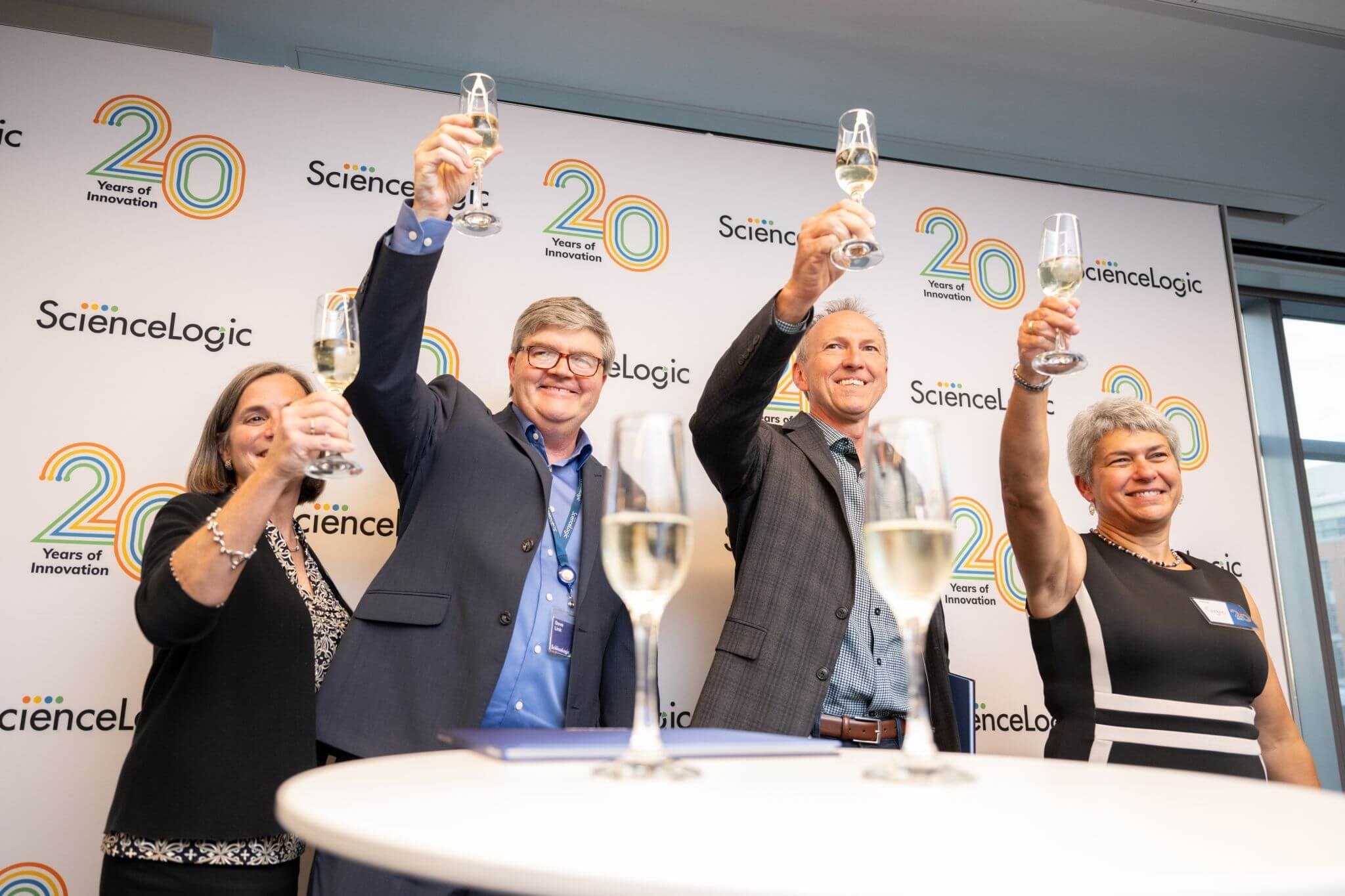
One early design choice was multi-tenancy, allowing a provider to manage infrastructure for multiple customers. It made service providers a natural audience. The company’s beginnings were local, but the distribution problem already pointed beyond a single office: how could a small team reach customers whose technology sprawled across organizations and locations?
George Costanza enters the product meeting
One answer involved an unlikely consultant: a Seinfeld episode. Link has described the founders adopting an “opposite day” approach, listing roughly 220 ways to differ from incumbent products. The resulting proposition included an appliance that could discover, model, and monitor a network after being connected to power and Ethernet. A demonstration could make the argument without demanding a long installation first.
Sales also depended on other people’s relationships. Government contractors and systems integrators could introduce the technology to customers they already served. In a 2025 account of the business, partnerships represented roughly 75 to 80 percent of revenue. That proportion says something about the founder’s willingness to build a company around an indirect route to market. Other organizations brought access and credibility; ScienceLogic had to give them something worth taking into the room.
The comedy reference is memorable because enterprise software rarely invites George Costanza into its origin stories. The underlying choice was serious. Copying a larger competitor’s sales apparatus and product structure would have required resources the founders lacked. Their constraints encouraged them to examine how the product was installed, demonstrated, and distributed together.
The company has to be rebuilt, too
Capital eventually gave Link more room to act. In February 2021, ScienceLogic announced $105 million in Series E growth financing led by Silver Lake Waterman, with existing investors Goldman Sachs, Intel Capital, and NewView Capital participating. The stated plans included engineering, product development, and expansion in cloud-native technologies and machine learning. The company that had once needed to cover its bills was financing another stage of development.
Money did not remove the need to rethink the machinery. In 2024, Link published Innovation: Journey and Outcomes for the AIOps Revolution, a book about the company’s development. In discussing it with Michael Vizard, he returned to an inconvenient feature of the market: new technologies keep arriving while earlier ones remain in use. A service can draw on several generations of architecture at once. Software designed to understand it must keep adapting.
That makes longevity an active job. Maintaining a product means revisiting assumptions about what customers operate and how they operate it. A platform that suited one generation of infrastructure needs work when another arrives. For Link, writing the company’s history also meant explaining why its founders could not simply preserve the thing they had first built.
Getting there before the outage
Link’s ambition has become increasingly concerned with timing. At a 2023 industry conference, he discussed using large language models and generative AI to identify degradation before a service fails. He also warned that AI was in a hype cycle and that providers needed to understand its limitations. The useful test was practical: could a team find the condition that put a service at risk and intervene before a customer reported an outage?
That is a more demanding proposition than sending another alert. An alert tells someone to look. Prevention requires understanding what is changing, which service depends on it, and what action would help. Link wants operational software to bring those pieces into a unified view. The goal is straightforward enough to explain outside an IT department: discover the trouble while there is still time to do something about it.
The product vocabulary continues to change. In November 2025, Link and Douglas “DJ” James discussed bringing ScienceLogic’s observability, automation, compliance, and AI capabilities together under the Skylar name. By March 2026, Link was presenting Skylar Advisor, designed to explain issues using telemetry, topology, historical knowledge, and service context. These are product intentions and capabilities described by the company. Their relevance to his story is the persistent effort to move from seeing a problem toward deciding what to do.
“See a problem and want to fix it.”
David Link, on starting a company
Figs, old gadgets, and the next assignment
In January 2026, Appian announced Link’s appointment to its board, effective January 25. He also serves on the Northern Virginia Technology Council board. Appian’s announcement credited him with more than twelve technology patents in IT management. The appointments extend his work beyond the company he co-founded, into another enterprise software business and the region’s technology community.
Recognition has followed along the way: an EY Entrepreneur Of The Year Mid-Atlantic award in 2016, inclusion among MeriTalk’s 2024 Cyber Defenders, and a 2026 NVTC AI50 Executive honor. The dates span a decade in which the language around his business changed considerably. His current responsibilities still put him close to the practical question that first interested him: how organizations can understand and operate complicated technology.
Away from that work, Link enjoys hiking, gardening, cars, golf, and tennis. He grows fig trees and likes visiting antique shops, where old gadgets offer a view of how earlier generations solved familiar problems. There is a pleasing continuity there. The technology executive looking at an old device and the child dismantling a lawnmower share a recognizable interest. Both want to know what the pieces are doing. A fresh fig is a reasonable reward for putting the tools down.